
Let’s be completely real: you are already crushing it in the working world, but you’ve hit that inevitable wall where you ask yourself, “What’s next?” You want a credential that shouts leadership, commands a higher salary, and opens doors to elite professional circles, just like getting an MBA and a DBA.
But here is where most working professionals trip up when doing a search on MBA VS DBA. They assume a DBA is just a “glorified, longer version” of an MBA. Spoiler alert: it is absolutely not. While both degrees are built explicitly for ambitious, working professionals, they treat the business world through two completely different lenses.
So, how do you decide which path to pour your hard-earned time and money into? This GLCampus guide break down the ultimate MBA vs DBA confusion, so you can pick the perfect match for your career roadmap.
What is the Real Difference in the MBA vs DBA Debate?
To understand the core split, you have to look at how each degree treats business problems. An MBA teaches you how to apply existing rules to run a business efficiently. A DBA trains you to invent new rules and frameworks to solve systemic industry problems.
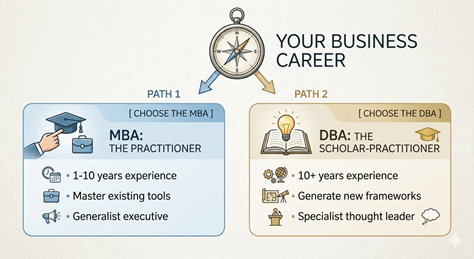
Understanding the Master of Business Administration (MBA)
Think of the MBA as the ultimate professional survival kit. It is a graduate-level master’s degree purposefully designed to transform specialists (like engineers, developers, or creatives) into versatile business generalists.
MBA programs emphasize practical business management skills that professionals can apply in the workplace. When you go through an MBA, you dive into case studies across finance, operations, human resources, and marketing. You learn how a healthy business machine breathes, how to read a balance sheet, and how to lead cross-functional teams without breaking a sweat. It is all about quick execution and practical management.
Understanding the Doctor of Business Administration (DBA)
The DBA, on the other hand, is a terminal professional doctorate, the highest academic peak you can scale in corporate business. It is designed for seasoned professionals who already have years of management under their belts and often already hold a master’s degree.
“Unlike an MBA, which focuses on practical business management, a DBA emphasizes advanced leadership, organizational strategy and applied research.” In a DBA program, you aren’t just memorizing what other legendary CEOs did. Instead, you learn heavy-duty qualitative and quantitative research methodologies to investigate massive corporate inefficiencies, industry shifts, or the macro impacts of emerging tech like automation and AI. Here, watch this informative video for help.

MBA vs DBA Career Outcomes and ROI for Working Professionals
At the end of the day, you want to ensure your investment translates to a heavier paycheck and a better job title. Let’s see how they stack up in the wild.
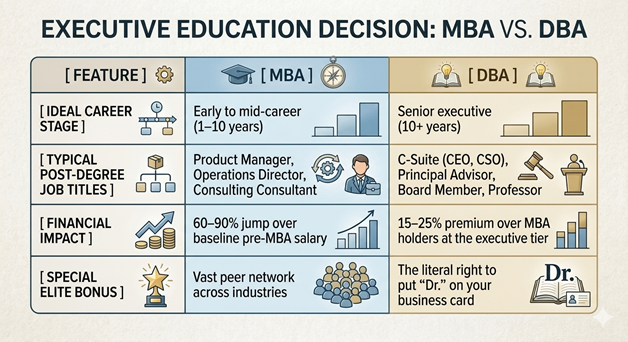
Climbing Mid-Level Management with an MBA
If your goal is to break out of a technical silo and climb the corporate ladder, the MBA is your golden ticket. It is perfect for the professional with 3 to 7 years of experience who wants to make a massive career pivot, switch industries entirely, or step into their very first director-level role. Corporate recruiters across the globe recognize the MBA as the universal baseline for management competency.
Stepping Into Executive Mastery with a DBA
Now, what if you already have an MBA or a couple of decades of leadership experience? An MBA won’t differentiate you anymore in a room full of regional VPs. That is where the DBA acts as a true career elevator. As DBA holders command a 15% to 25% salary premium over standard MBA holders at the executive tier.
Furthermore, if you plan to go into independent corporate consulting, a DBA lets you position yourself as a verified, peer-reviewed expert. That authority allows consultants to command 40% to 60% higher hourly advisory rates compared to those holding only a master’s degree. It is also your entry pass if you want to split your time teaching graduate school or sitting on prestigious corporate boards.
Curriculum and Commitment Check: MBA vs DBA
How you spend your nights and weekends over the next few years depends entirely on which door you open.
The Tactical Sprint of an MBA Program
An MBA program is intensely collaborative, fast-paced, and highly interactive. You will spend your time analyzing real-world Harvard Business School style case studies, working on chaotic group projects, and practicing high-stakes presentations.
- Time Commitment: Usually 1 to 2 years.
- Work Style: Heavy teamwork, networking mixers, and structured evening or weekend classes.
- End Game: A collaborative capstone project or business simulation.
The Strategic Marathon of a DBA Dissertation
A DBA program starts with a few advanced modules on research methodologies and structural data analysis, but it quickly transitions into a deeply solitary academic pursuit.
- Time Commitment: Typically, 3 to 6 years of self-paced work.
- Work Style: Heavy individual reading, deep literature reviews, writing research frameworks, and analyzing dataset models.
- End Game: Writing and defending a massive doctoral dissertation focused on solving a hyper-specific, real-world organizational problem.
The Final Verdict on Choosing an MBA vs DBA
The decision doesn’t boil down to which degree is objectively “better” or more prestigious. It comes down to an honest assessment of your current professional mileage and where you want your daily workspace to be.
- Pull the trigger on an MBA if you are in the first decade of your career, want to master general business execution, need to expand your immediate professional network, or want to execute a swift pivot into leadership.
- Invest your energy into a DBA if you are a seasoned veteran who already understands the operational mechanics of business, wants to develop proprietary, data-driven frameworks, and intends to transition into elite consulting, high-level corporate strategy, or institutional thought leadership.
Frequently Asked Questions (FAQs)
Can I get a DBA without having an MBA first?
Yes, absolutely. While many DBA students do hold an MBA, it is not an absolute prerequisite for every university. Most reputable institutions will accept an alternate master’s degree (like an MS in Finance, Data Analytics, or Engineering Management) provided you have substantial, documentable managerial or executive work experience to back it up.
Is a DBA considered equal to a PhD?
Yes, academically they are on the exact same doctoral level, but their purposes are different. A PhD is designed for those who want a lifelong career in full-time academic research and university teaching, focusing on building pure academic theory. A DBA is a professional, applied doctorate meant for corporate practitioners who want to use rigorous academic research methods to fix immediate, real-world industry problems.
How do employers look at an MBA vs DBA?
Employers view an MBA as proof that you are an agile, well-rounded manager who can jump into a division and optimize operations right away. They view a DBA as proof of master-level expert authority. A DBA signals to an organization that you possesses the deep analytical capabilities required to handle their most complex, high-stakes organizational issues and macro-level corporate transformations.