
Planning to study in the USA starts with understanding the study in USA requirements for your chosen degree and university. From academic qualifications and English language tests to application documents, financial preparation and the student visa process, each stage requires careful planning.
This GL Campus guide explains the major requirements for international students applying for bachelor and master degree programs in the USA.
Study in USA Requirements for Master Degree Applicants
Postgraduate admissions require a higher level of academic specialization and professional alignment.

Recognized Bachelor Degree
Candidates must hold an accredited bachelor degree or its international equivalent prior to enrollment in a master’s program.
Academic Transcripts
Graduate admissions committees carefully review university-level transcripts, paying close attention to performance in upper-level major courses.
Relevant Academic or Professional Background
Certain specialized master’s programs expect foundational coursework in relevant fields or direct professional work experience.
Resume or CV
Applicants must submit a structured resume highlighting their academic history, research projects, internships, professional employment, publications, and technical skills.
Recommendation Letters
Graduate programs typically require two or three academic or professional recommendation letters from professors, research supervisors, or line managers.
GPA and Academic Requirements for US Universities
Navigating academic evaluation is a key step in understanding study in USA requirements.
- Transcript Evaluation: Admissions officers review overall academic progression, class rank, and performance in core subjects rather than relying solely on a final cumulative number.
- Grading System Variations: Grading systems differ globally; universities either perform internal credential conversions or request an evaluation from external bodies such as WES or ECE.
- GPA Conversions: While a 4.0 scale is standard in the US, acceptable conversion thresholds vary significantly across top-tier, mid-tier, and open-enrollment institutions.
- Holistic Admission Process: A lower GPA can often be balanced by high standardized test scores, compelling essays, relevant research, or strong professional experience.
Do not assume a single universal GPA cutoff applies to every institution; research specific departmental thresholds for each university on your list.
English Language Requirements for Studying in the USA
Demonstrating strong English communication capabilities is essential for academic success in the American classroom.
Common English Language Tests
Universities widely accept tests like TOEFL iBT, IELTS Academic, Duolingo English Test (DET), and Pearson Test of English (PTE) Academic.
Minimum Score Requirements
Required benchmark scores depend on institutional competitiveness and degree level. Top-tier programs and teaching assistantships generally enforce higher minimum score barriers.
English Test Waivers
Exemptions may be granted if an applicant completed secondary or higher education in an English-speaking country or studied at an institution where English was the primary medium of instruction.
Always confirm current language waiver conditions with admissions departments before waiving test requirements.
Documents Needed for US University Admissions
Organizing application materials is a core component of navigating the US university admissions roadmap.
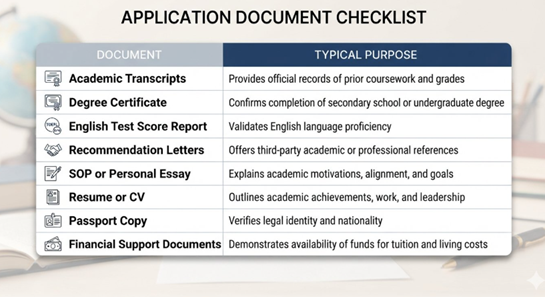
Document specifications vary by department, so double-check all formatting guidelines prior to submission.
How to Write a Strong SOP for US University Applications
A Statement of Purpose (SOP) provides context to your grades and highlights your intellectual curiosity.
Start with Your Academic Story
Begin by articulating what sparked your interest in your field and how your academic background prepared you for postgraduate study.
Connect Your Goals with the Program
Demonstrate thorough research by explaining how specific courses, professors, labs, or university resources align with your long-term career objectives.
Highlight Relevant Experience
Detail key projects, published research, internship achievements, or employment responsibilities that demonstrate practical competence.
Keep the Statement Authentic
Write in a clear, sincere voice using concrete examples instead of relying on generic platitudes or unverified claims.
Understanding American Degree Pathways
Understanding American degree pathways helps international applicants choose the right academic structure for their long-term career planning.
High School / Secondary Education → Bachelor Degree → Master Degree → Doctoral Study
Bachelor Degree Pathway
A standard undergraduate program typically spans four years and combines general education courses with focused study in a primary major.
Master Degree Pathway
Postgraduate programs usually take one to two years to complete, offering specialized technical or management training for career advancement.
Transfer and Alternative Pathways
Students can also enter American higher education by completing foundational coursework at a community college or pathway program before transferring into a four-year university.
Application Timeline for US Universities
Following a structured timeline ensures you fulfill all study in USA requirements without missing key intake deadlines.
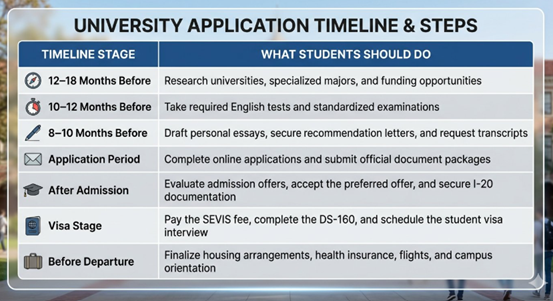
Start your preparation early, as popular intake periods (Fall and Spring) enforce strict application deadlines.
Financial Requirements for Studying in the USA
International students must prove they have sufficient financial resources to cover their tuition and living costs for at least the first academic year before receiving visa documentation.
Key financial expenses to budget for include:
- Annual university tuition and institutional fees
- On-campus or off-campus accommodation costs
- Food, groceries, and daily living expenses
- Mandatory student health insurance coverage
- Books, software, and academic supplies
- Travel expenses, transit passes, and flight tickets
- Visa application and SEVIS fee payments
Cost requirements vary widely based on whether the institution is public or private, as well as its geographical location.
F1 Visa Guide for International Students
After securing university admission, applicants must navigate the student visa process using this concise F1 visa guide.
Receive Admission and Form I-20
Once accepted and financial proof is verified, the university issues a Form I-20, which is required to start your student visa application.
Prepare Required Documentation
Organize your valid passport, Form I-20, SEVIS fee receipt, DS-160 confirmation page, university acceptance letter, and original financial proof.
Complete the Required Visa Process
Pay the SEVIS I-901 fee, complete the online DS-160 visa application form, pay the visa processing fee, and schedule your biometric and consular interview appointments.
Prepare for Travel
Upon visa issuance, book your travel arrangements, finalize university housing, attend pre-departure orientations, and ensure you arrive in the US no earlier than 30 days before your program start date.
Visa issuance is determined entirely by official consular officers during your interview.
Common Mistakes Students Make When Applying to US Universities
Avoid these frequent oversights to improve your admissions outcomes:
- Submitting applications close to deadlines with unverified information
- Ignoring unique departmental or program-specific prerequisites
- Uploading incomplete or uncertified transcript documents
- Writing a single generic essay for multiple university applications
- Delaying English proficiency testing until late in the cycle
- Postponing financial documentation preparation until after acceptance
- Applying to institutions without verifying regional or national accreditation status
How to Meet Study in USA Requirements Successfully
Prepare systematically to ensure a seamless university application experience.
Research Early
Identify program structures, faculty specializations, and departmental entry requirements at least one year before applying.
Create a Document Folder
Maintain an organized digital repository containing verified transcripts, test score reports, passport scans, and certificates.
Track Deadlines
Use a tracking spreadsheet to monitor application deadlines, recommendation submission statuses, and test reporting dates across all target universities.
Verify Every Requirement
Cross-reference your completed submission package against official university checklists before submitting applications.
Final Thoughts on Study in USA Requirements
Understanding the complete set of study in USA requirements is the first major milestone toward pursuing an international degree. From maintaining academic performance and obtaining language certifications to preparing financial evidence and completing student visa procedures, early planning simplifies every step of the journey.
Because entry rules and document requirements differ across institutions, use this guide as a foundational roadmap while confirming specific details directly with your chosen universities. Start gathering your academic records early to build a strong application package.
FAQs About Study in USA Requirements
1. What are the main study in USA requirements for international students?
The essential study in USA requirements include recognized academic qualifications, official transcripts, proof of English language proficiency, recommendation letters, a personal essay or SOP, financial support documentation, and an active passport. Specific programs may also evaluate standardized test scores or professional experience.
2. What GPA is required to study in the USA?
There is no single universal GPA requirement across US universities. While competitive institutions often prefer a GPA of 3.0 or higher on a 4.0 scale, many universities offer admission to students with lower GPAs through holistic evaluations that consider test scores, strong essays, and relevant extracurricular achievements.
3. Do I need IELTS or TOEFL to study in the USA?
Most US universities require non-native English speakers to submit English proficiency scores from accepted exams such as TOEFL, IELTS, Duolingo, or PTE. However, test waivers may be available if you completed previous education in an English-speaking country or studied at an institution where English was the medium of instruction.
4. What documents are required for US university admissions?
Standard document requirements include official academic transcripts, degree completion certificates, English proficiency test reports, recommendation letters, a Statement of Purpose (or personal essay), an updated resume or CV, a copy of your valid passport, and certified financial proof.
5. Do international students need an F1 visa to study in the USA?
Yes, international students enrolled in full-time academic degree programs in the US typically require an F1 student visa. After receiving an official acceptance letter and Form I-20 from an accredited university, students must complete the SEVIS payment, DS-160 application, and attend a consular visa interview.