
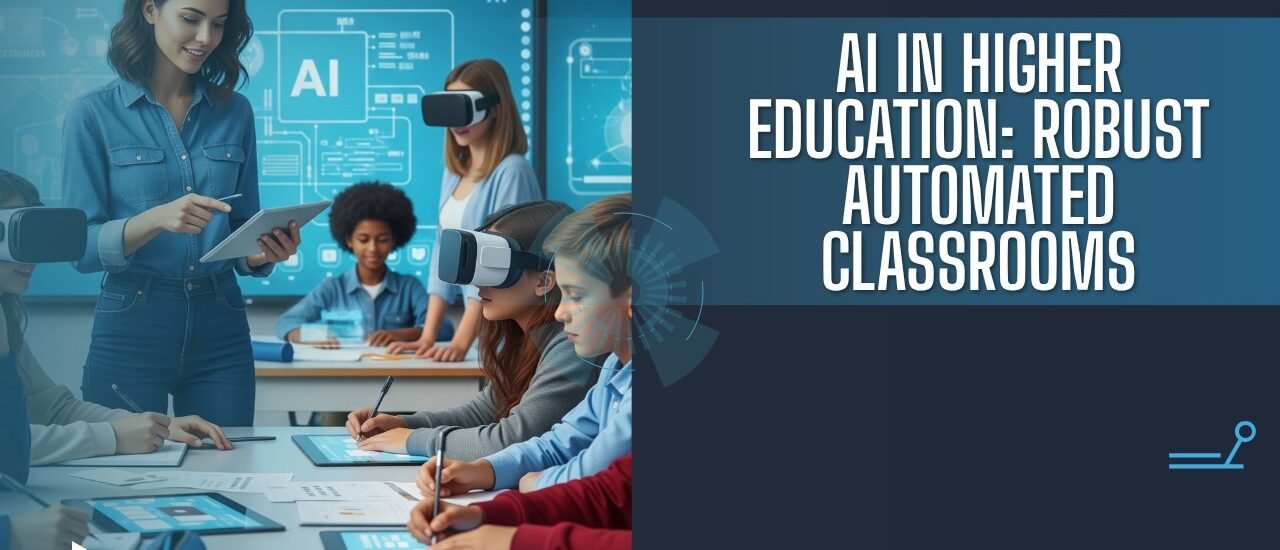
AI in Higher Education is changing how universities teach, assess, and support students. From personalized learning platforms to automated grading, artificial intelligence is becoming part of everyday academic experiences. This GL Campus guide explains that when universities adopt smarter technologies, students and educators are entering a new era of flexible, data-driven, and personalized learning.
What Is AI in Higher Education?
Several institutional and technological drivers are accelerating the growth of AI in Higher Education:
AI in Higher Education refers to the integration of machine learning algorithms, natural language processing, and predictive models into academic environments.
Within modern universities, artificial intelligence supports critical areas including:
- Teaching and learning: Adaptive content delivery and virtual tutoring
- Student support: 24/7 campus query assistants and advisory systems
- Assessment: Automated scoring and real-time learning feedback
- Research: Advanced literature synthesis and data processing
- Administration: Enrolment workflows and document management
- Campus management: Smart resource allocation and facility tracking
Crucially, AI is not meant to replace educators. Instead, it provides administrative and instructional tools that help faculty make faster decisions and deliver targeted student support.
The Role of Edtech Trends 2026
When evaluating edtech trends 2026, artificial intelligence stands out as the core engine powering digital education infrastructure. Modern universities are heavily investing in predictive analytics, intelligent virtual assistants, and adaptive learning platforms to remain competitive and improve retention rates.
Trend 1: AI Powered Personalized Learning
The expansion of AI in Higher Education is making true individualization possible at scale. Rather than forcing every student through a rigid syllabus, AI platforms adapt to individual strengths and knowledge gaps.
Adaptive Learning Paths
Adaptive systems evaluate a student’s responses in real time. If a student struggles with a concept, the system automatically provides additional explanations, simplified exercises, or prerequisite material before moving forward.
Personalized Student Support
Virtual learning assistants offer tailored study recommendations based on historical performance, directing students to specific textbook chapters, recorded lectures, or practice quizzes when they need extra help.
Trend 2: Smarter Automated Grading Systems
Grading administrative tasks consume a significant portion of an instructor’s time. Smarter automated grading tools are streamlining evaluation workflows across departments.
Faster Assessment
Automated systems can quickly score objective assessments, multiple-choice quizzes, coding submissions, and standardized test responses, giving students immediate feedback.
Human Oversight Still Matters
While AI excels at objective evaluation, human educators remain essential for evaluating creative assignments, subjective arguments, and critical thinking. Institutions must maintain transparent review processes to ensure AI grading tools operate accurately and fairly.
Trend 3: Artificial Intelligence in College Classrooms
Integrating artificial intelligence in college environments directly enhances the daily classroom experience for both professors and students.
Everyday applications include:
- AI-powered tutoring: On-demand assistance for complex problem-solving
- Intelligent learning assistants: Real-time translation and transcription for lecture accessibility
- Automated feedback: Instant style and syntax reviews on draft submissions
- Interactive simulations: AI-driven scenario modeling for business, medicine, and engineering
- Research assistance: Rapid scanning of academic journals for background literature
How Teachers Can Use AI Responsibly
Educators should position AI tools as supplements to traditional learning. By automating routine administrative tasks, instructors gain more time for active mentoring, debate facilitation, and deep discussion.
Trend 4: AI Research and Automated Study Tools
Modern automated study tools help students process vast amounts of complex course material efficiently.
Key applications include:
- Summarizing lengthy research papers and textbook chapters
- Generating customized practice questions and flashcards
- Organizing raw lecture notes into structured study guides
- Creating personalized revision schedules based on exam dates
- Identifying specific knowledge gaps prior to major assessments
Academic Integrity and Responsible AI Use
While automated study tools accelerate comprehension, clear institutional policies are critical. Universities must clearly define the boundary between using AI as a study aid and improperly submitting AI-generated text as original coursework.
Trend 5: The Rise of the Future University Learning Model
The broader concept of future university learning relies on flexible, technology-driven ecosystems designed for non-traditional and traditional students alike.
Blended and Hybrid Learning
AI platforms seamlessly bridge physical classrooms and virtual spaces, tracking student participation and comprehension regardless of location.
On-Demand Academic Support
Intelligent AI assistants provide instant academic guidance late at night or during weekends when university help desks and tutoring centers are closed.
Lifelong Learning
AI-driven micro-credentialing platforms help graduates and mid-career professionals continuously reskill by recommending targeted modules based on industry demands.
Trend 6: Smart Campus Frameworks
Adopting smart campus frameworks allows universities to extend artificial intelligence beyond academic coursework into physical and operational management.
Applications include:
- Campus resource management: Optimizing space utilization and room scheduling
- Facility & energy management: Automatically adjusting HVAC and lighting based on occupancy
- Campus security & mobility: Managing smart parking systems and campus transit routes
AI Powered Student Services
Virtual campus guides help students instantly find information regarding financial aid, course registration deadlines, dining menus, library hours, and campus health facilities.
Trend 7: Predictive Analytics and Student Success
Universities utilize predictive analytics to analyze engagement patterns, attendance metrics, and assignment submission rates to identify students who may need additional support.
Early Student Support
Predictive systems flag early warning signs—such as missed lectures or declining quiz scores—allowing academic advisors to offer help before a student falls behind.
Improving Retention
By identifying systemic roadblocks in specific degree programs, administrators can adjust course structures, update prerequisites, and implement targeted academic support programs. However, institutions must govern these algorithms carefully to prevent data bias or incorrect assumptions.
Benefits of AI in Higher Education
Benefits for Students
- Personalized learning pacing and customized content pathways
- Immediate assessment feedback and 24/7 academic support
- Greater accessibility for diverse learning needs and schedules
Benefits for Educators
- Substantial reduction in repetitive grading and administrative tasks
- Data-driven insights into overall class comprehension
- More time dedicated to active teaching, research, and 1-on-1 mentorship
Benefits for Universities
- Streamlined operational processes and optimized resource allocation
- Scalable academic support systems across online and physical campuses
- Higher student retention and satisfaction rates
Challenges and Risks of AI in Higher Education
- Data Privacy: Managing and protecting large volumes of sensitive student data requires strict governance frameworks.
- Algorithmic Bias: Flawed historical data can cause predictive models to generate unfair outputs.
- Academic Integrity: The risk of unapproved AI generation in assignments requires clear institutional boundaries.
- Digital Inequality: Unequal access to high-speed internet or premium AI software can exacerbate educational disparities.
How Universities Can Build Responsible AI Strategies
- Establish Clear AI Policies: Draft plain-language rules defining ethical AI use for faculty and students.
- Train Faculty and Students: Provide digital literacy programs to teach effective, critical evaluation of AI outputs.
- Keep Humans in the Decision Loop: Require mandatory human oversight for admissions, grading appeals, and disciplinary decisions.
What the Future Holds for AI in Higher Education
The future of higher education points toward seamless collaboration between educators and intelligent systems. Anticipated developments include:
- Hyper-personalized degree curricula tailored to individual career goals
- Immersive virtual-reality simulations powered by conversational AI
- Advanced AI research assistants that analyze vast scientific datasets
- Real-time cognitive analytics that adjust course difficulty on the fly
Final Checklist for Universities Adopting AI
- Are student data privacy and security protocols fully enforced?
- Does the institution have a clear, published policy on academic integrity and AI?
- Is there explicit human oversight for all high-stakes academic decisions?
- Are faculty members trained on incorporating AI tools into their teaching?
- Are AI tools accessible to all students regardless of socioeconomic status?
- Are AI platforms regularly audited for algorithmic bias and technical accuracy?
Final Thoughts
AI in Higher Education is moving beyond brief experimentation and becoming a permanent structural component of modern universities. The most successful institutions will combine powerful AI capabilities with human mentorship, ensuring technology enhances—rather than replaces—the rich experience of higher learning.
Frequently Asked Questions About AI in Higher Education
How is AI used in higher education?
AI in Higher Education supports personalized learning, automated assignment assessment, 24/7 student support, predictive success analytics, and administrative management. Universities utilize these tools to streamline campus operations and provide students with flexible, data-driven academic support.
What are the main benefits of AI in universities?
Key benefits include customized learning paths for students, faster assessment feedback, reduced administrative workloads for faculty, and improved operational efficiency across campus facilities. It also gives educators real-time insights into student comprehension.
Can AI replace university teachers?
No, AI is unlikely to replace university professors because effective teaching relies on critical thinking, ethical judgment, mentorship, empathy, and open debate. Instead, AI automates repetitive tasks so educators can focus more on direct student interaction and high-value instruction.
What are the risks of using AI in higher education?
Primary risks involve student data privacy concerns, potential algorithmic bias, challenges to academic integrity, and technological inequality among students. Establishing clear governance policies and maintaining human oversight helps mitigate these risks.
What will the future of AI in universities look like?
The future will likely feature hyper-personalized degree pathways, advanced virtual tutors, AI-assisted academic research, smart campus infrastructure, and continuous skill-development platforms that support lifelong learning well past graduation.




