

Choosing the right route to university abroad can feel confusing, especially when both an HND and a foundation year can lead toward higher education. Understanding the differences between HND vs foundation year can help students identify the pathway that matches their academic background, career plans, and preferred way of learning.
This GL Campus guide explains that neither pathway automatically suits every student as progression depends on the institution, course, grades, and specific university requirements.
What Is a Foundation Year?
A foundation year is an introductory year integrated into a degree programme, often structured as a four-year degree pathway (Foundation Year + Year 1 + Year 2 + Year 3).

It acts as a bridge, preparing students for the academic expectations of full undergraduate study.
How Does a Foundation Year Degree Pathway Work?
A foundation year degree pathway focuses on building underlying subject knowledge and fundamental academic skills.
- Preparatory academic study: Focuses on essay writing, research techniques, and critical thinking.
- Subject-related modules: Introduces key principles needed for Year 1 of the chosen degree.
- Transition and progression: Students who meet the grade criteria automatically move into the first year of their degree programme.
Foundation Year Entry Requirements
Foundation routes offer alternative access for students who fell short of standard undergraduate entry requirements. They usually require lower tariff points than Year 1 degree entry, opening accessible degree pathways for motivated learners who need extra preparation.
What Is an HND?
A Higher National Diploma (HND) is a higher education qualification equivalent to the first two years of a standard three-year university degree. It is designed to develop practical, subject-specific skills alongside essential theoretical knowledge.
Key areas of comparison include:
- Course structure and assessment styles
- Overall duration and total time to degree completion
- Academic and subject-specific entry requirements
- University progression arrangements and credit transfer
- Direct career opportunities versus academic preparation
- Practical learning versus preparatory study
- Cost implications and long-term planning.
Entry Requirements for HND and Foundation Year
Entry requirements vary significantly across institutions and subject areas. Always review individual course criteria before submitting applications.
HND courses usually require lower UCAS points than direct entry into a full degree. Admissions teams often look for:
- Relevant A-Levels, BTECs, or equivalent Level 3 qualifications
- GCSE passes in core subjects such as English and Mathematics
- Demonstration of interest or practical experience in the chosen field
- Proof of English language proficiency for international applicants
How Does an HND Work?
An HND focuses primarily on career-oriented, practical education.
- Course structure: Modules are tied directly to vocational industries.
- Assessment methods: Evaluated through practical assignments, projects, group presentations, and portfolio work rather than heavy examination structures.
- Subject specialisation: Courses target specific industries, such as a business HND, engineering, computing, or hospitality.
After finishing the course, some students enter the workforce immediately, while others utilize HND progression agreements to join a university degree.
HND vs Foundation Year: Key Differences
Comparing how you spend your time on each route is crucial for setting expectations regarding overall study length and workload.
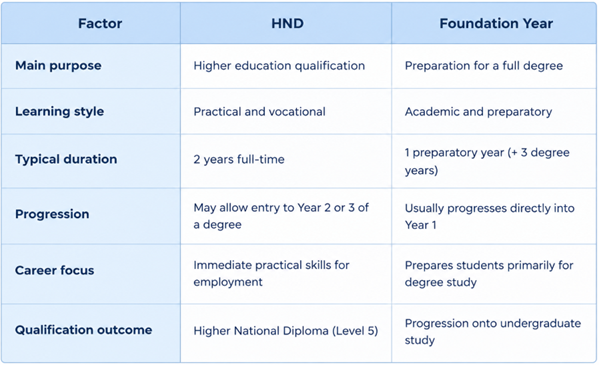
HND Duration
An HND typically takes two years of full-time study (or three to four years part-time). Upon completion, you hold a nationally recognized qualification at Level 5. If you choose to convert your diploma into a full degree, you can apply for a top-up degree, which usually takes one additional year.
Foundation Year Duration
A foundation year lasts one academic year. However, it is important to remember that this year is added to the standard degree length. Completing a full degree through this route typically requires four years in total. Evaluating HND vs foundation year timelines depends largely on whether you prefer a staged qualification or a continuous four-year university commitment.
Can You Go From an HND to University?
Yes. Transitioning from an HND to university is a common path. Many universities allow HND graduates to join the final year of a related degree (known as a top-up degree or Year 3 entry). In other cases, depending on module alignment, students may enter into Year 2.
What Should Students Check Before Applying?
Before committing to an HND with the goal of earning a degree, verify:
- Formal progression agreements between the HND provider and target universities
- Credit transfer policies and specific module requirements
- Minimum grades required in your HND units (e.g., Merit or Distinction profiles)
- Compatibility between HND units and degree subject tracks
Foundation Year Degree Progression
The relationship between a foundation year and your main degree is direct and structured.
What Happens After the Foundation Year?
Upon passing your foundation modules and satisfying specific progression criteria, you transition directly into the first year of the main undergraduate degree at the same institution without reapplying through UCAS.
Can You Change Your Degree After a Foundation Year?
While progressing within the same department is straightforward, changing your degree subject or transferring to another university after a foundation year can be complicated. Some institutions allow internal transfers, but external transfer policies vary greatly and are not guaranteed.
Career Options After an HND or Degree
Both routes lead to strong career opportunities, but they prepare you for the job market in different ways.
Career Opportunities After an HND
An HND prepares you directly for technical and mid-level vocational roles. For example, a business HND equips graduates with practical knowledge in core operational areas such as:
- Digital marketing and brand management
- Business operations and logistics
- Practical financial accounting and budgeting
- Human resource management
- Small business management and entrepreneurship
Career Opportunities After a Degree
Completing a full undergraduate degree satisfies entry requirements for formal corporate graduate schemes, regulated professions, and postgraduate academic study. Ultimate career outcomes depend heavily on industry demand, work experience, and individual skills.
HND vs Foundation Year: Which Route Fits Different Students?
Selecting the ideal path comes down to understanding your strengths and learning preferences.
An HND May Suit Students Who Prefer:
- Practical assignments, project work, and continuous assessment
- Career-oriented skills tied directly to immediate industry needs
- Focused study in a specific subject area
- Obtaining a standalone, recognized qualification after two years
A Foundation Year May Suit Students Who Need:
- Extra academic preparation and essay-writing guidance
- A smooth, supportive transition into full university life
- An accessible entry point into a full three-year degree
- Additional time to develop academic study habits
Costs, Time and Long-Term Planning
Financial considerations should extend beyond the first year of study:
- Tuition Fees: HND fees at further education colleges are often lower per year than standard university tuition fees.
- Total Study Years: Calculate whether a 2-year HND + 1-year top-up is more cost-effective than a 4-year foundation degree route.
- Living and Travel Expenses: Consider whether studying locally at a college saves money compared to moving to a university campus early.
How to Choose Between an HND and Foundation Year
Use this practical decision framework to guide your final choice:
What Is Your Academic Background?
Review your existing Level 3 results and UCAS points against course entry criteria.
What Is Your Career Goal?
Determine whether your field values immediate practical vocational training or requires a full academic degree.
How Do You Prefer to Learn?
Decide whether you thrive on continuous practical assessments or written academic study and exams.
Where Do You Want to Study?
Check if you prefer studying at a local further education college or immersing yourself directly in a university environment.
Evaluating these options in the context of HND vs foundation year pathways will help you make a confident decision.
Key Questions to Ask Before Enrolling
Keep this checklist handy during open days and university visits:
- Does this course offer direct progression to my preferred university?
- How many total years will it take to finish the full degree?
- What specific grades are required to progress to the next level?
- Are there tuition fee differences between the course options?
- Does the curriculum cover practical skills or theoretical concepts?
- What additional costs, such as equipment or software, should I expect?
Final Takeaway on HND vs Foundation Year
The choice between HND vs foundation year comes down to your personal learning style, current qualifications, and long-term career aspirations.
An HND offers a practical, vocational qualification that equips you for the workforce or advanced university entry. A foundation year provides a structured academic safety net designed to prepare you directly for full degree study.
Compare entry requirements, progression policies, course structures, and overall costs carefully before submitting your application.
FAQs
1. Is an HND better than a foundation year?
Neither qualification is inherently better than the other, as both serve different purposes. An HND provides a standalone vocational higher education qualification, whereas a foundation year offers academic preparation for entry into an undergraduate degree. The best choice depends entirely on your qualifications, learning style, and ultimate career goals.
2. Can I go to university after an HND?
Yes, students can progress to university after completing an HND. Many universities offer top-up courses that allow HND graduates to enter directly into the final year of a related bachelor’s degree. Always check specific credit transfer and progression agreements with target institutions.
3. Is a foundation year part of a degree?
Yes, a foundation year is typically integrated into a four-year undergraduate degree programme. It acts as Year 0, providing the preparatory knowledge required before students advance into the first official year of their chosen degree course.
4. Which is faster, an HND or foundation year?
A foundation year takes one year to complete, but leading to a full degree requires four years total study time. An HND takes two years to finish, and adding a one-year top-up degree equals three years total. Therefore, an HND plus top-up pathway can sometimes be faster for obtaining a full degree.
5. Can an HND lead to a full degree?
An HND can lead directly to a full degree through university progression agreements. Depending on how closely your HND modules match the degree curriculum, you may be granted advanced standing into Year 2 or Year 3 of an undergraduate degree programme.




