
Want to study in Germany in English without becoming fluent in German first? Germany offers international students a range of business and management programs taught in English, particularly at the postgraduate level.
This GL Campus guide is for students planning to study in Germany in 2027 understanding universities, admission requirements, tuition costs, language requirements, and career opportunities can make the application process much easier.
Why Study Business in Germany in English in 2027?
Germany is one of Europe’s top study-abroad destinations. The top-notch universities of Germany combine rigorous academic standards with a powerful economic ecosystem, making it an ideal environment for studying management, finance, marketing, international business, and entrepreneurship for international students.

- Internationally recognized education system
- Expanding range of English-taught degree programs
- Direct connection to a strong European business environment
- Diverse, multicultural international student community
- Flexible post-graduation career and residency opportunities
7 Reasons to Study Business in Germany in English
Here are seven practical advantages that make Germany an attractive destination for international business students.
1. Access to English-Taught Business Programs
German higher education institutions offer a wide variety of undergraduate and postgraduate programs taught completely in English. Core areas of focus include:
- International Business and Strategy
- Business Administration (BBA / MBA)
- Corporate Finance and Accounting
- Global Marketing and Digital Media
- Strategic Management and Operations
- Entrepreneurship and Innovation Management
2. Strong European Business Environment
Studying in Germany puts you at the economic center of Europe. Universities maintain close relationships with industry leaders, giving students direct access to corporate case studies, guest lectures, and networking events.
3. Diverse International Classrooms
English-taught programs in Germany attract students from across the globe. Studying in multicultural peer groups develops your cross-cultural communication, teamwork, and global networking capabilities—essential skills for modern business leaders.
4. Opportunities for Practical Learning
German business education emphasizes practical application. Many institutions incorporate mandatory internship semesters, corporate consulting projects, and practical case studies directly into their degree curricula.
5. Multiple Business Specializations
Whether you want to specialize in fintech, sustainable management, supply chain operations, or digital transformation, German universities offer specialized tracks tailored to evolving global market needs.
6. Career Development Opportunities
Graduates holding a German business degree can pursue various global career paths, including roles in management consulting, corporate finance, brand management, tech operations, and business analytics.
7. Gateway to European Experience
Studying in Germany provides exposure to European corporate governance and trade policies. It also grants access to the broader Schengen area for international networking, conferences, and travel.
Best Business Universities in Germany for International Students
When searching for business universities in Germany, evaluate each institution based on course curriculum, accreditation, industry links, and location rather than relying solely on global rankings.
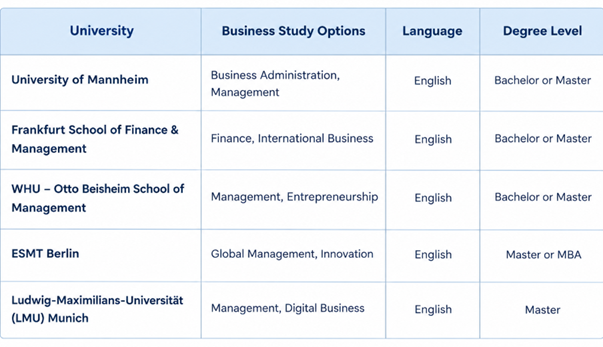
Note: Program availability, language of instruction, tuition costs, and admission deadlines change regularly. Always confirm specific details directly on the university’s official portal.
How to Choose Among Business Universities in Germany
When evaluating potential universities, compare the following key parameters:
- Comprehensive course curriculum and available electives
- Tuition fees and mandatory semester contributions
- Specific admission cut-offs and test requirements (e.g., GMAT/GRE)
- Campus location and regional cost of living
- Built-in internship support and career center services
- Program duration and semester start dates (Winter vs. Summer intake)
English-Taught Business Programs in Germany
Depending on your academic background and career stage, several degree levels are available in English.
Bachelor’s Degrees
Bachelor of Science (B.Sc.) or Bachelor of Arts (B.A.) in Business programs typically last 6 to 7 semesters (3 to 3.5 years). Fully English-taught undergraduate business degrees are growing in popularity at public universities, though they are most widely available at private institutions or Universities of Applied Sciences (Fachhochschulen).
Master’s Degrees
Master of Science (M.Sc.) or Master of Arts (M.A.) business programs usually run for 3 to 4 semesters (1.5 to 2 years). Postgraduate education is where you will find the largest selection of tuition-free or low-cost English-taught business degrees at public universities.
MBA Programs
Master of Business Administration (MBA) degrees are tailored for professionals with relevant work experience (typically 2 to 5 years). German MBA programs focus heavily on international management, leadership, and entrepreneurship.
Admission Requirements to Study Business in Germany in English
Admission standards vary by university, degree level, and whether the institution is public or private.
Academic Qualifications
- For Bachelor’s Degrees: You must hold a recognized secondary school diploma equivalent to the German Abitur (e.g., A-Levels, IB Diploma). If your diploma is not recognized as direct entry, you may need to complete a one-year foundation course (Studienkolleg).
- For Master’s / MBA Degrees: A relevant Bachelor’s degree from a recognized university is required, usually totaling 180 to 240 ECTS credits in business, economics, or related quantitative subjects.
English Language Requirements
You must provide official proof of English proficiency through recognized test scores:
- IELTS Academic: Typically 6.5 minimum (7.0 for competitive programs)
- TOEFL iBT: Typically 80 to 100 minimum
- Duolingo / PTE Academic: Accepted by select institutions
Additional Documents
- Certified academic transcripts and degree certificates
- Passport copy
- Up-to-date Europass-style CV / Resume
- Letter of Motivation (SOP) explaining your academic goals
- Official English proficiency test certificate
- GMAT or GRE scores (frequently required for competitive Master/MBA programs)
- Recommendation letters from academic professors or employers
Tuition Fees and Living Costs in Germany
Understanding the financial structure of studying in Germany helps avoid unexpected expenses.
Public Universities
At most public universities in Germany, tuition is free for both domestic and international students. Instead, students pay a nominal Semester Contribution (Semesterbeitrag) ranging from €150 to €450 per semester. This contribution covers administrative fees, student union support, and often a regional public transit pass (Semesterticket).
Exception: Public universities in the state of Baden-Württemberg charge non-EU international students a tuition fee of €1,500 per semester.
Private Universities
Private business schools in Germany (such as Frankfurt School, WHU, or ESMT) charge tuition fees ranging from €10,000 to €35,000+ per year. These institutions often offer specialized networking networks, smaller class sizes, and corporate mentorship programs.
Cost of Living
International students should budget for essential monthly living expenses:
- Accommodation: €350 to €750+ (varies greatly between cities like Leipzig vs. Munich)
- Health Insurance: Approximately €120 to €130 per month for statutory student insurance
- Food & Groceries: €200 to €300 per month
- Transportation & Leisure: €100 to €200 per month
How to Study Business in Germany in English in 2027
Follow this structured step-by-step roadmap to organize your application process for 2027:
Step 1: Select Your Business Specialization
Identify your target area of focus—such as corporate finance, international management, business analytics, or marketing strategy.
Step 2: Find Suitable English-Taught Programs
Use platforms like the DAAD (German Academic Exchange Service) program database or uni-assist to search for fully English-taught business degrees.
Step 3: Check Eligibility
Verify that your current qualifications match the university’s specific entry criteria, credit requirements, and English language cut-offs.
Step 4: Prepare Your Application
Gather and officially translate your academic records. Write a tailored motivation letter, update your CV, and sit for required standardized tests (IELTS, TOEFL, GMAT).
Step 5: Apply Before the Deadline
Applications for the Winter Semester (starting October 2027) generally open in March or April and close between May 15 and July 15, 2027. Non-EU applicants should apply as early as possible to allow time for visa processing.
Student Visa and Financial Requirements
International students from non-EU/EEA countries must secure a German Student Visa before traveling to Germany.
Proof of Financial Resources (Blocked Account)
To obtain a student visa, non-EU students must demonstrate sufficient financial means to cover living expenses. The standard method is opening a Blocked Account (Sperrkonto) in Germany.
- The standard required blocked account amount is €11,904 per year (equivalent to €992 per month).
- Once in Germany, students can withdraw up to €992 each month to pay for living expenses.
Health Insurance
Having adequate health insurance is mandatory for enrollment at any German university and for visa issuance. Non-EU international students under 30 can subscribe to Germany’s public health insurance system (Gesetzliche Krankenversicherung).
Career Opportunities After a Germany Business Degree
A German business qualification opens doors across European and global corporate landscapes.
Popular Career Paths
- Business Analyst: Evaluating company operations and financial efficiency
- Management Consultant: Advising firms on strategic growth and restructuring
- Financial Analyst: Managing investment strategies and corporate budgets
- Marketing Manager: Leading global brand campaigns and digital strategy
- Project Manager: Overseeing cross-functional corporate initiatives
- Operations Manager: Streamlining supply chain and production workflows
Common Mistakes When Applying to Business Programs in Germany
Avoid these common pitfalls when preparing your business school applications:
Choosing a Program Only Because It Is Taught in English
Never choose a program based solely on the instruction language. Evaluate module handbooks, accreditation (AACSB, EQUIS, AMBA), professor profiles, and corporate partnerships.
Ignoring Individual University Requirements
Admission rules in Germany are strictly enforced. Missing a prerequisite module, credit count, or language certificate deadline will lead to immediate rejection.
Applying Without Checking Costs
Calculate all prospective costs—including tuition fees, semester contributions, health insurance, and local rent—before accepting an offer.
Waiting Until the Last Minute
Visa processing, certified document translations, and blocked account transfers take time. Begin your preparations at least 8 to 12 months before your target semester start date.
Is Study Business in Germany in English the Right Choice for You?
Studying business in Germany in English is ideal if you want:
- A high-quality degree in an economically stable European nation
- Access to tuition-free or cost-effective higher education options
- A global curriculum taught entirely in English
- Post-study stay-back options to build international work experience
Compare your budget, academic background, career objectives, and willingness to adapt to a new culture to determine if Germany is the right fit for your academic goals.
Final Thoughts on Study Business in Germany in English
Studying business in Germany in English gives international students access to world-class academic training inside Europe’s economic powerhouse.
For students planning to enroll in 2027, the key to success lies in early preparation: research suitable programs on the DAAD portal, verify academic credit requirements, calculate your total study costs, and submit your applications well ahead of institutional deadlines.
FAQs About Study Business in Germany in English
1. Can I study business in Germany in English?
Yes, many German universities offer business programs taught entirely in English. While these options are most abundant at the Master’s and MBA levels, an increasing number of English-taught Bachelor’s degrees are available.
2. Is Germany good for a business degree?
Germany offers access to business education within Europe’s largest economy. Students can study finance, management, international business, marketing, and business analytics while gaining exposure to multinational corporations.
3. Do I need German to study business in Germany?
You do not need German language skills for admission if your degree is fully taught in English. However, learning basic to intermediate German is highly recommended for everyday life, finding internships, and securing full-time jobs in Germany after graduation.
4. How much does it cost to study business in Germany?
Most public universities charge no tuition fees, requiring only a semester contribution of roughly €150 to €450 per semester. Private institutions charge tuition ranging from €10,000 to €35,000+ annually. Additionally, students should budget approximately €992 per month for living expenses.
5. Can I work in Germany after completing a business degree?
Yes, non-EU international graduates can apply for an 18-month post-study job-seeker visa to find relevant employment in Germany after graduation.