

Choosing the right qualification after secondary education can feel confusing, especially when you are comparing UK qualifications, foundation routes, and university entry options. An OTHM Level 3 diploma provides a structured academic pathway for learners who want to progress toward higher education. As an Ofqual-regulated UK qualification, its position on the framework ensures quality standards, making it a viable foundation for further study.
This comprehensive GL Campus guide breaks down what the qualification entails, its equivalent framework level, key benefits, entry pathways, flexible study formats, and essential criteria to check before enrolling.
What Is OTHM Level 3?

OTHM is a regulated UK awarding organization recognized by Ofqual (Office of Qualifications and Examinations Regulation). An OTHM Level 3 qualification sits on the UK Regulated Qualifications Framework (RQF), designed to equip students with foundational subject knowledge and academic skills required for higher-level education.
Understanding the Level 3 Qualification
Within the UK qualifications structure, Level 3 represents post-secondary education. It bridges the gap between secondary school (GCSE level or equivalent) and undergraduate-level study (Level 4 and beyond). Learners frequently evaluate Level 3 options to find the pathway that best suits their learning style and timeline.
Why Level 3 Matters for University Progression
Higher education institutions require proof of academic readiness. Completing a Level 3 qualification demonstrates that a student has acquired core analytical, research, and writing competencies needed to manage the rigor of a degree program.
Who Can Consider an OTHM Level 3 Diploma?
- High school graduates seeking a direct foundation route.
- Mature learners returning to education to gain formal credentials.
- International students looking for a UK-aligned qualification to support global university applications.
What Is the OTHM Level 3 Diploma Equivalent?
Understanding qualification equivalence requires looking at framework levels rather than assuming every course is identical in delivery or structure.
OTHM Level 3 and the UK RQF
The Regulated Qualifications Framework (RQF) categorizes qualifications based on difficulty and learning outcomes. Level 3 indicates that the depth of study is standard for pre-university education across England, Wales, and Northern Ireland.
Is OTHM Level 3 the Same as A Levels?
While an OTHM Level 3 diploma sits at the same RQF level as A Levels, they differ in structure and assessment:
- Assessment Style: A Levels typically rely heavily on final written examinations, whereas OTHM programs generally focus on continuous coursework and assignment-based assessments.
- Subject Focus: A Levels often involve studying three or four distinct subjects, while an OTHM diploma focuses on a single specialized discipline (such as Business or IT).
RQF Level 3 Equivalent Qualifications
Other qualifications at RQF Level 3 include BTEC Level 3, International Baccalaureate (IB) diplomas, and Access to Higher Education Diplomas. Students must evaluate how target universities view each specific pathway.
7 Powerful Benefits of Studying OTHM Level 3
1. Build a Strong Academic Foundation
Enrolling in an OTHM Level 3 program equips learners with core subject knowledge, introducing academic terminology and essential concepts before entering undergraduate studies.
2. Create a Clear University Entry Pathway
It provides a transparent academic progression route, allowing students to fulfill university entry requirements upon successful completion.
3. Develop Practical Knowledge
The curriculum combines theoretical frameworks with practical vocational insights, bridging academic concepts with real-world application.
4. Explore Flexible Study Options
Many approved study centers offer full-time, part-time, and online delivery models, accommodating diverse schedules and personal commitments.
5. Prepare for Higher-Level Study
Assignments focus on critical thinking, academic writing, structured research, and independent study—skills directly transferable to degree-level work.
6. Support International Education Goals
Because it is aligned with UK educational standards, the qualification appeals to international students seeking recognized pathways to UK and overseas universities.
7. Gain Confidence Before University
Stepping directly into a bachelor’s degree can be daunting. Completing a structured Level 3 program builds academic self-assurance and study discipline.
How Does an OTHM Level 3 University Entry Pathway Work?
Navigating progression to higher education involves a straightforward, step-by-step process:
- Choose the Subject: Select an OTHM Level 3 diploma aligned with your target degree field.
- Review Entry Criteria: Ensure you meet the study center’s prerequisites (such as English proficiency or secondary education completion).
- Complete Coursework: Submit required modules, projects, and assessments for evaluation.
- Identify Universities: Research institutions that recognize OTHM qualifications for entry into Year 1 of a degree or an international foundation year.
- Confirm Admission Requirements: Contact target admissions teams to confirm specific grade requirements.
- Submit Application: Apply to your chosen university program with your completed Level 3 transcript.
Note: Progression is always subject to individual university admissions policies.
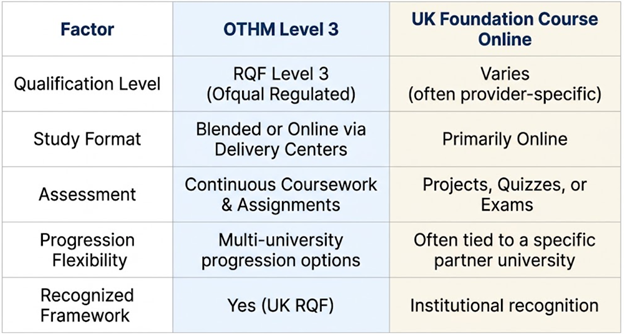
OTHM Level 3 vs. a UK Foundation Course Online
Choosing between a regulated diploma and a university-specific foundation program depends on flexibility, progression goals, and learning preference.
Key Differences Between the Two Routes
Who Should Consider OTHM Qualifications in the UAE?
Educational demand for UK-aligned qualifications in the United Arab Emirates (UAE) has expanded significantly.
- Students Planning International Degrees: UAE-based learners aiming for UK, European, or Australian degrees can use this pathway as an alternative pre-university qualification.
- Working Learners Seeking Flexible Education: Flexible study schedules allow individuals to balance work or family obligations while gaining qualifications.
- Alternative Foundation Seekers: Provides a flexible option for students seeking an alternative to traditional high school final years or campus-bound foundation courses.
What Can You Study After OTHM Level 3?
Successful completion enables progression into various undergraduate fields or higher-level diplomas (such as OTHM Level 4):
- Business and Management
- Accounting and Finance
- Information Technology and Computing
- Health and Social Care
- Education and Training
- Hospitality and Tourism Management
How to Choose the Right OTHM Level 3 Qualification
To ensure your chosen course aligns with your educational goals, apply these criteria:
- Check the Qualification Level: Confirm that the specific program is Ofqual-regulated and listed on the official Register of Regulated Qualifications.
- Match the Subject Area: Select a discipline that directly feeds into your planned degree subject.
- Research Progression Pathways: Review verified university progression agreements provided by OTHM.
- Verify Directly with Universities: Always contact your target university admissions office to confirm acceptance before enrolling.
- Evaluate the Delivery Center: Choose an authorized OTHM center that offers reliable student support, qualified tutors, and clear pricing.
Common Mistakes Students Make When Choosing a Level 3 Pathway
Avoid these common missteps during your planning process:
- Enrolling without verifying if target universities accept the diploma.
- Assuming all Level 3 qualifications carry identical university weight.
- Ignoring university-specific English language requirements.
- Choosing a provider solely based on the lowest tuition fees.
- Selecting a diploma discipline completely unrelated to future degree goals.
- Failing to confirm whether the center is officially authorized by the awarding body.
Is OTHM Level 3 Worth It for Your Future?
An OTHM Level 3 diploma is a valuable asset for students seeking a structured, assignment-based path to higher education. It suits self-motivated learners, international candidates, and those who prefer continuous assessment over high-pressure final examinations. However, its value ultimately depends on your individual goals, center quality, and proactive verification of university progression criteria.
Final Thoughts
Navigating post-secondary options requires clear information and strategic planning. Understanding RQF framework levels, assessment styles, and progression routes ensures you choose a pathway that matches your academic ambitions. Take time to evaluate delivery centers, consult university admissions teams, and make an informed decision for your long-term success.
Frequently Asked Questions
What is OTHM Level 3 equivalent to?
An OTHM Level 3 qualification sits at Level 3 on the UK Regulated Qualifications Framework (RQF). This puts it at the same academic framework level as A Levels, BTEC Level 3, and Access to Higher Education Diplomas, representing post-secondary foundation education.
Is an OTHM Level 3 Diploma equivalent to A Levels?
While both occupy RQF Level 3, they differ in delivery and assessment. A Levels usually involve standardized end-of-year examinations across multiple subjects, whereas an OTHM diploma focuses on assignment-based assessment within a specific field of study.
Can I go to university after an OTHM Level 3 Diploma?
Yes, progression to university is possible. Many institutions accept Level 3 diplomas for entry into undergraduate programs or international foundation pathways, provided applicants meet specific grade criteria and entry conditions.
Can I study an OTHM Level 3 qualification online?
Yes, many accredited delivery centers offer full online or blended learning options. This provides flexibility for international students and working professionals to complete coursework remotely.
Are OTHM qualifications accepted in the UAE?
Yes, OTHM qualifications are widely utilized in the UAE through authorized learning centers. Students should verify that their chosen university or employer recognizes the specific award for their intended academic or career progression.




