

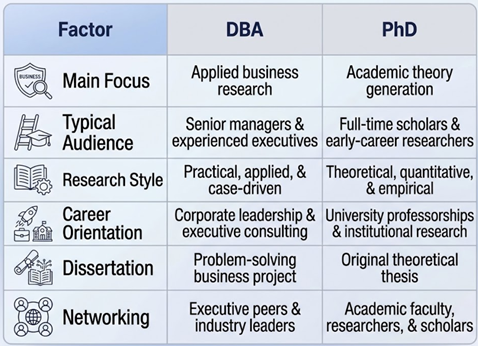
A Doctorate in Business Administration (DBA) focuses primarily on applying research to solve real-world business challenges, whereas a Doctor of Philosophy (PhD) in business traditionally emphasizes original academic research and expanding scholarly knowledge.
Understanding the DBA vs PhD difference is essential before committing years to a business doctorate. Although both represent advanced doctoral qualifications, they serve distinctly different career goals, research approaches, and professional pathways.
What Is the DBA vs PhD Difference?
Both the DBA and the PhD represent the highest level of academic achievement in business education. However, their core philosophies diverge in how knowledge is developed and applied.

What Is a Doctorate in Business Administration?
A Doctorate in Business Administration is a terminal degree designed for experienced executives, managers, and consultants. Rather than focusing purely on theoretical frameworks, a DBA program trains professionals to use advanced research methodologies to tackle complex corporate issues. Key aspects include:
- Applied Business Research: Translating academic theory into actionable strategies.
- Organizational Challenges: Addressing internal operations, governance, and strategy.
- Strategic Decision Making: Enhancing high-level executive judgment through data.
- Leadership Development: Building advanced problem-solving tools for senior roles.
- Practical Solutions: Delivering immediate, measurable impact within industries.
What Is a Doctor of Philosophy?
A Doctor of Philosophy in Business is a research-intensive doctoral qualification focused on producing new academic theory. PhD candidates aim to discover fundamental truths about economic models, consumer behavior, and organizational dynamics. Key aspects include:
- Theoretical Research: Developing new conceptual models and hypotheses.
- Academic Investigation: Conducting deep empirical studies using rigorous methodologies.
- Scholarly Contribution: Expanding the literature within a specific discipline.
- Research Methodology: Mastering quantitative and qualitative analytical tools.
- Academic Publishing: Preparing papers for peer-reviewed scholarly journals.
DBA vs PhD Difference in Career Goals
Career intent is often the deciding factor when choosing between these two terminal degrees.
DBA Career Path
DBA graduates typically remain in or advance within the corporate ecosystem, taking on executive leadership positions such as:
- Chief Executive Officer (CEO) or Chief Strategy Officer (CSO)
- Principal Management Consultant
- Director of Organizational Development
- Executive Vice President of Operations
- Senior Business Advisor or Board Member
PhD Career Path
PhD graduates usually pursue pathways centered around higher education and specialized research, including:
- University Professor or Tenure-Track Faculty
- Academic Department Chair or Researcher
- Economic Policy Analyst for Think Tanks
- Director of Research at Federal or Global Research Institutions
- Quantitative Specialist in Financial or Technical Industries
Career outcomes vary depending on individual work experience, program reputation, specialization, and market demand.
Business PhD vs DBA: Research Focus
The research distinction defines the daily work of candidates in both programs.
Applied Research in a DBA
DBA research addresses immediate, practical organizational problems. Candidates use established frameworks to study operational challenges, such as:
- Mitigating employee turnover during cross-border mergers
- Optimizing supply chain resilience during global disruptions
- Measuring the ROI of artificial intelligence in customer service
- Evaluating leadership frameworks in remote-first corporate cultures
Theoretical Research in a PhD
PhD research focuses on filling gaps in existing academic literature. Instead of solving a specific company’s problem, PhD candidates aim to develop or test broader theories, such as:
- Modeling consumer psychology behind price-sensitivity shifts
- Developing statistical methods for market risk forecasting
- Testing foundational economic theories under novel regulatory conditions
DBA vs PhD Difference in Study Structure
While structural requirements vary across universities, the structural differences generally reflect their targeted student bases:
DBA vs PhD Difference in Admission Requirements
Admission criteria reflect the preparation required for each program’s focus.
Typical DBA Requirements
- A relevant master’s degree (e.g., MBA or MSc in Business)
- Significant leadership experience (often 5 to 10+ years in management)
- Professional references and high-level academic transcripts
- A research proposal outlining a practical business problem to investigate
- Proof of English proficiency (where applicable)
Typical PhD Requirements
- A bachelor’s or master’s degree in a relevant quantitative or business discipline
- Strong academic record with coursework in statistics, calculus, or economics
- Competitive GMAT or GRE test scores
- Academic references highlighting research potential
- A statement of purpose outlining scholarly research interests
DBA vs PhD Difference in Study Duration
There is no fixed completion time for either degree, as program duration depends heavily on enrollment status, research complexity, and university regulations.
Which Doctorate Can Be Completed Faster?
Neither degree is inherently faster. A DBA program often runs on a structured part-time schedule taking 3 to 5 years, designed to accommodate working executives. A full-time PhD program typically takes 4 to 6 years, driven by intensive coursework, comprehensive qualifying exams, and deep dissertation research.
DBA vs PhD Difference for Working Professionals
Balancing professional responsibilities with doctoral research requires careful planning.
Why Professionals Choose a DBA
Executive DBA programs are specifically built for full-time professionals. Classes are frequently scheduled on weekends, during intensive short residencies, or through flexible hybrid models, allowing students to apply their research directly to their workplace.
Can You Complete a PhD While Working?
While part-time PhD options exist, most top-tier PhD programs require full-time, on-campus commitment. PhD students often work as teaching or research assistants, making full-time external employment difficult to maintain alongside research demands.
Executive Doctorates and the Modern Business Leader
Executive doctorates belong to an evolving category of professional qualifications designed to merge high-level research with corporate governance. They equip modern business leaders with:
- Advanced data analysis methods to drive executive strategy
- Rigorous frameworks for addressing market disruption
- Enhanced credibility for high-stakes consulting and board positions
While a DBA is the most common executive doctorate in business, other specialized executive doctorates exist across fields like public administration and education.
DBA vs PhD Difference in Dissertation Requirements
The dissertation is the capstone requirement for both degrees, but the criteria for success differ.
DBA Dissertation
A DBA candidate produces a dissertation or applied research project that solves a practical organizational challenge. It demonstrates how rigorous research techniques can be applied to real-world corporate strategy.
PhD Dissertation
A PhD candidate produces an exhaustive thesis that introduces original concepts, methodologies, or empirical evidence to the academic community. It must pass review by a committee of scholars and aim for publication in academic journals.
DBA vs PhD Difference in Academic and Corporate Recognition
Both qualifications are recognized worldwide as terminal degrees, but their value depends on the career setting.
Academic Career Opportunities
Research-intensive universities typically prefer PhD holders for tenure-track positions because PhD programs focus explicitly on academic publication and teaching. However, DBAs are increasingly valued for clinical professorships, executive education instruction, and practical business lectures.
Corporate Leadership Opportunities
Major corporations and advisory firms value the DBA for its practical, results-oriented approach. Candidates show they can handle high-level research without losing sight of business outcomes.
Terminal Academic Degrees: What Does the Term Mean?
A terminal academic degree is the highest level of formal education achievable in a specific field. Both the DBA and PhD are terminal degrees in business. When choosing between them, candidates should look beyond the degree title and evaluate which program aligns best with their practical or theoretical goals.
DBA or PhD: Which One Should You Choose?
Choose a DBA If You Want To:
- Apply scientific research methods to real-world corporate issues
- Advance into C-suite leadership, board seats, or management consulting
- Conduct research while continuing your full-time executive career
- Solve specific operational, strategic, or organizational problems
Choose a PhD If You Want To:
- Build a full-time academic career as a researcher or university professor
- Formulate new business, economic, or management theories
- Engage in intensive full-time study and academic publishing
- Work in specialized research institutions or policy think tanks
7 Questions to Ask Before Choosing Your Doctorate
- What is my ultimate career goal over the next 10 years?
- Do I prefer applying existing research to corporate problems or generating new theories?
- How many years of management experience do I currently hold?
- Am I looking for an academic environment or an executive corporate setting?
- Can I commit to a full-time, on-campus program, or do I require a flexible schedule?
- Is the institution properly accredited (e.g., AACSB, EQUIS, AMBA)?
- How will this degree directly support my long-term personal and financial goals?
Final Verdict on the DBA vs PhD Difference
The choice between a DBA and a PhD comes down to purpose rather than academic standing. The DBA is tailored for experienced executives looking to solve complex organizational problems using research methodologies. The PhD is designed for aspiring scholars seeking to expand academic knowledge and pursue full-time research or teaching careers.
By evaluating your current professional experience, preferred research style, and long-term ambitions, you can choose the doctoral pathway that best supports your career goals.
FAQs
1. What is the main DBA vs PhD difference?
The primary difference lies in research application. A DBA focuses on using research to solve practical business issues, while a PhD emphasizes generating original academic theories and expanding literature.
2. Is a DBA better than a PhD for business professionals?
For working executives, a DBA is often more practical because its coursework and schedules are designed around full-time employment, and its research directly benefits organizational decision-making.
3. Is a PhD more prestigious than a DBA?
Neither degree is inherently superior; both are recognized terminal doctorates. Prestige depends primarily on the accreditation, global standing, and reputation of the awarding university.
4. Can I become a university professor with a DBA?
Yes. DBA graduates can teach at the university level, particularly as clinical professors, lecturers, or in executive education programs. However, tenure-track research positions at major universities typically require a PhD.
5. Which doctorate is better for working executives?
A DBA is specifically designed for working executives, featuring flexible hybrid formats, weekend sessions, and research projects that can be integrated into current management roles.




