

Studying in Germany can offer international students a way to study business in a globally connected European environment without needing to complete the entire degree in German. This GL Campus guide explains admission requirements, tuition fees, program format, and career opportunities for understanding MBA in Germany English options, which can help you compare programs with greater confidence.
7 Key Things to Know About an MBA in Germany English
Before submitting Germany university applications, evaluate these seven key criteria to find a program that matches your career objectives.

Academic & Institutional Evaluation
1. Teaching Language (100% English coursework & thesis)
2. Core Curriculum (Strategy, Finance, Digital Innovation)
3. Accreditation (AACSB, AMBA, EQUIS, Systemaccreditation)
Practical & Financial Planning
4. Entry Prerequisites (GMAT/GRE, English tests, 1-3+ yrs experience)
5. Total Cost Structure (Tuition fees + €11,904/yr living budget)
6. Delivery Format (Full-time, Part-time, Executive, Online)
7. Career Ecosystem (Corporate partnerships & alumni access)
1. Check Whether the Entire Program Is Taught in English
Never assume every program marketed to international candidates is delivered 100% in English.
Before applying, verify the official language policy across all program components:
- Language of primary lectures and elective modules
- Textbooks, academic literature, and case studies
- Language used for written examinations and continuous assessments
- Master’s thesis writing and oral defense requirements
- Language policies for optional exchange semesters
2. Compare the MBA Curriculum
A program’s curriculum determines the specific skill sets you develop. Evaluate module listings to ensure alignment with your industry targets.
Core subjects generally cover:
- Strategic Management: Corporate decision-making and competitive analysis
- Corporate Finance: Capital budgeting, financial accounting, and valuation
- Marketing Strategy: Global brand management and consumer insights
- Organizational Leadership: Talent management and cross-cultural leadership
- Digital Transformation: Data analytics, AI integration, and tech operations
- Entrepreneurship: Innovation models, venture funding, and business plans
3. Research the business school Germany Carefully
Investigating the hosting institution is essential for verifying quality. When researching a business school Germany, check for triple-crown international accreditations (AACSB, AMBA, EQUIS) or institutional state recognition through German accreditation bodies.
Examine the faculty’s industry background, class size dynamics, alumni network strength, and corporate career partnerships.
4. Understand MBA Admission Requirements
Admissions standards vary significantly between institutions.
Common criteria typically include:
- A recognized undergraduate degree (Bachelor’s degree or equivalent)
- Verified post-graduate work experience (ranging from 1 to 5+ years)
- Proof of English language proficiency (TOEFL, IELTS, or official waivers)
- GMAT or GRE scores (required by top-tier business schools, optional at others)
- Professional CV, motivation essay, and recommendation letters
- Structured admissions interview (in-person or online)
5. Calculate the Complete Cost
Tuition is only one part of the financial requirement. Candidates must calculate total study and living expenses before committing.
Essential budget items include:
- Total tuition or semester contribution fees
- Visa application, document translation, and notary processing fees
- Mandatory student health insurance coverage
- Housing, food, transit, and personal living expenses
- Academic textbooks, software licenses, and printing allowances
6. Explore Program Duration and Study Format
Structure your selection around your work commitments and relocation capability.
Full-Time MBA
Full-time programs usually last 12 to 24 months. They require full daytime availability, making them suitable for professionals taking a dedicated career break to focus entirely on study and networking.
Part-Time MBA
Part-time courses take 20 to 30 months. They allow working professionals to balance evening or weekend classes alongside full-time employment.
Online or Hybrid Options
Online and hybrid MBAs combine remote digital modules with limited on-campus residencies. Ensure your target employers recognize online formats before enrolling.
7. Consider Career and Networking Opportunities
An MBA provides maximum value through its career network. Evaluate career development centers, campus recruitment fairs, company visits, mentorship programs, and active alumni networks within your target industries.
MBA in Germany English Admission Requirements
A successful application requires organized preparation. Standard requirements include:
Academic Qualifications
Applicants must hold an internationally recognized Bachelor’s degree (or equivalent academic qualification). German institutions usually require a minimum credit threshold (such as 180 or 210 ECTS points).
Work Experience
Work experience requirements depend on the program type:
- Standard MBAs: Typically require 1 to 3 years of post-graduation professional experience.
- Executive MBAs (EMBA): Often require 5+ years of managerial or supervisory experience.
English Language Requirements
Applicants whose native language is not English must provide official language test scores:
- IELTS Academic: Generally a minimum score of 6.5 to 7.0
- TOEFL iBT: Generally a minimum score of 88 to 100
- Waivers: Sometimes granted if prior university education was completed entirely in English
Additional Documents
Applications must be submitted with a current resume, official academic transcripts, degree certificates, letters of recommendation from managers or academics, a personal statement of purpose, and a copy of your passport.
How Much Does an MBA in Germany English Cost?
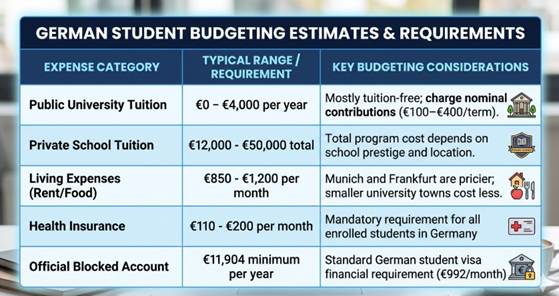
Educational costs vary significantly between public universities and private business institutions.
Public vs. Private Business Schools in Germany
When searching for an MBA in Germany English, understanding institutional models helps narrow down options.
Public Institutions
Public universities are state-funded. Most do not charge standard tuition fees for master’s programs, though specialized professional MBAs may carry tuition charges. Public universities offer large campuses, academic research access, and lower tuition costs, but may have larger class sizes and fixed academic start dates.
Private Business Schools
Private business institutions charge higher tuition fees but often offer smaller class sizes, specialized career coaching, international exchange programs, and dedicated corporate networks. They also tend to feature multiple intake dates throughout the year.
How to Choose the Right MBA in Germany English
Use this checklist to select the program that best fits your goals:
1. Match the MBA With Your Career Goal
Ensure the elective modules, industrial focus, and practical projects support your specific target industry—such as tech, finance, consulting, or automotive manufacturing.
2. Compare Total Costs
Calculate total expenses by combining tuition fees, local city living costs, mandatory insurance, and visa processing charges.
3. Check Accreditation and Recognition
Verify that degrees are fully recognized by state education ministries and hold international accreditations (AACSB, AMBA, EQUIS).
4. Examine the Curriculum
Read module descriptions directly instead of relying solely on school marketing brochures or online rankings.
5. Consider Location
Select a city that aligns with your preferred industry and living style. Munich and Frankfurt are top financial and industrial centers, while Berlin offers a major startup ecosystem.
Mistakes to Avoid When Choosing an MBA in Germany English
- Choosing based only on rankings: Institutional rankings do not always reflect personalized career support, regional employer connections, or specific module quality.
- Ignoring work experience requirements: Submitting an application without the required professional experience hours leads to automatic rejection.
- Assuming every MBA is fully English-taught: Failing to confirm the language policy for electives or master’s thesis writing can cause unexpected language barriers.
- Focusing only on tuition fees: Omitting living costs, accommodation deposits, health insurance, and visa fees results in incomplete financial planning.
- Applying without checking deadlines: Missing early-bird discounts or university application deadlines can delay your enrollment by an entire year.
Is an MBA in Germany English Right for International Students?
Ask yourself these final self-assessment questions before applying:
- Does the program’s module structure support my long-term career goals?
- Do I meet all academic prerequisites, test scores, and work experience criteria?
- Can I secure the necessary tuition fees and official living expense requirements?
- Am I comfortable studying management in English while learning conversational German for daily life?
- Does the business school offer strong career services and corporate networking in my field?
Final Thoughts on MBA in Germany English
Selecting an MBA in Germany English involves evaluating program details beyond the teaching language.
To make an informed decision, compare module content, admission requirements, tuition structures, regional living costs, accreditation credentials, study formats, and career services. Thorough research helps international applicants identify programs that align with their background and long-term career vision.
FAQs About MBA in Germany English
1. Can I study an MBA in Germany entirely in English?
Yes, many German universities and private business schools offer MBA degrees taught entirely in English. These programs cover all lectures, case studies, exams, and master’s theses in English. Always verify the language breakdown on the official university curriculum page before applying.
2. What are the requirements for an MBA in Germany?
Requirements generally include a recognized undergraduate degree, 1 to 3+ years of post-graduation work experience, and proof of English proficiency (IELTS or TOEFL). Some business schools also require GMAT or GRE scores, recommendation letters, a personal essay, and an admissions interview.
3. How much does an MBA in Germany cost?
Tuition for an MBA in Germany ranges from nominal semester fees at public universities to €12,000–€50,000 at private business schools. Additionally, international students should budget between €850 and €1,200 per month for living expenses, housing, health insurance, and study materials.
4. Do I need German to study an English MBA?
No, German proficiency is usually not required for admission to an English-taught MBA program. However, learning basic German is helpful for daily life, local social integration, and expanding job opportunities within local companies after graduation.
5. How do I choose the right business school Germany option?
To select the right business school Germany option, evaluate triple-crown accreditations (AACSB, AMBA, EQUIS), review the module curriculum, calculate total study and living costs, examine campus locations, and assess career support services. Choose a school whose strengths match your specific industry goals.




