

Doctor of Business Administration (DBA) is a practice-focused doctoral programme for senior professionals, combining advanced research with real-world business challenges to drive strategic leadership and organisational impact. A DBA Research Proposal is the foundation of a serious doctoral research project. It explains what you want to investigate, why the topic matters, and how you plan to conduct the study.
This GL Campus guide offers a detailed understanding for experienced business professionals on how to write a DBA research proposal, a well-structured proposal connects real-world management challenges with rigorous academic research.
What Is a DBA Research Proposal?
During the degree of DBA a DBA Research Proposal serves as a formal roadmap that demonstrates to an academic review committee that your proposed doctoral study is viable, original, and academically rigorous

Unlike standard postgraduate assignments, a doctoral proposal establishes seven key components:
- The research problem: Identifying a pressing, unsolved business dilemma.
- Research objectives: Defining actionable, step-by-step milestones.
- Research questions: Formulating specific core inquiries your study will answer.
- Existing academic knowledge: Synthesizing literature to ground your work in business theory.
- Research methodology: Detailing data collection and analytical models.
- Expected contribution: Explaining how your findings will improve professional practice.
- Research feasibility: Proving the study can be executed within resource and time limits.
Because institutional expectations vary, always cross-check your outline against your university’s specific handbook guidelines.
Steps to Write an Extraordinary MBA Thesis Proposal
Step 1: Choose a Strong Doctoral Research Topic
Topic selection is one of the most critical decisions in your doctoral journey. A strong topic for a Doctor of Business Administration bridges high-level academic theory with actionable corporate strategy.
Find a Practical Business Problem
Select a domain grounded in contemporary management challenges:
- Strategic Management: Executing pivot strategies during macro-economic volatility.
- Leadership: Managing cross-cultural teams within asynchronous remote workplaces.
- Digital Transformation: Overcoming employee resistance to enterprise AI adoption.
- Corporate Finance: Evaluating capital structure decisions in high-interest rate environments.
- Entrepreneurship: Managing burn rate and scaling metrics in venture-backed startups.
- Organizational Performance: Mitigating executive burnout to maintain productivity.
Narrow Your Research Focus
Broad subjects lead to superficial conclusions. Transform broad themes into executable research scopes:
- Too Broad: How digital transformation affects modern companies.
- Doctoral Focus: The impact of generative AI integration on operational efficiency and job roles within mid-market European logistics firms.
Developing a focused idea into a structured research plan begins directly within your DBA Research Proposal.
Step 2: Define Your Research Problem and Questions
A clearly defined research problem provides structural direction to your entire document.
A strong problem statement outlines:
- What specific business dilemma exists.
- Why resolving it matters to industry leaders.
- Who or what organizations are most affected.
- What existing academic literature has left unexamined.
Develop Research Questions
Ensure your core research questions directly interrogate the problem. Keep them specific, non-compound, and researchable using empirical data.
Create Research Objectives
Translate your research questions into clear actionable tasks using formal research verbs:
- Examine the correlation between executive compensation and long-term ESG performance.
- Analyze qualitative interview data from supply chain directors facing global disruptions.
- Investigate customer retention factors in subscription-based SaaS models.
- Evaluate the efficacy of agile frameworks in non-tech corporate environments.
- Explore organizational risk factors associated with cloud migration.
Step 3: Build a Strong Literature Review
Doctoral research demands critical synthesis rather than a simple summary of past studies.
Go Beyond Summarizing Sources
Critically analyze existing work by evaluating theoretical perspectives, pointing out methodological flaws in previous studies, contrasting conflicting empirical outcomes, and thematic grouping.
Identify the Research Gap
Your research gap justifies the academic existence of your study. Gaps typically emerge from:
- Limited empirical evidence in specific regions or emerging industries.
- Conflicting research findings across prior publications.
- Evolving business environments caused by economic, regulatory, or technological shifts.
- Under-researched contexts, such as niche business models or family-owned enterprises.
Step 4: Select an Applied Research Methodology
Your applied research methodology details the precise framework used to gather and analyze data. The chosen methodology must align with your primary research questions.
Qualitative Research
Utilizes semi-structured executive interviews, single or multiple case studies, observational research, and thematic document analysis. Ideal for exploring complex organizational behaviors, executive decision-making, and organizational cultures.
Quantitative Research
Leverages structured surveys, corporate financial datasets, econometric modeling, and statistical regression analysis. Best suited for testing hypothesis models and establishing statistical relationships between variables.
Mixed Methods Research
Combines qualitative insights with quantitative metrics. For instance, using survey datasets to uncover general market trends followed by executive interviews to understand the contextual reasons behind those numbers.
Step 5: Understand Executive DBA Requirements
Navigating executive DBA requirements requires aligning your professional background with academic expectations.
Standard institutional requirements include:
- Master’s degree or equivalent academic credentials
- Significant management or executive-level experience (typically 5–10+ years)
- Demonstrated English language proficiency (IELTS/TOEFL where applicable)
- A comprehensive research proposal and personal statement
- Professional and academic reference letters
- Formal interview with the admissions committee
Research Experience and Professional Background
While rich managerial experience provides essential domain expertise, it should complement—not replace—rigorous academic methodology and critical literature analysis.
Step 6: Structure Your DBA Research Proposal Professionally
A clean, standardized structure allows university evaluators to assess your proposal efficiently.
Suggested Proposal Structure
- Proposed Research Title
- Research Background & Context
- Problem Statement
- Primary Aim & Actionable Objectives
- Specific Research Questions
- Preliminary Literature Review
- Applied Research Methodology
- Expected Practical & Theoretical Contributions
- Scope & Research Limitations
- Project Timeline (e.g., Gantt Chart)
- Complete Academic References
Connect Every Section
Maintain strict narrative alignment throughout your proposal. The business problem must directly inspire the research questions, which drive the literature review, dictate the methodology, and determine the expected contributions.
Step 7: Write a Doctoral Statement That Strengthens Your Application
When you write doctoral statement documents alongside your proposal, you present your personal readiness for doctoral research.
Explain Your Academic Motivation
Detail your intellectual interest in the field and why pursuing a Doctor of Business Administration aligns with your career trajectory.
Connect Professional Experience With Research
Highlight how your leadership background gives you unique access to organizational insights, industry datasets, or specialized networks relevant to your research.
Show Research Readiness
Demonstrate that you understand the time commitments, independent critical thinking, and methodological rigor required to complete a professional doctorate.
How the Doctor of Business Administration Differs From Other Doctorates
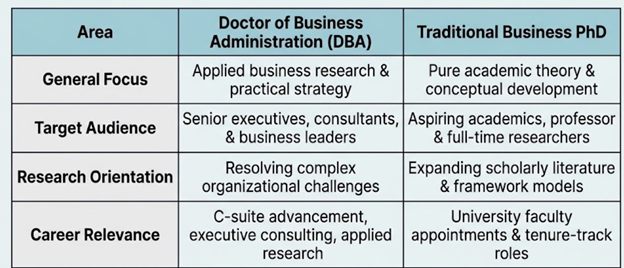
A Doctor of Business Administration (DBA) differs fundamentally from a traditional Doctor of Philosophy (PhD) in its core orientation and application.
Common Mistakes That Can Weaken a DBA Research Proposal
- Choosing an overly broad topic: Leads to shallow analysis and unmanageable scope.
- Vague research questions: Unclear inquiries create confusion during data collection.
- Poor methodology alignment: Selecting qualitative tools for questions requiring statistical proof.
- Insufficient scholarly sources: Relying on trade blogs instead of peer-reviewed journal articles.
- Ignoring practical feasibility: Failing to secure early participant access or reliable datasets.
How to Make Your DBA Research Proposal More Compelling
- Focus on a Genuine Business Problem: Clearly articulate why the issue matters to industry leaders and modern markets.
- Demonstrate Methodological Rigor: Show a solid understanding of data analysis techniques and ethical research practices.
- Highlight Practical Contributions: Explain how your findings will directly inform business strategies, operational models, or organizational policies.
- Ensure Realistic Feasibility: Detail an achievable timeline and demonstrate clear access to required data sources and research participants.
Final DBA Research Proposal Checklist
- Is the business research problem clearly defined and bounded?
- Are the research questions specific and directly tied to the problem?
- Do the objectives use measurable, formal action verbs?
- Does the literature review identify a clear research gap?
- Is the applied research methodology justified and appropriate?
- Are access channels to data and participants verified?
- Is the expected contribution to business practice clearly articulated?
- Are all references formatted accurately according to institutional guidelines?
- Does the draft strictly follow university submission specifications?
Final Thoughts
A well-crafted DBA Research Proposal transforms a practical business idea into a rigorous doctoral project. By combining a clear problem statement, strong literature review, robust methodology, and realistic timeline, you lay the foundation for a successful doctoral journey.
Frequently Asked Questions About DBA Research Proposal
What should a DBA research proposal include?
A DBA Research Proposal typically includes an introduction, problem statement, research aim and objectives, core questions, literature review, methodology, expected practical contribution, research limitations, timeline, and reference list.
How long should a DBA research proposal be?
Length requirements are set by individual universities. Proposals generally range between 2,000 and 5,000 words. Always check your university’s guidelines for precise word counts.
What methodology is suitable for DBA research?
Qualitative, quantitative, and mixed-methods approaches are all suitable for DBA research. Your choice should depend strictly on which approach best answers your core research questions.
What are common executive DBA requirements?
Standard executive DBA requirements include a master’s degree, substantial managerial or executive experience, proof of English language proficiency, letters of recommendation, a formal proposal, and an admissions interview.
How can I make my DBA research proposal stronger?
Focus on a well-defined business problem, support your claims with peer-reviewed academic literature, align your methodology closely with your research questions, and demonstrate that the project is realistic within your given timeline.




