

Completing an OTHM qualification marks a major educational milestone, but it does not have to be the final destination of your academic journey. Understanding OTHM Progression to University provides a clear, structured pathway to turn your previous hard work into advanced standing toward an undergraduate or postgraduate degree. By taking advantage of credit transfer mechanisms, top-up degree options, and standardized framework mappings, students can transition smoothly into recognized degree programs without starting their education from scratch.
This comprehensive GL Campus guide outlines the step-by-step progression process, credit evaluation systems, and critical factors to verify before submitting your university applications.
What Are Top-Up Degree Pathways?
A top-up degree allows students holding a recognized higher national diploma or Level 5 qualification to complete the final year of an undergraduate degree, earning a full bachelor’s award.

- How Top-Up Degrees Can Save Time
Instead of repeating fundamental coursework, eligible students enter directly into the final stage of study. This approach reduces overall tuition costs and shortens the timeframe required to achieve a full university degree.
- Who Can Consider a Top-Up Degree?
Top-up degrees are ideal for learners who hold a relevant Level 5 qualification (or equivalent 240 credits) and meet the university’s academic and language prerequisites.
7 Key Steps for OTHM Progression to University
Following a structured process ensures a smooth academic transition. Here are the 7 key steps for navigating your OTHM Progression to University route effectively:
1. Identify Your Completed OTHM Qualification
Verify the exact title, Ofqual level, total credit value, and subject specialization listed on your official transcript. Ensure all module results are fully finalized before starting university inquiries.
2. Research Suitable University Pathways
Focus your search on institutions that offer degree programs directly aligned with your OTHM subject area. Many universities maintain formal articulation agreements specifically designed for top-up degree pathways.
3. Review the Credit Requirements
Compare your earned credits with the credit requirements of the target university degree. Determine whether your qualification qualifies you for Year 2 entry, Year 3 top-up, or postgraduate advanced standing.
4. Check Entry and Progression Conditions
Examine non-credit entry criteria, such as English language proficiency scores (IELTS or equivalent), relevant professional work experience, and overall grade performance in your OTHM assessments.
5. Request Formal Credit Confirmation
Contact the university admissions department to request an official evaluation of your transcript. Secure a written confirmation of credit exemption before making financial or binding commitments.
6. Prepare Your Academic Documents
Gather certified copies of your OTHM transcript, final diploma certificate, unit specifications, passport copy, updated CV, and academic references into organized digital files.
7. Complete Your University Application
Submit your formal university application through the designated admissions portal or UCAS, attaching your formal credit evaluation letter alongside your academic portfolio.
How OTHM Qualifications Support University Progression
OTHM is a UK-regulated awarding organization approved by Ofqual (Office of Qualifications and Examinations Regulation). Because these qualifications are aligned with national standards, universities can evaluate their curriculum, learning outcomes, and credit values to determine appropriate advanced standing. However, final admission decisions always rest with the receiving university.
Check Your OTHM Qualification Level
Understanding your qualification level within the UK academic framework is essential for determining your entry point:
- Level 4 Diploma: Equivalent to the first year of a UK bachelor’s degree (Higher National Certificate/HNC level).
- Level 5 Diploma: Equivalent to the second year of a UK bachelor’s degree (Higher National Diploma/HND level).
- Level 6 Diploma: Equivalent to the final year of a UK bachelor’s degree.
- Level 7 Diploma: Equivalent to postgraduate/master’s level study.
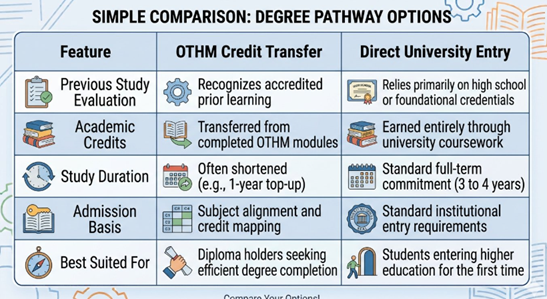
OTHM Credit Transfer vs. Direct University Entry
Choosing between credit-based progression and standard entry impacts your overall study duration and cost:
Factors That Affect Degree Progression
- Subject Alignment: The diploma curriculum must closely mirror the core subjects of the target degree.
- Credit Volume: You must hold sufficient credit volume at the required academic level.
- Institutional Policy: The university’s internal recognition of prior learning (RPL) framework governs final acceptance.
Understanding the UK Academic Framework
The Regulated Qualifications Framework (RQF) structures qualifications in England, Wales, and Northern Ireland by level and credit value, making it easier to compare different credentials.
Level reflects difficulty, while credits represent study duration and workload (1 credit equals approximately 10 hours of learning). A higher RQF level indicates greater analytical depth, but both level and total credit volume must meet university entry standards for successful progression.
How to Choose the Right University Progression Route
Evaluating potential academic routes requires careful attention to institutional details:
- Verify Program Accreditation: Confirm the receiving university is fully accredited and recognized.
- Evaluate Subject Compatibility: Ensure the degree modules build logically upon your diploma coursework.
- Review Total Costs: Calculate remaining tuition, application fees, and living expenses.
- Confirm Delivery Modes: Decide whether on-campus, online, or blended study suits your lifestyle.
- Check Graduation Outcomes: Assess career placement services and alumni outcomes for your chosen degree program.
Common Mistakes Students Make
Avoiding common application pitfalls saves time and prevents unnecessary delays in your OTHM Progression to University strategy:
- Assuming Universal Credit Acceptance: Believing that every university accepts OTHM credits in identical ways without prior written confirmation.
- Applying to Unrelated Disciplines: Attempting to transition from a business diploma into an unrelated degree field without foundational coursework.
- Overlooking Non-Academic Criteria: Forgetting to account for English language testing or reference requirements until right before submission deadlines.
Is OTHM Progression to University Right for You?
Pursuing OTHM Progression to University is ideal for students seeking a flexible, cost-effective, and structured route to a full degree. Whether you plan to enter the workforce quickly or continue onto postgraduate study, building on your existing diploma credits provides an efficient path toward your career and educational goals.
Final Checklist Before Starting Your Application
Before submitting your documentation to your chosen university, review this final checklist:
- Finalized official OTHM certificate and unit transcripts gathered.
- Target university programs and subject mappings researched.
- Formal credit transfer evaluation requested in writing.
- Minimum English language proficiency requirements verified.
- Application deadlines, tuition fees, and administrative costs confirmed.
Conclusion
Navigating your OTHM Progression to University effectively turns your diploma into a powerful springboard for academic success. By selecting aligned degree pathways, verifying credit mappings early, and securing written recognition from your target university, you can confidently complete your degree and achieve your professional ambitions.
Frequently Asked Questions
Can OTHM qualifications lead to a university degree?
Yes, eligible OTHM qualifications provide structured progression routes to university degrees. Acceptance depends on your qualification level, earned credits, subject alignment, and the admissions policies of the receiving institution.
What is OTHM credit transfer?
OTHM credit transfer is the process by which a university evaluates and accepts academic credits earned during your OTHM diploma, applying them as exemptions toward equivalent modules in a degree program.
Can I use OTHM for a top-up degree?
Yes, students holding Level 5 OTHM diplomas can often apply for final-year top-up degree programs, provided their diploma subject closely aligns with the undergraduate degree discipline.
Can I convert an OTHM diploma into a degree?
A diploma cannot be automatically converted into a degree. Instead, you use your diploma credits to gain advanced standing into a university program, completing the remaining required modules to earn a degree.
How do I confirm my university progression route?
Submit your official transcripts, module outlines, and qualification details to the university admissions office. Request a formal credit assessment letter detailing your accepted entry point and remaining study requirements.




