

Studying in Germany can open doors to advanced research and academic careers, but the cost of studying abroad can feel overwhelming. A fully funded PhD pathway at a German university is more financially accessible for eligible international students. Germany offers research opportunities across business, management, economics, finance, marketing, and related disciplines.
This GL Campus guide explores seven practical ways to improve your chances of securing doctoral funding in Germany.
What Is a Fully Funded PhD Program in Germany?

A fully funded doctoral program in Germany means that your primary living costs, research expenses, and institutional costs are covered through a tax-free stipend, a university employment contract, or a grant.
Funding packages vary across institutions, but typically include a combination of:
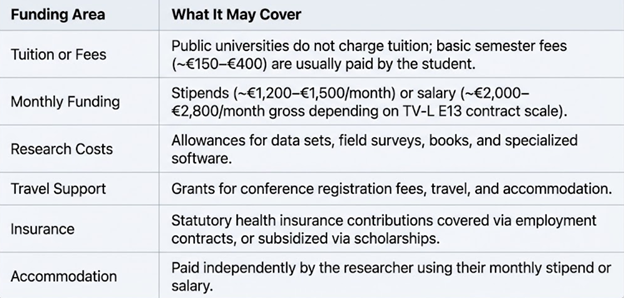
- Tuition Exemption: Public German universities generally do not charge tuition fees for doctoral programs (aside from nominal semester contribution fees covering transit and administration).
- Monthly Stipend or Salary: Living allowances generally range between €1,200 and €1,500 per month for scholarship recipients, or higher gross salaries for academic staff contracts.
- Research & Conference Funds: Allowances for laboratory materials, software licenses, data sets, and travel costs to present at international academic conferences.
- Health Insurance Coverage: Subsidy contributions or organized coverage depending on whether you are enrolled as a scholar or employed on a work contract.
Note that “fully funded” does not mean unlimited personal allowances; candidates must still budget carefully according to local living costs.
7 Powerful Ways to Secure a Fully Funded PhD in Germany
1. Search for Funded Research Positions
Rather than applying through general admissions, search for advertised research assistant vacancies (Wissenschaftliche Mitarbeiter positions). These positions are attached to funded university research projects where professors recruit PhD candidates to conduct research related to an overarching grant.
2. Explore Major Scholarship Opportunities
Investigate major funding organizations and political or academic foundations active in Germany:
- DAAD (German Academic Exchange Service): Offers individual doctoral grants covering monthly stipends, health coverage, and travel allowances.
- Party-Affiliated Foundations: Organizations like the Friedrich Ebert Foundation, Konrad Adenauer Foundation, or Heinrich Böll Foundation fund researchers demonstrating social or civic engagement.
- European Funding Initiatives: Marie Skłodowska-Curie Actions (MSCA) offer high-value doctoral network fellowships across Europe.
3. Develop a Strong Research Proposal
A clear, rigorous research proposal distinguishes strong applicants from the crowd. Your proposal should articulate:
- Research Problem: A specific, well-defined problem within your field.
- Literature Gap: What existing academic literature has missed or failed to resolve.
- Methodology: The qualitative, quantitative, or mixed-methods empirical framework you plan to use.
- Expected Contribution: The theoretical or practical value your thesis will generate.
Align your research proposal directly with the prospective supervisor’s recent publications and current research grants.
4. Find the Right Academic Supervisor
In Germany’s individual PhD model (Individualpromotion), securing a professor who agrees to supervise your thesis (Doktorvater or Doktormutter) is essential before formal registration.
- Research Faculty Profiles: Read recent journal articles published by business faculty members to identify scholars working in your niche.
- Write a Personalized Introduction: Send a concise email detailing your academic credentials, your proposed research scope, and why your project fits their specific research desk. Avoid sending mass, template emails.
5. Strengthen Your Academic Profile
Demonstrate that you possess the skills necessary to complete independent research within three to four years:
- High academic standing in a relevant Master’s degree (M.Sc., M.A., or MBA with a research thesis).
- Prior research experience, such as a strong master’s dissertation, research assistantships, or published working papers.
- Conference presentations or relevant professional experience in data analysis, corporate strategy, or specialized business fields.
6. Target Relevant Business Research Areas
Choosing high-demand research topics makes your application more attractive to grant-giving bodies and funding panels. Key fields include:
- Digital transformation and AI integration in business operations.
- Sustainable corporate finance and ESG metrics.
- Fintech, quantitative finance, and blockchain governance.
- Entrepreneurship, venture capital, and innovation ecosystems.
- Advanced marketing analytics and consumer behavior modeling.
7. Apply Early and Strategically
Research grants and scholarship deadlines operate on rigid annual cycles. Build a simple tracking spreadsheet to record application windows, supervisor contact statuses, required documentation, reference letter requests, and submission deadlines.
How to Find a Business Doctorate in Germany Opportunity
Finding the right business doctorate path in Germany requires using specialized search channels:
- Search University Research Departments: Check management, economics, and business faculties at German universities (e.g., Mannheim Business School, TUM School of Management, Goethe University Frankfurt, or LMU Munich).
- Search Research Projects: Monitor academic job portals like Academics.de, Research in Germany, and EURAXESS for open PhD research positions.
- Contact Potential Supervisors: Reach out directly to department chairs when your proposed project aligns closely with their published work.
Fully Funded PhD Germany Eligibility Requirements
Admission and funding guidelines depend on the awarding body and department rules.
Academic Qualifications
Applicants must hold a recognized Master’s degree (minimum 120 ECTS or equivalent) in a relevant subject area (such as Business Administration, Economics, Management, or Finance).
Research Proposal
For individual PhD routes or scholarship applications, a comprehensive 5-to-15 page research proposal is generally required. Structured PhD programs or pre-funded research project roles may instead request a targeted statement of purpose.
Language Requirements
Most business doctorate programs in Germany are conducted entirely in English. Proof of English proficiency (IELTS 7.0+ or TOEFL iBT 95+) is standard. While German proficiency (B1/B2) is not always required for academic research, learning basic German simplifies daily life and administrative tasks.
Additional Requirements
- Official academic transcripts and degree certificates.
- Academic CV formatted according to European standards (Europass or standard reverse-chronological academic layout).
- Two to three academic reference letters from university professors.
- A copy of your master’s thesis or a representative writing sample.
Scholarship Funding vs. Research Positions
- Scholarships (Stipendien): Tax-free monthly allowances awarded by external foundations or government agencies (e.g., DAAD). They offer independent research time but usually do not count toward German social security contributions.
- Research Positions (Wissenschaftliche/r Mitarbeiter/in): Formal university employment contracts (often TV-L E13 pay scale at 50% to 100% capacity). You earn a monthly salary with full healthcare, pension contributions, and teaching duties, but your working time is split between research duties and departmental support.
Why Funding Terms Matter
Applicants must review the exact conditions of any offer. Confirm how long the funding lasts (typically 3 to 4 years), whether annual progress reviews are required for renewal, and whether the award limits outside paid employment.
Why Choose a Fully Funded PhD in Germany Opportunity?
Germany is home to world-renowned research centers, vibrant business hubs, and highly respected higher education institutions.
Strong Research Environment
Germany boasts an extensive network of research-focused universities, Max Planck Institutes, Fraunhofer Societies, and Leibniz Associations. These institutions give doctoral candidates access to advanced analytical infrastructure, research grants, and international research collaborations.
International Academic Opportunities
German universities operate directly within European higher education networks. Doctoral students frequently collaborate with international scholars, participate in dual-degree programs (Cotutelle), and present research at major international symposia.
Business Research Potential
Pursuing a fully funded PhD in Germany in business fields connects candidates directly with European commercial markets. German business faculties conduct leading research in digital transformation, corporate strategy, international management, finance, supply chain management, and organizational behavior.
How Much Does a Fully Funded PhD Program in Germany Cover?
Funding structures vary between scholarship programs and university employment contracts:
Documents You Need for a Funded PhD Application
Academic Documents
- Master’s and Bachelor’s degree certificates.
- Official academic transcripts with grading scale explanations.
- Master’s thesis summary or full copy.
Research Documents
- Detailed research proposal (with literature review, methodology, and timeline).
- Statement of research intent.
- Writing samples or academic publications (if available).
Professional Documents
- Updated Academic CV detailing education, research experience, and technical skills.
- Academic recommendation letters on official university letterheads.
- Certified English (or German) language test score reports.
How to Write a Winning PhD Research Proposal
- Start With a Clear Research Problem: Define an unambiguous, academically relevant question tailored to your chosen business discipline.
- Show the Research Gap: Explain what existing theories or empirical studies have overlooked.
- Explain Your Methodology: Detail your data collection strategy (e.g., econometric analysis, survey experiments, case studies) and analytical software (e.g., R, Python, STATA, NVivo).
- Show Academic and Business Relevance: Highlight how your findings will advance theoretical knowledge and provide actionable strategies for industry practitioners.
Common Mistakes to Avoid
- Choosing a Topic Without Researching the Supervisor: Submitting a proposal that falls outside the supervisor’s domain expertise leads to immediate rejection.
- Sending Generic Applications: Generic outreach emails to faculty members are easily spotted and ignored.
- Ignoring Funding Conditions: Failing to check funding durations, teaching requirements, or citizenship eligibility rules wastes valuable effort.
- Applying Only to One Opportunity: Competition for doctoral funding is intense. Apply to multiple universities, research groups, and scholarship foundations simultaneously.
Fully Funded PhD Germany Application Timeline
12-18 Months Before Start ➔ Identify research interests & draft core research proposal
9-12 Months Before Start ➔ Identify potential supervisors & research university vacancies
6-9 Months Before Start ➔ Contact professors, finalize proposal, & request reference letters
4-6 Months Before Start ➔ Submit formal scholarship & university admissions applications
2-4 Months Before Start ➔ Complete interviews, accept funding offer, & apply for German Student/Researcher Visa
0 Months ➔ Arrive in Germany, register at university, & begin doctoral research
Is a Fully Funded PhD in Germany Worth It?
Pursuing a fully funded PhD in Germany offers significant advantages: zero tuition debt, competitive monthly income, access to top-tier European research networks, and strong career prospects in both academia and international industry. However, it requires a three-to-four-year commitment to demanding independent research.
Final Thoughts
Securing a fully funded PhD position in Germany requires methodical preparation, a clear research vision, and targeted applications. By drafting a strong research proposal, identifying compatible supervisors, and applying strategically to both research assistant vacancies and major scholarship programs, you can pave the way for a successful academic journey in Germany.
Frequently Asked Questions
Can international students apply for a fully funded PhD in Germany?
Yes. German universities and major funding organizations like the DAAD welcome international applicants. Eligibility depends on holding a recognized Master’s degree, meeting language criteria, and submitting a strong research proposal.
Is a fully funded PhD in Germany completely free?
Public universities in Germany generally do not charge tuition fees for PhD programs. A fully funded scholarship or employment contract provides monthly funds to cover living expenses, healthcare, and research costs. Students are typically responsible only for a nominal semester administrative contribution.
Can I pursue a business doctorate Germany program with funding?
Yes. Funded opportunities exist across business disciplines, including corporate strategy, finance, marketing, economics, supply chain management, and entrepreneurship. Funding is available via advertised university research positions (Wissenschaftliche Mitarbeiter) or individual foundation grants.
Do I need a supervisor for a PhD in Germany?
For the traditional individual PhD route (Individualpromotion), securing a formal agreement from an academic supervisor (Doktorvater/Doktormutter) is required before enrolling. Structured PhD programs or open research project positions assign supervisors as part of the admission process.
How can I increase my chances of getting PhD funding in Germany?
Develop an exceptional, gap-focused research proposal, align your research topic with a supervisor’s ongoing projects, maintain high academic marks, secure strong reference letters, and apply to multiple university vacancies and scholarship foundations well ahead of deadlines.




