

Studying in Germany can shape your future career and unlock global mobility. Educational degrees in Germany provide students with unique opportunities to explore early childhood development, classroom instruction, educational psychology, and academic administration. Germany is increasingly recognized as a top international destination because German universities offer high-quality, research-backed education pathways for international students.
This GL Campus guide shows you the roadmap before embarking on this path, prospective applicants should verify language requirements, university entrance criteria, living expenses, and visa regulations directly with target institutions.
7 Types of Educational Degrees in Germany Students Can Consider
Students looking into educational degrees in Top universities of Germany can choose from specialized disciplines tailored to different career objectives.
1. Early Childhood Education
Early childhood education programs focus on child development, early learning environments, educational psychology, and foundational pedagogy. Students learn how young children acquire language, social skills, and cognitive abilities in early learning centers.
2. Educational Studies
Educational studies explore broader academic themes, including educational theory, system design, comparative education, and historical learning frameworks. This pathway is ideal for students interested in education policy, curriculum research, and non-formal learning spaces.
3. Teaching and Teacher Education
Teacher preparation programs focus on subject pedagogy, instructional methods, and classroom management. In Germany, formal state teaching qualification pathways (Lehramt) usually require studying two subjects along with pedagogical sciences, often leading to a State Examination or specialized Master of Education.
4. Special Education
Special education programs train educators to work with students who have physical, learning, emotional, or developmental challenges. Coursework emphasizes inclusive teaching methods, adaptive technologies, and individualized learning plans.
5. Educational Psychology
Educational psychology examines the psychological principles underlying learning, student motivation, human development, and cognitive assessment. Graduates gain skills useful in educational counseling, academic guidance, and student support services.
6. Education Management
Education management combines leadership principles with organizational governance in academic environments. Students learn about institutional leadership, quality assurance, education economics, and human resource management in educational organizations.
7. International Education
International education focuses on global education trends, cross cultural teaching, comparative learning systems, and international school administration. It suits students planning careers in international schools, non governmental organizations, or global education consultancies.
Are Education Degrees Germany Available in English?
A primary concern for international applicants is instruction language. While many higher education programs in Germany are taught in German, English taught options exist, especially at the master’s degree level and in fields like international education or educational research.
When evaluating English taught programs, verify the following details:
- Official primary teaching language of the course
- Accepted English language test scores (such as IELTS or TOEFL)
- Mandatory German language modules included in the curriculum
- Specific academic entry criteria and portfolio requirements
- Language requirements for local school internships or practical training
Note that completing an English taught degree does not automatically guarantee that all local employment options will be available in English, especially for positions within state-run German public schools.
Study Teaching Europe: Is Germany a Good Option?
When planning to study teaching Europe, Germany stands out as a strong candidate alongside other European study destinations. Comparing destinations helps align your academic goals with regional opportunities:
- Academic Rigor: German universities emphasize evidence-based research and systematic pedagogical theory.
- Language Integration: Studying in Germany offers natural opportunities to learn German, a major language across Europe.
- Pan-European Recognition: Qualifications earned at German universities follow the European Credit Transfer System (ECTS), facilitating recognition across European Higher Education Area member states.
- Degree Diversity: Programs range from early childhood education to higher education administration.
Admission Requirements for Education Degrees Germany
Entry requirements for education degrees Germany depend on the institution, study level, and degree focus.
Academic Qualifications
Undergraduate applicants generally need a secondary school leaving certificate recognized as equivalent to the German Abitur (or must complete a Studienkolleg preparatory course). Postgraduate applicants need a relevant bachelor’s degree in education, social work, psychology, or a related field.
Language Requirements
For English taught courses, universities require proof of English proficiency (IELTS or TOEFL). For German taught programs, applicants must demonstrate advanced German proficiency through tests such as TestDaF or DSH.
Supporting Documents
Most university applications require a complete documentation portfolio:
- Certified academic transcripts and graduation certificates
- Valid passport or national identity card
- Official language proficiency test results
- Detailed Curriculum Vitae (CV) in standard European format
- Statement of Purpose or motivation letter
How Much Do Education Degrees Germany Cost?
Distinguishing between institutional tuition costs and general living expenses helps create a realistic study budget.
Tuition and University Fees
Most public universities in Germany charge zero tuition fees for both domestic and international students. Exceptions exist in federal states like Baden-Württemberg, where non-EU international students pay around €1,500 per semester. All public university students pay a semester contribution (typically €100 to €400) covering administrative costs and public transit tickets. Private universities charge higher tuition, often ranging from €5,000 to €20,000 annually.
Living Expenses
To obtain a German student visa, non-EU international students must demonstrate sufficient financial resources, usually through a blocked account (Sperrkonto) containing around €11,904 per year (roughly €992 per month). Monthly expenses cover rent, health insurance, food, study materials, and personal items.
Additional Costs
Budget for initial visa application fees, flight travel, temporary accommodation upon arrival, and safety deposit funds for apartment rentals.
Career Opportunities After an Education Degree
Graduating with an education degree opens pathways in diverse professional sectors, depending on your specialization and language fluency.
Early Childhood Education
Graduates can work as early years educators, childcare coordinators, or curriculum developers in bilingual preschools, international nurseries, and early learning centers.
Education Administration
Positions in university admissions, student services, international office coordination, and academic program management are suitable for education management graduates.
Educational Support
Opportunities exist in educational publishing, educational technology companies, youth development organizations, and private learning centers providing academic support.
Further Academic Study
Many bachelor’s degree graduates continue their studies through specialized master’s programs or research-focused doctoral studies (PhD), leading to academic and research careers.
How to Choose the Right Education Degrees Germany Program
Selecting the right academic program requires systematic research into your options.
- Examine the Curriculum: Review core modules, elective options, practical internships, and research requirements.
- Verify Language Rules: Confirm whether internship components require local language skills even if coursework is in English.
- Research Professional Recognition: If you plan to teach in public schools, verify state recognition rules (Anerkennung) for foreign qualifications.
- Evaluate Location Factors: Consider living expenses, accommodation availability, and regional lifestyle differences between German cities.
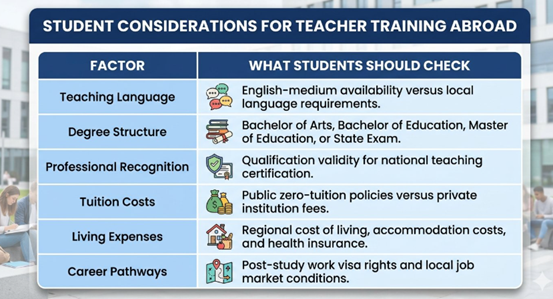
Study Teaching Europe: What Should International Students Compare?
Use this framework when evaluating options to study teaching Europe:
Mistakes to Avoid When Applying
Avoid these common pitfalls during your planning process:
- Applying to programs without checking specific language proficiency cutoffs
- Assuming every education degree leads directly to a state teaching license
- Overlooking state-level professional recognition rules for school teachers
- Submitting incomplete document translations or uncertified copies
- Underestimating total monthly living costs in major German cities
Step-By-Step Application Guide
Step 1: Choose Your Education Specialization
Identify whether your long-term goal aligns with early childhood teaching, academic research, education management, or special needs support.
Step 2: Research Suitable Programs
Use university databases (such as DAAD) to compare program structures, entry prerequisites, tuition details, and application deadlines.
Step 3: Prepare Your Documents
Translate academic credentials into English or German, request certified copies, and sit for necessary language tests.
Step 4: Submit Your Application
Apply directly through university portals or via the uni-assist platform according to specific institutional guidelines.
Step 5: Plan Your Relocation
Upon receiving an admission letter, open a blocked bank account, apply for a German student visa, secure health insurance, and arrange initial accommodation.
Final Checklist Before Choosing a Program
✓ Verify the official language of instruction for all course modules
✓ Confirm academic eligibility and credential recognition
✓ Check local teacher registration rules if planning a school teaching career
✓ Calculate total estimated expenses, including semester contributions and rent
✓ Note exact application deadlines for international applicants
✓ Confirm student visa and financial proof requirements
Conclusion
Enrolling in education degrees Germany offers a strategic pathway to gaining pedagogical expertise, international experience, and academic growth. Evaluating program structures, language requirements, tuition details, and post-graduation goals ensures an informed decision when choosing your degree in Europe.
FAQs About Education Degrees Germany
1. What are education degrees Germany students can study?
Students can explore early childhood education, educational studies, teacher education, special needs education, educational psychology, education management, and international education. Specific course offerings vary across public and private universities.
2. Can I study education degrees Germany in English?
Yes, English taught programs exist, particularly at the postgraduate level or in specialized fields such as international education and educational research. Applicants must check course listings carefully, as many public school teacher preparation degrees require advanced German proficiency.
3. Can international students study teaching in Germany?
International students can enroll in teacher education programs if they meet academic and language requirements. Those aiming to teach in German public schools must fulfill state teacher certification rules, which usually require fluency in German and mastery of two academic subjects.
4. What should I consider before I study teaching Europe?
When preparing to study teaching Europe, compare instructional languages, tuition fees, cost of living, credit transfer systems, and professional registration rules across candidate countries. Your desired teaching location and target student age group should guide your choice.
5. Are education degrees Germany suitable for early childhood education?
Germany offers specialized study options in early childhood education and primary pedagogy. These programs prepare graduates for roles in preschools, international childcare centers, early intervention organizations, and childhood research institutes.




