

Planning to study in the UK starts with understanding UK University Intakes and knowing when to begin your application. Choosing the right intake gives international students sufficient time to prepare academic documents, personal statements, financial proof, and visa requirements without unnecessary last-minute pressure.
What Are Top UK University Intakes?
UK University Intakes refer to the specific enrollment periods when higher education institutions accept new students into academic programs.

Universities primarily structure their academic years around two major entry points:
- Autumn (September/October) Intake: The primary and most comprehensive intake for undergraduate and postgraduate degrees.
- Spring (January/February) Intake: The secondary intake, popular for postgraduate courses and specialized master’s programs.
- Summer (May/June) Intake: A limited intake offered primarily for foundation courses, language programs, or select business modules.
Steps to Choose the Right UK University Intake
Selecting your start term impacts your preparation timeline, course options, funding opportunities, accommodation availability, and visa processing windows.
Step 1: Choose the Right UK University Intake
Before launching an application, compare intake cycles against your academic readiness and personal goals.
Key considerations include:
- Course availability: Not all degree programs offer entry in both autumn and spring.
- Admission requirements: Minimum academic grades and English proficiency cutoffs.
- Application deadlines: Priority dates for international student consideration.
- Preparation time: Time required to gather transcripts, references, and financial proof.
- Visa processing timelines: Recommended windows for CAS issuance and visa appointments.
- Accommodation availability: On-campus housing fills faster for the autumn term.
September Intake
The main September cycle offers the widest range of courses, full scholarship access, and comprehensive orientation activities across all UK institutions.
January Intake
The January intake enrollment serves as an ideal alternative for students needing extra time to complete prerequisites, fulfill language tests, or secure funding after missing autumn deadlines.
Step 2: Understand International Admission Windows
Navigating international admission windows requires managing multiple interconnected deadlines rather than relying on a single final submission date.
Essential milestone dates include:
- UCAS application deadlines: Standard undergraduate cutoffs (typically in January).
- University course deadlines: Rolling cutoffs for postgraduate degrees.
- Scholarship application deadlines: Often months prior to general application cutoffs.
- Deposit and offer acceptance deadlines: Required to secure your place.
- CAS issuance request deadlines: The prerequisite document for student visa applications.
- Accommodation application windows: Key dates for university hall guarantees.
Why International Students Should Start Early
International applicants require buffer time for credential evaluations, English language testing (IELTS/PTE), official document translations, and financial verification to align with UK University Intakes schedules.
Step 3: Build Your Degree Application Timeline
Creating a structured degree application timeline ensures steady progress across every phase of the admissions process.
Research Stage (10–12 Months Before Intake)
- Identify target universities and compare course curricula.
- Verify entry requirements and language proficiency minimums.
- Review tuition fee structures and available international scholarships.
Application Stage (6–8 Months Before Intake)
- Gather academic transcripts, degree certificates, and passport copies.
- Draft a compelling personal statement tailored to your chosen program.
- Request academic and professional reference letters.
Post-Application Stage (2–4 Months Before Intake)
- Evaluate conditional and unconditional offer letters.
- Pay required tuition deposits to request your Confirmation of Acceptance for Studies (CAS).
- Apply for student accommodation and finalize financial documentation.
Step 4: Learn How to Apply to a British University Online
When preparing to apply British university online, precision and completeness prevent processing delays.
Prepare Your Academic Documents
Consolidate certified academic transcripts, graduation certificates, English proficiency scorecards, and updated CVs into clean digital formats.
Write a Strong Personal Statement
Craft an engaging narrative detailing your academic motivation, subject passion, relevant work experience, and long-term career aspirations.
Submit the Application Carefully
Review all personal details, uploaded attachments, and referee contact information carefully before submitting your portal application or UCAS form.
Step 5: Understand Study in UK Deadlines
Staying aware of study in UK deadlines prevents missed enrollment windows and rushing visa applications.
University Deadlines
Postgraduate programs often operate on rolling admissions, closing once course capacities are met.
Course-Specific Deadlines
Competitive disciplines—such as medicine, dentistry, and MBA programs—enforce strict early deadlines.
Visa Preparation Deadlines
Receiving an admission offer is only step one; factor in at least 3–4 weeks for visa processing prior to your travel date.
Step 6: Prepare Your Documents Before the Deadline
Gathering all credentials well in advance minimizes last-minute delays.
Essential Documents Checklist
- Official academic transcripts and degree certificates
- Valid passport (with at least 6 months validity)
- Recognized English language test results (IELTS Academic, PTE, TOEFL)
- Tailored personal statement
- Academic or professional letters of recommendation
- Updated CV/Resume (for postgraduate and MBA applicants)
- Bank statements or sponsorship letters (for visa preparation)
Check Course-Specific Requirements
Review specific department pages directly, as creative courses may require portfolios, while technical fields may require GRE/GMAT scores or writing samples.
Step 7: Plan Your Offer, Visa, and Arrival
Once applications are submitted, shift your focus to final enrollment logistics.
Respond to Your University Offer
- Conditional Offer: Complete remaining requirements (e.g., final degree marks, language scores).
- Unconditional Offer: Accept the place directly and pay the tuition deposit to obtain your CAS.
Prepare for Visa Requirements
Review current UK Student Visa rules, ensuring your funds meet bank maintenance criteria (held for a minimum of 28 consecutive days) before lodging your visa application.
Arrange Accommodation and Travel
Book university halls or verified private student housing, arrange flight travel, and complete pre-arrival health checks (such as TB screening where applicable).
January Intake vs September Intake
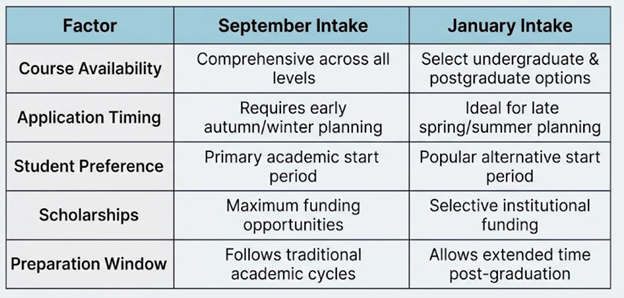
Note: Course availability, deadlines, and funding options vary by institution and academic program.
Common Mistakes Students Make With UK University Intakes
- Waiting until the final deadline: Late submissions limit course choices, scholarship eligibility, and housing options.
- Assuming uniform intake availability: Presuming all degree modules open in January leads to missed September cycles.
- Ignoring course-specific prerequisites: Failing to verify specific entry criteria results in rejected applications.
- Confusing university and visa deadlines: Treating admission deadlines and immigration timelines as the same causes travel delays.
How to Create a Stress-Free UK Application Plan
6 Months Before Intake
Complete university research, finalize course selections, register for English language exams, and outline your personal statement.
3 to 4 Months Before Intake
Submit online applications, upload certified documents, request references, and monitor application tracking portals.
After Receiving an Offer
Fulfill offer conditions, pay tuition deposits, request your CAS statement, complete visa financial checks, and lodge your UK Student Visa application.
How to Choose Between Different UK University Intakes
There is no single “best” intake; select the entry window that best aligns with your circumstances.
Evaluate these key factors:
- Availability of your preferred degree program
- Readiness of academic transcripts and language scores
- Financial preparation and scholarship deadlines
- Time required for visa clearance and travel arrangements
Final UK University Intakes Checklist
- Confirm course availability for your target intake
- Verify official university application cutoffs
- Compile certified academic transcripts and certificates
- Write and polish your personal statement
- Secure academic/professional references
- Complete required English language tests
- Submit your online application accurately
- Track portal status and respond promptly to offers
- Fulfill CAS deposit requirements
- Complete visa processing and travel arrangements
Final Thoughts
Understanding UK University Intakes simplifies the international admissions journey. Working backward from your intended start date gives you ample time for applications, documentation, offer acceptance, visa processing, and travel planning.
Frequently Asked Questions About UK University Intakes
What are the main UK university intakes?
The primary admission cycles are the September (Autumn) intake and the January (Spring) intake. September offers the widest course selection across all degree levels, while January offers flexible options primarily for postgraduate students.
Is January intake enrollment available for all UK courses?
No, January intake enrollment depends on the specific university and program. While many postgraduate business, computing, and engineering courses offer January starts, most undergraduate degrees begin solely in September.
When should international students apply to UK universities?
International applicants should start researching and preparing documents 8 to 12 months before their intended intake. Submitting applications 4 to 6 months in advance provides adequate time for offer processing, CAS issuance, and visa approvals.
What documents are needed to apply to a UK university?
Applicants typically need official academic transcripts, degree certificates, a valid passport, a personal statement, reference letters, and proof of English proficiency. Certain courses may also require a portfolio or professional CV.
Are UK university deadlines the same for international students?
No, study in UK deadlines vary by university, department, degree level, and applicant residency status. International students should apply early to allow sufficient buffer time for visa clearance and pre-arrival arrangements.




