

Understanding the UAE university admission requirements is an important first step for international students planning to study in UAE. Requirements can vary significantly by university, degree level, chosen curriculum, and nationality.
This GL Campus guides you from academic qualifications and English language proficiency to document attestations and student visa procedures, knowing what to prepare in advance makes your application journey much smoother and far more efficient.
What Are the UAE University Admission Requirements?
Admission criteria in the United Arab Emirates are not uniform. Entry criteria differ across public and private universities, as well as between branch campuses of international institutions. As an international education hub, Dubai university admission pathways cater specifically to foreign students through a combination of federal frameworks and free-zone academic regulations.

Dubai University Admission Criteria
In higher education hubs like Dubai International Academic City (DIAC) and Dubai Knowledge Park (DKP), branch campuses (such as Middlesex University Dubai, University of Birmingham Dubai, and Heriot-Watt University Dubai) set entry requirements aligned with both their home country standards and local regulations. Criteria vary based on degree level, program discipline, and academic background.
Universities generally assess applicants on:
- Previous academic qualifications and accreditation
- Minimum cumulative grade averages or subject-specific marks
- English language proficiency test results
- Complete set of verified supporting documents
- Program-specific requisites (e.g., portfolios, entrance tests, or interviews)
Undergraduate and postgraduate applicants face distinct admission standards due to the academic level and research intensity required for higher degrees.
7 Key UAE University Admission Requirements International Students Should Know
1. Academic Qualifications
Applicants must present evidence of completing previous formal education from an accredited institution.
- Bachelor’s Applicants: Must hold a recognized secondary school qualification equivalent to Grade 12 in the UAE system.
- Postgraduate Applicants: Must hold a recognized Bachelor’s degree (for Master’s entry) or a Master’s degree (for PhD entry) from an institution accredited by its home country’s Ministry of Education.
2. Required Academic Grades
Universities set minimum grade thresholds depending on the competitiveness of the program:
- General Programs: Typically require a minimum high school average of 60%–70% (or equivalent GPA).
- Competitive Programs: Specialized tracks like Engineering, Medicine, and Law frequently mandate 80%–90%+ overall averages alongside higher marks in core subjects like Mathematics, Physics, Chemistry, or Biology.
3. English Language Proficiency
Because English is the primary medium of instruction across most higher education institutions in the UAE, international students must demonstrate proficiency through recognized standardized tests like IELTS Academic or TOEFL iBT. Minimum score requirements vary based on the level and field of study.
4. Valid Identification Documents
International applicants must provide valid government-issued identification. A passport with at least six months of remaining validity is mandatory for application registration and student visa issuance. Applicants already residing in the UAE must also supply a copy of their valid Emirates ID and residence visa.
5. Academic Transcripts and Certificates
Universities require full, official academic records detailing all completed courses and grades. International certificates often need to undergo a multi-step attestation chain—including the issuing country’s Ministry of Education, Ministry of Foreign Affairs, and the UAE Embassy—to confirm authenticity.
6. Program-Specific Requirements
Certain specialized fields carry secondary entry criteria beyond baseline academic grades:
- Medicine & Healthcare: Foundation science subject requirements, competitive entrance exams, and health screening.
- Engineering & IT: Higher mathematics and physics subject benchmarks.
- Architecture & Design: Creative portfolio submissions demonstrating design capability.
- Business & Executive Programs: Video interviews, letters of intent, and relevant work experience for executive tracks.
7. Application and Visa Requirements
Following conditional or unconditional acceptance, international students must formally accept their offer, pay an initial registration/tuition deposit, and fulfill student visa sponsorship procedures (which include mandatory medical fitness screenings and health insurance enrollment in the UAE).
Academic Qualifications Needed to Study in UAE
High School Qualifications
UAE universities evaluate a wide range of international secondary school curricula:
- British Curriculum (IGCSE / A-Levels): Requires completion of Year 13, typically with a minimum number of GCSEs/IGCSEs plus 2 to 3 A-Level passes in relevant subjects.
- International Baccalaureate (IB): Requires the full IB Diploma with specific points targets (usually 24–28+ points depending on the program).
- American Curriculum: High School Diploma accompanied by strong cumulative GPA, along with standardized test scores (e.g., SATs) or Advanced Placement (AP) courses where requested.
- National Curricula: Indian CBSE/ICSE, Pakistani HSSC, and other national boards are widely accepted with official board mark sheets.
Bachelor’s Degree Requirements
For admission into a Master’s or MBA program, universities typically look for:
- A Bachelor’s degree in a related field from an accredited university.
- A minimum cumulative GPA (often 2.5 to 3.0 on a 4.0 scale).
- Relevant academic prerequisites or foundational modules in quantitative or analytical subjects.
Professional Qualifications
Some professional Master’s or postgraduate diploma tracks may accept executive applicants with non-traditional academic backgrounds if they possess recognized professional certifications (e.g., ACCA, CIMA) or extensive managerial work experience.
English Language Requirements for International Students UAE
IELTS and TOEFL
Demonstrating English competence is central to UAE university requirements.
- Undergraduate Entry: Typically requires an IELTS Academic score of 5.0 to 6.0 or TOEFL iBT equivalent (60–79).
- Postgraduate Entry: Typically requires an IELTS Academic score of 6.0 to 6.5+ or TOEFL iBT equivalent (79–90+).
Can You Study Without IELTS?
While IELTS and TOEFL are standard, alternatives exist:
- EmSAT Achieve: The Emirates Standardized Test (English) is widely accepted across UAE institutions.
- Pearson PTE Academic: Accepted by many international branch campuses.
- Medium of Instruction (MOI) Certificate: If your prior education was completed entirely in English in an English-speaking country, some universities may waive the test requirement upon review of an official MOI letter from your previous institution.
Always verify language waivers directly with your prospective university’s admissions office.
Documents Required for UAE University Admission
Below is a document checklist for international applicants:
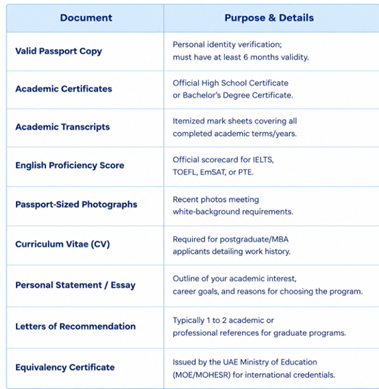
UAE University vs Dubai University Requirements
- Federal / Public Universities: Often enforce standardized government guidelines, including specific entry score benchmarks and MOHESR equivalency processes.
- International Branch Campuses in Dubai: Offer direct equivalencies based on your home country qualification system (e.g., direct conversion of IB scores, US High School GPAs, or Indian Board percentages).
There is no single admission score that applies across all institutions in the region; applicants must confirm specifics on a per-college basis.
UAE University Application Process for International Students
Step 1: Choose Your Course and University
Evaluate programs based on academic fit, university ranking, tuition fees, campus location, accreditation, and post-graduation career opportunities.
Step 2: Check the Entry Requirements
Verify minimum grade criteria, language prerequisites, module requirements, and application deadlines on the university’s official portal.
Step 3: Prepare Your Documents
Gather certified copies of your transcripts, certificates, passport, language test results, and reference letters. Initiate the document attestation process early.
Step 4: Submit Your Application
Complete the online application form on the university website and pay the non-refundable application fee.
Step 5: Receive the Admission Decision
Universities will issue an admission verdict:
- Unconditional Offer: You meet all criteria and are accepted.
- Conditional Offer: You are accepted provided you submit pending documents (e.g., final exam results or equivalency certificates).
Step 6: Complete Enrollment and Visa Procedures
Confirm acceptance by paying the tuition deposit. The university will then assist with issuing your entry permit, arranging medical fitness tests, and securing your student residence visa.
UAE University Admission Requirements for Different Degree Levels
Bachelor’s Degree
- Secondary school completion (Grade 12 equivalent).
- Minimum overall GPA or percentage mark.
- Proof of English proficiency (e.g., IELTS 5.5–6.0).
- Subject-specific prerequisites (e.g., Advanced Mathematics for Engineering).
Master’s Degree
- Accredited Bachelor’s degree in a relevant field.
- Cumulative GPA of 2.5–3.0+ on a 4.0 scale.
- Proof of English proficiency (e.g., IELTS 6.0–6.5).
- Academic transcripts and recommendation letters.
MBA
- Recognized undergraduate degree.
GloboPrime Corporate Services
- Professional work experience (typically 2–3 years minimum).
- Resume/CV, personal statement, and professional references.
- Video interview or entrance assessment (for select business schools).
Doctoral Degree (PhD)
- Recognized Master’s degree in a related discipline.
GloboPrime Corporate Services
- High academic standing in previous graduate coursework.
- Comprehensive research proposal outlining your proposed study topic.
- Academic references and approval from a potential supervisor.
UAE University Admission Requirements and Equivalency
Qualifications earned outside the UAE generally require official recognition to confirm that they match national education standards.
Why Equivalency May Matter
An Equivalency Certificate issued by the UAE Ministry of Education (MOE) / Ministry of Higher Education and Scientific Research (MOHESR) officially validates that a foreign high school diploma or university degree corresponds to the equivalent UAE academic level.
International Qualifications
Students with overseas certificates must complete an attestation chain:
- Attestation by the Ministry of Education & Ministry of Foreign Affairs in the home country.
- Attestation by the UAE Embassy in the home country.
- Attestation by the UAE Ministry of Foreign Affairs (MOFA) upon arrival.
- Submission to the MOE/MOHESR portal for equivalency issuance.
Note: Many universities allow international students UAE to enroll conditionally for their first semester while their MOE equivalency process is completed.
How Much Does It Cost to Study in UAE?
Tuition Fees
Tuition varies depending on the degree level, subject specialization, and institution:
- Undergraduate Degrees: AED 40,000 to AED 90,000+ per year.
- Postgraduate Degrees: AED 50,000 to AED 120,000+ for the complete program.
- Specialized Programs (Medicine / Executive MBAs): AED 100,000 to AED 180,000+ per year.
Always evaluate total program costs rather than annual estimates alone.
Additional Expenses
In addition to tuition, budget for:
- Accommodation: AED 20,000 – AED 45,000 per year (student housing or shared apartments).
- Health Insurance: AED 1,500 – AED 4,000 per year (mandatory for student visa holders).
- Student Visa Fees & Deposits: AED 2,500 – AED 5,000 (one-time fee depending on the university).
- Living Expenses: AED 1,500 – AED 3,000 per month (groceries, transport, books, personal utilities).
Common Mistakes When Applying to UAE Universities
Ignoring Program-Specific Requirements
Reviewing only general university criteria is a common mistake. Professional tracks like Architecture, Engineering, and Healthcare have stringent subject requirements that must be met.
Submitting Incomplete Documents
Submitting un-attested certificates, missing grade sheets, or expired language scores delays processing times and can cause missed intake deadliness.
Assuming Every University Has the Same Criteria
Criteria vary significantly between federal universities and private or foreign branch campuses. Never assume one set of entry conditions applies across the country.
Applying Too Close to the Deadline
Document attestations, visa processing, and equivalency requests take several weeks to complete. Start your application process 3 to 6 months in advance.
How to Prepare for UAE University Admission Successfully
To ensure a seamless transition:
- Shortlist Universities: Select 3–4 institutions that align with your budget, location preferences, and career goals.
- Confirm Prerequisites: Contact the admissions department to verify specific course prerequisites.
- Organize Documents Early: Begin the document attestation process early to avoid last-minute delays.
Amercenter.ae
- Book Language Tests: Take your IELTS, TOEFL, or EmSAT exam early to allow time for re-takes if necessary.
- Budget Comprehensive Costs: Calculate tuition, housing, health insurance, and visa fees before committing.
- Track Deadlines: Maintain a calendar of application cut-offs, scholarship deadlines, and visa processing dates.
Final Thoughts on UAE University Admission Requirements
Preparing your application according to official UAE university admission requirements is key to securing your place as an international student. By understanding academic criteria, gathering verified documents, demonstrating English proficiency, and planning your study budget, you can navigate the process smoothly.
Research prospective institutions early, double-check specific course requirements on university portals, and begin your application preparations well ahead of upcoming intake deadlines.
FAQs About UAE University Admission Requirements
1. What are the basic UAE university admission requirements for international students?
International applicants generally need a recognized high school diploma (for Bachelor’s) or Bachelor’s degree (for Master’s), official transcripts, valid passport, proof of English proficiency (IELTS/TOEFL/EmSAT), and attested qualification documents.
2. Do I need IELTS to study at a UAE university?
Most English-taught programs require an English test like IELTS Academic or TOEFL. However, some institutions accept EmSAT, PTE Academic, or a Medium of Instruction (MOI) certificate if your prior education was conducted entirely in English.
3. What documents are needed for UAE university admission?
Essential documents include your passport copy, certified mark sheets, degree/high school certificates, English test results, photographs, personal statement, CV, and an MOE Equivalency Certificate (or proof of application).
4. Are UAE university requirements different for international students?
Yes. International students must fulfill document attestation, visa sponsorship processing, health insurance setup, and credential equivalency verification through the UAE Ministry of Education.
5. How can I apply to a university in the UAE?
Select your university and program, verify entry criteria on the institution’s official portal, prepare required academic and identity documents, submit your application online, and complete enrollment deposit and student visa procedures once accepted.




