

Choosing a degree abroad between analytics and management shapes your studies, skills, and future career direction. Understanding business analytics vs business management helps students identify which degree better matches their interests and professional goals. Both degrees lead to strong business careers, but they focus on distinctly different abilities.
This comprehensive GL Campus guide compares subjects, skills, career paths, job roles, and further study options to help you choose the right route for your professional future.
What Is a Business Management Degree?
A business management degree focuses on leading organizations, coordinating cross-functional teams, understanding operational workflows, and making key strategic decisions. It provides a comprehensive overview of how businesses operate across various functional departments and global markets.

Common areas of study include:
- Organizational leadership and administration
- Strategic marketing and brand positioning
- Financial accounting, budgeting, and corporate finance
- Human resources management and talent development
- Operations and supply chain logistics
What Is a Business Analytics Degree?
A business analytics degree combines core business knowledge with data analysis, statistics, technology, and decision science. Students learn how to harness quantitative methods, statistical software, and predictive models to solve operational challenges and optimize organizational performance across various commercial sectors.
Common areas of study include:
- Data analysis and management
- Business intelligence frameworks
- Statistical modeling and quantitative analysis
- Data visualization and executive reporting
- Predictive analysis and demand forecasting
Understanding Business Analytics vs Business Management
While both disciplines operate commercially, their core objectives differ significantly. Business analytics focuses on gathering, processing, statistical modeling, and interpreting quantitative data to drive evidence-based corporate strategy. In contrast, business management focuses on overseeing organizational operations, directing personnel, managing resources, and executing high-level strategic goals.
Business Analytics vs Business Management Subjects
Examining the curriculum reveals clear differences in academic emphasis, quantitative rigor, and technical depth across degree programs.
Business Analytics Degree Subjects
Coursework in an analytics program is quantitative and technology-driven:
- Business Statistics: Learning probability theory, regression analysis, and hypothesis testing for decision making.
- Data Visualization: Utilizing tools like Tableau and Power BI to present quantitative insights clearly.
- Business Intelligence: Designing and maintaining enterprise dashboards to track key performance indicators.
- Predictive Analytics: Building statistical models and algorithmic tools to forecast market trends.
- Database Management: Structuring, organizing, and querying relational databases using SQL tools.
Business Management Degree Subjects
Coursework in a management program emphasizes organizational dynamics, strategic planning, and broad corporate leadership:
- Business Strategy: Evaluating market positioning, competitive advantage, and long-term business models.
- Marketing Management: Studying consumer behavior, strategic market research, and brand management.
- Organizational Behavior: Understanding team dynamics, corporate culture, and modern leadership styles.
- Human Resource Management: Managing talent acquisition, performance appraisal systems, and labor relations.
- Operations Management: Optimizing production workflows, inventory control, and resource allocation.
Which Degree Has More Technical Subjects?
A business analytics degree is substantially more technical and quantitative. It requires working directly with relational databases, programming languages, statistical software platforms, and quantitative modeling tools. In contrast, a business management degree focuses primarily on strategic decision making, interpersonal communication, team leadership, and organizational problem solving.
Skills Developed in Business Analytics vs Business Management
Both academic pathways equip students with valuable professional capabilities, but cultivate distinctly different skill sets.
Skills From a Business Analytics Degree
Graduates in business analytics excel at quantitative problem solving and empirical research:
- Analytical Thinking: Dissecting complex business problems into measurable components and structured data sets.
- Statistical Reasoning: Applying mathematical principles and quantitative techniques to validate business hypotheses.
- Data Interpretation: Extracting meaningful patterns, trends, and anomalies from large corporate datasets.
- Data Visualization: Translating technical findings into intuitive charts and visual executive summaries.
- Technology Skills: Mastering specialized software tools, SQL databases, and business intelligence suites.
Skills From a Business Management Degree
Graduates in business management develop strong interpersonal, organizational, and executive capabilities:
- Leadership: Guiding, inspiring, and aligning diverse teams toward achieving shared corporate objectives.
- Communication: Articulating complex business ideas, strategies, and expectations clearly across all organizational levels.
- Team Management: Coordinating cross-functional projects, resolving friction, and optimizing productivity.
- Strategic Thinking: Evaluating high-level commercial opportunities, industry trends, and organizational risks.
- Negotiation: Reaching mutually beneficial agreements with external suppliers, clients, and internal stakeholders.
Business Analytics vs Business Management Career Paths
Evaluating potential career trajectories helps align academic choices with long-term professional ambitions and personal strengths.
Analytics Careers
Careers in analytics focus on gathering, processing, and interpreting business data to help organizations make evidence-based strategic decisions. Typical professional roles include:
- Business Analyst: Identifying operational inefficiencies and recommending process improvements.
- Data Analyst: Gathering, cleaning, and analyzing structured data to identify key commercial trends.
- Business Intelligence Analyst: Developing corporate dashboards and enterprise reporting systems.
- Marketing Analyst: Measuring the quantitative performance, ROI, and targeting of marketing campaigns.
- Operations Analyst: Evaluating supply chain workflows and logistics to reduce operational costs.
Management Careers
Careers in management involve coordinating people, resources, operational processes, and overarching organizational goals. Typical professional roles include:
- Business Development Manager: Identifying new market opportunities, strategic partnerships, and revenue streams.
- Operations Manager: Overseeing daily corporate activities, resource allocation, and workflow efficiency.
- Project Manager: Planning and monitoring complex corporate initiatives to ensure delivery on schedule.
- Marketing Manager: Overseeing campaign creation, brand positioning strategies, and market research teams.
- Human Resources Manager: Directing talent acquisition, employee development, and organizational culture.
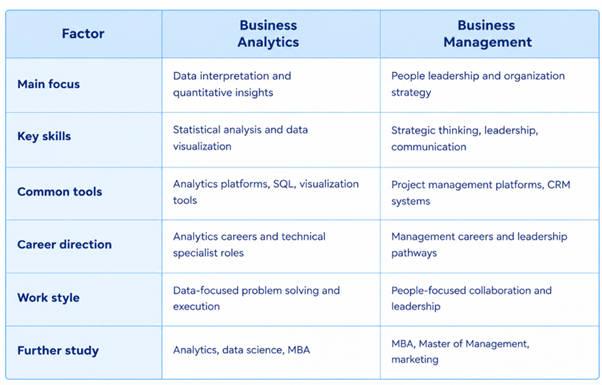
Business Analytics vs Business Management Job Roles Compared
The table below outlines core functional differences between both tracks:
Who Should Choose Which Degree?
Choose Business Analytics If You Enjoy:
- Working with numbers, spreadsheets, and quantitative metrics
- Discovering patterns, correlations, and trends within raw data
- Utilizing specialized software, database querying tools, and visualization suites
- Solving complex operational challenges using logical models
Choose Business Management If You Enjoy:
- Guiding collaborative teams, delegating tasks, and motivating people
- Presenting ideas, writing professional reports, and public speaking
- Designing operational schedules, setting milestones, and organizing resources
- Evaluating broad commercial opportunities and competitive landscapes
Business Analytics vs Business Management for Further Study
Both academic foundations open diverse postgraduate opportunities, allowing students to specialize.
Further Study After Business Analytics
- Master of Science in Business Analytics
- Data science and data engineering master’s programs
- Artificial intelligence and technology management programs
- Master of Business Administration (MBA)
Further Study After Business Management
- Master of Business Administration (MBA)
- Master of Management
- Specialized Master of Science in Marketing or Finance
- Human resources management postgraduate programs
Common Mistakes to Avoid When Choosing
Navigating academic choices requires objective research. Avoid these common mistakes:
- Choosing only for popularity: Selecting a program based on hype rather than personal aptitude.
- Ignoring course modules: Failing to review curriculum topics, leading to unexpected workloads.
- Focusing only on initial job titles: Assuming a degree limits you to a single narrow career path.
- Not considering personal strengths: Forcing yourself into a field that conflicts with your natural style.
FAQs About Business Analytics vs Business Management
1. What is the main difference between business analytics and business management?
Business analytics focuses on using data, statistical methods, and quantitative tools to support evidence-based decisions. Business management focuses on leadership, strategy, operations, team coordination, and overall organizational performance.
2. Is a business analytics degree more technical than a business management degree?
Yes. Business analytics programs feature technical coursework like business statistics, database management, visualization software, and predictive modeling. Management programs place greater emphasis on strategic planning, leadership theories, communication, and general administration.
3. What careers can I pursue with a business analytics degree?
Graduates can explore careers as a business analyst, data analyst, business intelligence analyst, marketing analyst, operations analyst, or data consultant depending on technical skills and experience.
4. What careers can I pursue with a business management degree?
A business management degree supports career paths in operations management, marketing management, human resources, business development, project management, account management, and management consulting.
5. Can I pursue an MBA after either degree?
Yes, graduates from both business analytics and business management academic backgrounds are eligible for MBA programs, depending on specific university admission criteria.




