
Changing industries can feel challenging when your previous professional experience does not directly match your dream position. Executing a fast track MBA career switch allows professionals to build critical business acumen, strengthen strategic leadership skills, and prepare for new opportunities across competitive industries.
This GL Campus guide explains how a fast track MBA degree can redefine your career path and help you pivot successfully.
1. What Is a Fast Track MBA and How Does It Work?
A fast track MBA is an accelerated Master of Business Administration degree designed to equip students with comprehensive business credentials in significantly less time than standard two-year programs.
Understanding an Accelerated MBA
Accelerated MBA programs condense rigorous graduate coursework into an intensive study timeline. Instead of stretching modules across traditional academic semesters, these programs cover fundamental business disciplines through focused, high-impact coursework:
- Business Strategy & Management: Analyzing competitive markets, corporate growth strategies, and global business models.
- Financial Decision-Making & Marketing: Mastering managerial accounting, corporate finance, consumer research, and brand positioning.
- Leadership & Organizational Behavior: Developing executive decision-making, conflict resolution, and cross-functional team management skills.
- Operations & Project Management: Optimizing supply chains, workflow processes, and organizational efficiency.
Who Should Consider an Accelerated MBA?
An accelerated MBA suits ambitious professionals who possess several years of full-time work experience and want to acquire managerial competencies without taking an extended break from the workforce. It is an ideal path for individuals targeting mid-to-senior management roles, exploring new sectors, or preparing to launch their own entrepreneurial ventures.
2. Can a Fast Track MBA Help You Switch Careers?
Executing a fast track MBA career switch provides a powerful mechanism to connect past achievements with future career goals. However, earning the degree alone does not automatically guarantee an immediate role change or higher executive title.
Building Skills for a New Industry
An MBA bridges knowledge gaps by teaching you how major business functions operate together. For example, a candidate coming from a specialized sales background can gain financial modeling skills and corporate strategy expertise, positioning them for roles in management consulting or corporate strategy.
An MBA curriculum helps career switchers master key competencies across:
- Strategic business modeling and competitive positioning.
- Corporate budgeting, financial statement analysis, and forecasting.
- Quantitative market research and customer acquisition strategies.
- Team leadership, cross-departmental coordination, and executive communication.
Identifying Transferable Skills
Transferable skills allow you to reframe existing experience so hiring managers in new industries see your immediate value. A project manager in construction, for example, already possesses risk management, budget oversight, and stakeholder negotiation skills that directly transfer to tech operations, health management, or business consulting.
Identifying your strongest core capabilities and mapping them directly to the key responsibilities of target job descriptions is crucial during an industry change.
Understanding the Limitations
While an MBA offers broad managerial versatility, certain technical fields—such as specialized software engineering, quantitative finance, clinical healthcare, or corporate law—require mandatory professional certifications, technical degrees, or industry licenses. An MBA should complement, rather than replace, necessary technical qualifications.
3. Which Industries Can You Enter After an MBA?
The career pathways available after an MBA depend heavily on your target specialization, background, geographic location, and local hiring demand. Successful transitions occur when candidates combine past strengths with advanced business training.
Consulting and Business Strategy
Management consulting remains a premier target for MBA graduates. Strategy firms value candidates who can dissect complex business problems, evaluate market opportunities, and optimize operational structures. Former engineers, educators, and project leaders often leverage an MBA to transition into strategic analyst or associate consulting roles.
Marketing and Digital Business
Professionals transitioning into brand management, digital marketing, or consumer analytics learn consumer behavior psychology, campaign measurement, product positioning, and performance metrics. Candidates entering digital sectors combine creative direction skills with data analytics to oversee full-funnel marketing campaigns.
Technology and Product Management
Tech companies frequently recruit business graduates for product management, strategy, and business operations roles. Product managers sit at the intersection of business strategy, software design, and user experience. While technical literacy is beneficial, strategic product positioning and customer lifecycle management are key drivers for success.
Finance, Operations and Entrepreneurship
An MBA opens pathways into corporate finance, supply chain management, logistics leadership, and business development. While technical investment banking roles may require quantitative expertise, general corporate finance roles value broad strategic oversight. Prospective founders can use their coursework to refine business models, build pitch decks, and secure venture funding.
4. How to Plan a Successful MBA Career Transition
Planning an MBA career transition requires a clear, step-by-step strategy long before submitting university applications.
Step 1: Choose Your Target Industry
Research two or three primary industries that align with your long-term interests. Analyze job descriptions, required software proficiencies, and typical entry pathways for candidate profiles similar to yours.
Step 2: Select the Right MBA Specialization
Align your academic concentration with your intended career path:
- Finance: Best for corporate financial planning, budget management, and investment strategy roles.
- Marketing: Tailored for brand management, growth marketing, and commercial strategy positions.
- Business Analytics: Ideal for data-driven roles, market research analysis, and operational reporting.
- Operations & Supply Chain: Designed for process optimization, logistics planning, and manufacturing oversight.
- Strategy & Leadership: Built for general management, organizational consulting, and executive leadership.
Step 3: Build Relevant Experience While Studying
Do not rely solely on classroom lectures. Build practical evidence of your new skill set through applied consulting projects, corporate case competitions, student-led business initiatives, or part-time internships during your program.
Step 4: Update Your CV and LinkedIn Profile
Reframe your resume away from niche technical jargon toward quantifiable business impact. Highlight achievements using clear metrics—such as revenue generated, cost reductions achieved, team sizes managed, or project timelines optimized.
5. How to Choose the Best Fast Track MBA Program
Selecting the right fast track MBA career switch route requires evaluating several essential factors beyond program length.
Check Accreditation and Recognition
Ensure your chosen university holds recognized institutional accreditation and program-specific credentials from top business education bodies (such as AACSB, AMBA, or EQUIS). Accredited degrees ensure international credibility among global employers and executive recruiters.
Compare Curriculum and Career Support
Review the curriculum to confirm it covers your focus area. Additionally, inspect the university’s career services department, alumni network strength, corporate recruitment partnerships, and career mentorship initiatives.
Evaluate Total Costs and Return on Investment (ROI)
Calculate the total cost of attendance, including tuition, administrative fees, course materials, living expenses, and opportunity costs from time off work. Evaluate these investments against post-graduation employment rates and median salary benchmarks for alumni in your target industry.
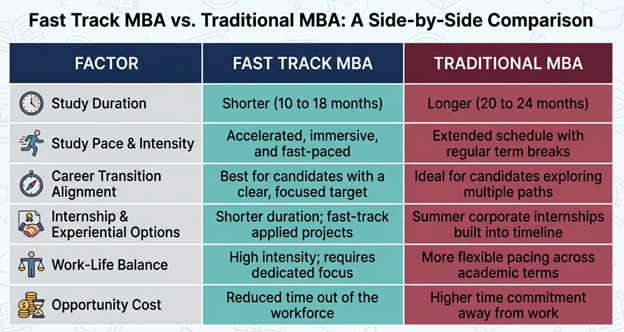
Fast Track MBA vs. Traditional MBA for Career Switchers
Common Mistakes to Avoid When Switching Careers With an MBA
A well-regarded degree requires a targeted execution strategy to deliver optimal results. Avoid these common pitfalls during an MBA career change:
- Enrolling Without a Clear Goal: Pursuing an MBA simply to leave a current job without identifying a target role leads to unfocused course choices and missed networking opportunities.
- Neglecting Practical Application: Academic theory must be backed by real-world application. Participate in case studies, industry projects, or consulting practicums to demonstrate capability to recruiters.
- Expecting Unrealistic Immediate Positions: Industry switchers may sometimes need to pivot laterally or enter at mid-level management positions before climbing to senior executive roles.
- Underestimating Professional Networking: Job openings are frequently filled through professional connections. Connect proactively with alumni, industry guest speakers, and corporate recruiters throughout your studies.
Is a Fast Track MBA Worth It for Career Switchers?
A fast track MBA career switch provides exceptional value when paired with a clear career vision, rigorous specialization training, and active professional networking. By merging your past professional background with advanced business training, an accelerated MBA can accelerate your transition into a new industry.
Evaluate program accreditations, course modules, alumni career outcomes, and career center resources to select the right academic institution for your future ambitions.
Frequently Asked Questions
1. Can I change industries with a fast track MBA?
Yes, an accelerated MBA equips you with essential business management credentials and strategic leadership skills that apply across multiple industries. Combining your prior work background with new business competencies allows you to position yourself effectively for new sectors.
2. How long does an accelerated MBA take?
Most accelerated MBA programs take between 10 and 18 months to complete, depending on the academic calendar and course format. Always confirm specific degree completion schedules and course requirements directly with university admissions offices.
3. Which MBA specialization is best for a career change?
The ideal specialization depends on your target role. Specializing in finance suits corporate strategy and financial planning, marketing supports brand management and growth roles, while business analytics fits data-focused decision-making positions.
4. Do employers value an accelerated MBA?
Employers highly value accelerated MBAs from accredited, reputable universities. Hiring managers focus on your combined professional experience, leadership capabilities, practical problem-solving skills, and cultural fit for the target position.
5. Can I pursue an accelerated MBA without management experience?
Many accelerated MBA programs welcome candidates without formal executive titles, provided they demonstrate leadership potential, professional growth, project management achievements, and strong academic credentials during the application process.