
Choosing the right higher education institution in Germany is one of the most pivotal decisions for international students planning to study abroad. A comprehensive public vs private universities in Germany comparison helps you evaluate tuition costs, academic standards, admission pathways, and graduate outcomes before submitting applications.
This GL Campus guide breaks down the seven primary differences so you can select the right path with confidence.
1. Tuition Fees and Overall Study Costs
The financial investment required represents one of the starkest points of distinction when evaluating public vs private universities Germany.
Public University Tuition Fees
Most public universities in Germany charge no general tuition fees for undergraduate or consecutive master’s programs. Higher education in Germany is heavily subsidized by the government for both domestic and international students.
- Semester Contributions: Students pay a mandatory fee ranging between €150 and €450 per semester covering administrative costs and regional public transit passes.
- State Exceptions: The state of Baden-Württemberg charges non-EU students a tuition fee of €1,500 per semester. Other states occasionally impose specialized fees for non-consecutive or executive programs.
- Living Expenses: Students must budget for cost-of-living necessities including housing, health insurance, food, and study supplies.
Private University Tuition Fees
Private higher education institutions operate independently of state funding and rely on student tuition fees to maintain operations and facilities.
- Annual Costs: Tuition typically ranges from €5,000 to over €20,000 per year depending on the institution, study discipline, and degree level.
- Payment Schedules: Institutions frequently offer flexible payment structures including monthly installments, semesterly billing, or deferred income-share agreements.
- Financial Aid: Many private academies supply institutional scholarships, merit-based grants, and corporate funding partnerships to ease financial strain.
2. Admission Requirements and Acceptance Chances
Understanding admission criteria is vital when comparing public vs private universities Germany, as entry hurdles vary considerably across institutional types.
Admission at Public Universities
Public universities maintain strict entry criteria rooted in academic merit and formal credential evaluation.
- Higher Education Entrance Qualification (HZB): Your foreign school-leaving certificate must be recognized as equivalent to the German Abitur. If not equivalent, completion of a Studienkolleg preparatory course is compulsory.
- Grade Cut-Offs (Numerus Clausus – NC): Popular degree courses enforce strict GPA thresholds based on applicant competition and seat capacity.
- Language Proficiency: Proof of advanced German proficiency (such as TestDaF or DSH) is standard for most bachelor’s programs, while English proficiency tests (IELTS or TOEFL) apply to English-taught tracks.
Admission at Private Universities
Private institutions frequently employ holistic admissions frameworks alongside flexible entry options.
- Flexible Qualification Pathways: Some private universities provide internal foundation pathways or direct assessments if traditional secondary qualifications fall slightly short.
- Personalized Assessment: Selection procedures heavily weigh personal motivation letters, portfolio submissions, and practical interview performance alongside high school grades.
- Language Flexibility: Many private programs operate entirely in English and may offer pre-sessional language training integrated directly into the study plan.
3. Teaching Style and Classroom Experience
The educational structure and day-to-day lecture environment directly shape how effectively you master course content.
Learning at Public Universities
Public institutions emphasize theoretical rigor, foundational knowledge, and scholarly research methodologies.
- Large Cohorts: Introductory lectures in popular disciplines can host hundreds of students in central lecture halls.
- Independent Study Culture: Students are expected to manage their schedules, exam preparation, research projects, and literature reviews independently.
- Academic Focus: Coursework focuses heavily on fundamental theories, methodological research, and empirical study design.
Learning at Private Universities
Private universities generally feature smaller class environments centered on applied learning and active participation.
- Small Class Sizes: Classes typically operate with smaller student groups, fostering direct interaction with professors and instructors.
- Applied Project Work: Curriculum structures frequently emphasize case studies, group problem-solving, and practical industry scenarios.
- Guided Student Support: Faculty and administrative advisors maintain regular office hours to provide dedicated academic coaching and project feedback.
4. Course Options and Specializations
Determining whether to choose a public or private institution depends heavily on the specific subject area you wish to pursue.
Programs at Public Universities
Public universities offer an expansive collection of academic disciplines across basic research and specialized fields.
- Comprehensive Disciplines: Strong representation across engineering, natural sciences, medicine, law, humanities, and social sciences.
- Research Leadership: Strong access to university research laboratories, research grants, and doctoral advancement tracks.
- Interdisciplinary Options: Wide selection of combined degrees and cross-departmental electives.
Programs at Private Universities
Private institutions typically focus their program catalog on career-focused sectors and market-driven academic tracks.
- Business and Management: Specializations in international business, finance, luxury management, and marketing.
- Technology and Design: Programs in computer science, digital media design, UX/UI, and data analytics.
- Entrepreneurship: Focused curricula designed for start-up founders, corporate innovation, and project management.
5. English-Taught Programs and International Student Support
Language barriers and international onboarding services significantly impact the overall international student experience.
Studying in English at Public Universities
- Master’s Availability: Public universities offer hundreds of English-taught master’s degrees, particularly in STEM and business fields.
- Bachelor’s Limitations: English-taught undergraduate degrees at public universities remain relatively limited compared to German-taught options.
- Self-Directed Onboarding: While international offices exist, students handle external administrative tasks like visa extensions and housing searches independently.
International Support at Private Universities
- Wide English Selection: Private universities offer a higher proportion of English-taught bachelor’s and master’s programs tailored for non-German speakers.
- Dedicated Onboarding Support: Staff often assist international students directly with visa processing, health insurance enrollment, and local city registration.
- Integrated Language Classes: Concurrent German language instruction is frequently included within the degree program to aid daily life and job integration.
6. Internships, Career Opportunities and Employer Connections
Graduate employability depends on practical experience, networking channels, and overall skill preparation.
Career Opportunities After Public University
- Respected Academic Reputation: Public university degrees enjoy prestige among traditional industrial firms, research institutes, and global corporations.
- University Career Fairs: On-campus career expos, alumni networks, and industry partnerships provide direct corporate outreach options.
- Self-Driven Career Building: Students proactively secure summer internships, working student (Werkstudent) jobs, and industry thesis topics.
Career Opportunities After Private University
- Corporate Network Integration: Private institutions maintain direct ties with partner companies, guest lecturers, and corporate sponsors.
- Embedded Internships: Mandatory internship semesters and applied project work are built directly into the graduation timeline.
- Targeted Career Services: Individualized career coaching, CV workshops, and mock interviews help streamline the job application process.
Key takeaway: German employers evaluate candidate qualifications, relevant practical experience, software proficiency, and language skills rather than institutional ownership status.
7. Degree Recognition and Return on Investment
Verifying official state accreditation guarantees that your academic credentials remain valid globally.
Recognition of Public University Degrees
Degrees awarded by state public universities carry automatic state recognition (Staatliche Anerkennung) and full international equivalency.
- Global Standards: Public degrees seamlessly align with the European Credit Transfer and Accumulation System (ECTS).
- Clear Academic Progression: Graduates qualify for advanced post-graduate study and doctoral research worldwide.
Recognition of Private University Degrees
- Accreditation Verification: Ensure the private institution is officially recognized by the state and that the specific degree program carries accreditation from recognized agencies such as FIBAA or Aquas.
- Database Checks: Verify institutional legitimacy using the official German Anabin database or the Higher Education Compass.
- Financial Value Consideration: Balance total tuition expenses against prospective post-graduation earning potential in your chosen field.
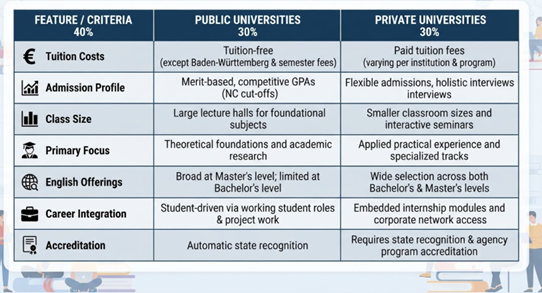
Public vs Private Universities Germany Comparison Table
How to Choose the Right University in Germany
Choosing between educational paths depends on individual academic credentials, professional goals, and financial resources.
Choose a Public University If:
- Minimizing total educational expenses is your primary goal.
- You meet standard German higher education entry qualifications (HZB) and language requirements.
- You prefer research-focused academic training and autonomous learning environments.
Consider a Private University If:
- You seek specialized study paths taught entirely in English at the undergraduate level.
- You prefer smaller study cohorts, structured guidance, and direct project mentorship.
- The investment fits your personal budget and the program holds verified state accreditation.
Essential Pre-Application Questions:
- Is the institution state-recognized and is the specific degree program accredited?
- What are the total estimated tuition fees, administrative costs, and local living expenses?
- Do I meet all academic prerequisites and required language proficiency scores?
- Does the curriculum include mandatory internships or practical industry projects?
- What administrative support services are available to assist incoming international students?
Conclusion
Conducting a thorough public vs private universities Germany evaluation clarifies the individual advantages of both institutional models. Public universities deliver lower study costs and deep academic research infrastructure. Conversely, private universities provide flexible entry pathways, specialized programs, and smaller learning environments.
Align your choice with your personal career ambitions, verify program accreditation, and plan your financial budget carefully before applying. A well-researched decision sets a solid foundation for your educational journey in Germany.
Frequently Asked Questions
1. Are public universities better than private universities in Germany?
Neither option is universally superior. Public universities offer broad academic selections and minimal tuition fees, while private institutions provide smaller class settings, targeted specializations, and tailored student services. The ideal selection depends on your budget, learning preferences, and degree goals.
2. Are private universities in Germany recognized internationally?
Yes, provided the institution holds official state recognition (Staatlich anerkannt) and its programs carry accreditation from recognized quality assurance bodies. Prospective international students should confirm institutional status through official portals like Anabin before applying.
3. Is studying at a public university in Germany completely free?
While public universities do not charge general tuition fees for most programs, education is not entirely free. Students pay a mandatory semester contribution covering administrative costs and public transport. Additionally, students must cover their personal accommodation, health insurance, and monthly living costs.
4. Can international students study in English in Germany?
Yes, international students can complete English-taught degrees at both public and private universities. English-taught programs are particularly common at the master’s level in public universities, while private academies offer numerous English-taught bachelor’s and master’s tracks.
5. Which universities are better for jobs in Germany?
German employers evaluate job applicants based on individual qualifications, practical work experience, technical skills, and language capabilities rather than institution ownership. Both public and private university graduates enjoy equal access to career opportunities across the German job market.