
Choosing a university abroad based only on its position in a global league table can be misleading. UK vs Australia university rankings can look very different when students compare specific courses, career outcomes, costs, research strengths, and student experience. For international students, the university with the highest overall position may not necessarily be the best fit for their chosen subject or career plans.
This GL Campus guide explains what students should compare beyond the headline ranking.
UK vs Australia University Rankings: Understanding Ranking Methodologies
Understanding how rankings are calculated prevents misinterpreting league table scores.

Global Rankings
Global ranking methodologies weigh institutional factors differently. Systems emphasizing heavy research volume and citation metrics favor old, large universities. Other systems focusing on class size and internationalization favor flexible, modern campuses.
Subject Rankings
Subject rankings provide actionable data for students targeting specific degrees. Evaluating a university subject score in computer science, business, or engineering offers a clearer picture of department quality than looking at general institutional metrics.
University Ranking Comparison
Conducting a comprehensive university ranking comparison involves checking multiple league tables side by side. Cross referencing metrics prevents relying on isolated methodology biases.
UK University Rankings: What International Students Should Examine
When evaluating UK university rankings, international students should look beyond traditional academic prestige.
Course and Department Reputation
Examine the exact school delivering the curriculum. A university overall rank may reflect medical research strengths, while its business or humanities department operates independently with different faculty credentials.
Research Strength
Research power is critical for postgraduate candidates. Institutions with extensive research networks provide stronger laboratory infrastructure, higher grant funding, and greater access to pioneering academic supervisors.
Employer Connections
Strong corporate ties translate directly to work placements. Top UK institutions maintain structured career hubs, professional mentoring networks, and on campus recruitment drives.
Australia University Rankings: What Students Should Look For
Analyzing Australia university rankings requires understanding how Australian institutions structure their degrees and industry exposure.
Course Structure
Australian programs frequently offer flexible degree structures, allowing students to combine majors, take cross disciplinary electives, and engage in practical, project based learning modules.
Industry Exposure
Australian universities integrate hands on learning directly into the curriculum. Look for courses offering credit bearing work placements, industry capstone projects, and direct corporate sponsorship.
International Student Support
Australia offers robust international student support systems. Evaluate orientation programs, English language support, academic skills advisors, on campus health services, and housing assistance.
Why UK vs Australia University Rankings Can Be Misleading
Overall university rankings should be treated as one research tool rather than the sole decision making factor. League tables combine diverse performance indicators into a single score, which often hides significant strengths or weaknesses in specific departments.
Rankings typically aggregate data across multiple criteria:
- Academic reputation derived from peer surveys
- Research output, performance, and impact
- Employer reputation and graduate hiring feedback
- International outlook, including foreign faculty and student ratios
- Citation counts per faculty member
Different ranking frameworks weight these indicators uniquely. Consequently, the exact same university can occupy dramatically different positions across global assessment tables.
What Should Students Compare Beyond Rankings?
Evaluating higher education options requires a broader decision framework focused on individual academic and professional priorities.
Course Quality
Subject specific quality matters far more than an institution overall rank. A university with a modest global position might house a world class facility, exceptional teaching staff, industry standard laboratories, or exclusive corporate partnerships for a specific major.
Career Outcomes
Targeted career preparation outweighs prestige. Focus on graduate employment metrics, active employer recruitment networks, integrated internship placements, and post graduation alumni performance.
Student Experience
University life extends past the lecture hall. Important considerations include international student support services, campus environments, housing access, student societies, and academic tutoring availability.
7 Factors More Important Than Overall University Rank
1. Subject Ranking
Subject specific rankings reflect the actual resources, teaching quality, and faculty expertise you will interact with daily.
2. Graduate Employability
Graduate employment statistics and direct employer recruitment ties indicate how well a degree prepares you for entering the global workforce.
3. Tuition Fees
Assess the complete tuition investment over the entire degree duration rather than comparing single year cost estimates.
4. Living Costs
Factoring in regional living expenses, including rent, food, local transport, health cover, and daily necessities, prevents unexpected financial stress.
5. Course Duration
Program length directly impacts overall expenditure and time to entry into the workforce. Shorter degrees reduce total living costs and opportunity costs.
6. Location
Geographic location dictates access to local industry hubs, lifestyle preferences, climate fit, transportation ease, and living costs.
7. Post Study Career Opportunities
Investigate post graduation work frameworks, regional job market demand, and industry growth rates in your target sector.
UK vs Australia University Rankings for Different Student Goals
Best Approach for Career Focused Students
Prioritize graduate employability scores, co-op placement availability, industry accreditation, and active corporate recruitment on campus.
Best Approach for Research Students
Prioritize research citation counts, supervisor publication history, laboratory facilities, and doctoral funding availability.
Best Approach for Budget Conscious Students
Calculate total tuition cost across all study years alongside local living expenses, scholarship availability, and program duration.
Best Approach for International Students
Look for high international student satisfaction scores, robust orientation support, multicultural city locations, and accessible student services.
UK vs Australia University Comparison Table
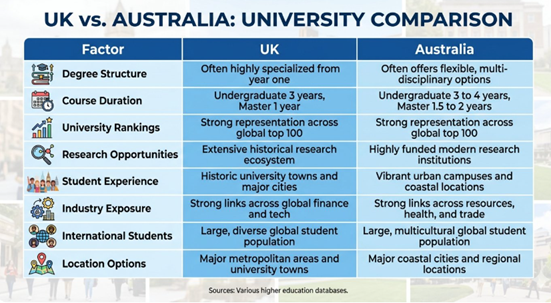
Note: Actual fees, program structures, and career outcomes vary depending on the individual university and course brief.
How to Use UK vs Australia University Rankings Correctly
Step 1: Shortlist Universities
Select an initial list of 8 to 10 institutions offering your target qualification.
Step 2: Check Subject Rankings
Filter your shortlist using subject specific rankings rather than overall global position.
Step 3: Research Course Content
Review exact course modules, elective freedom, assessment styles, and practical training opportunities.
Step 4: Compare Costs
Calculate total tuition fees plus estimated accommodation and living costs for the entire program duration.
Step 5: Investigate Career Outcomes
Review graduate employment rates, employer network strength, and career service track records.
Step 6: Consider Personal Fit
Factor in geographic location, city size, lifestyle fit, climate, and campus support infrastructure.
Common Mistakes When Comparing UK and Australian Universities
Choosing Only the Highest Ranked University
Selecting an institution based solely on prestige can lead to an environment, location, or course structure that does not align with your learning style.
Ignoring Subject Rankings
Ignoring subject league tables means missing specialized departments that lead their fields despite sitting in lower ranked parent universities.
Forgetting Total Cost
Failing to calculate living costs alongside tuition fees leads to inaccurate budget projections.
Overlooking Career Support
Disregarding career center active engagement can limit postgraduate networking and job search efficiency.
Comparing Rankings From Different Years
Comparing scores across different years or conflicting methodologies creates inaccurate comparisons.
Final Verdict on UK vs Australia University Rankings
League tables serve as an excellent starting point for building an initial shortlist, but UK vs Australia university rankings should never serve as the sole deciding factor. A comprehensive decision balances overall prestige with subject depth, total financial commitment, career support, location, and individual academic goals.
The ideal choice is the institution that offers the right blend of academic quality, financial feasibility, and career opportunity for your future pathway.
FAQs About UK vs Australia University Rankings
Are UK universities ranked higher than Australian universities?
Institutional ranks vary by ranking system, subject area, and evaluation year. Neither country holds a permanent advantage across all disciplines, making individual subject comparisons essential.
Are UK university rankings important for international students?
UK league tables help international students identify reputable institutions, but overall rank should always be weighed alongside course structure, total fees, and graduate career support.
Should students rely on Australia university rankings when choosing a university?
Australian rankings offer insight into institutional reputation, but candidates should also review module options, industry placement ties, living costs, and student support structures.
What is the most important factor in a university ranking comparison?
Subject specific ranking and graduate employability metrics generally offer far more practical value to students than overall institutional position.
Should I choose a university based on its overall ranking?
No, selecting a university based only on its overall position ignores critical factors like subject strength, tuition costs, location fit, and specific career services.