
Choosing among different BBA specializations can feel difficult when every business field offers a different career path. Marketing, finance, human resources, international business, analytics, entrepreneurship, and supply chain management can all lead to valuable professional opportunities.
This GL Campus guide explores the major BBA options and helps students identify the ideal major for their future.
7 Popular BBA Specializations Explained
The right choice depends less on which specialization sounds most popular and more on your personal interests, natural strengths, career goals, and the type of work you want to pursue after graduation.

1. BBA in Marketing
A BBA in Marketing focuses on how businesses identify customer needs, develop products, build brand equity, and execute promotional strategies across traditional and digital channels. Coursework covers consumer behavior, market research, digital marketing, brand management, advertising, and strategic sales.
Career Opportunities
- Marketing Executive
- Brand Specialist
- Digital Marketing Coordinator
- Content Strategy Specialist
- Market Research Analyst
This specialization is ideal for creative, communicative, and persuasive individuals who enjoy analyzing consumer trends, managing social platforms, and designing campaign strategies.
2. BBA in Finance
A BBA in Finance delves into financial management, corporate investment decisions, banking systems, financial accounting, risk assessment, and portfolio management. Students learn how capital is raised, allocated, and managed within businesses and global markets.
Career Opportunities
- Financial Analyst
- Investment Banking Associate
- Commercial Credit Analyst
- Corporate Risk Analyst
- Financial Planner
This major suits detail-oriented students who are comfortable working with numbers, financial modeling, balance sheets, and data-driven corporate decision-making.
3. BBA in Human Resources (HR)
A BBA in Human Resources concentrates on managing an organization’s most valuable asset: its people. The curriculum covers talent acquisition, workplace health and safety, employee development, labor relations, performance management, organizational behavior, and compensation structures.
Career Opportunities
- HR Generalist / Executive
- Talent Acquisition Specialist
- Learning & Development Coordinator
- Employee Relations Officer
- Compensation & Benefits Analyst
This field is well suited for empathetic, organized individuals with strong interpersonal skills who are passionate about organizational culture, workforce policy, and conflict resolution.
4. BBA in International Business
A BBA in International Business explores global commercial operations, cross-cultural management, international trade laws, foreign exchange markets, and global market expansion strategies. Students examine how multinational corporations navigate political, economic, and cultural environments.
Career Opportunities
- International Trade Specialist
- Import / Export Manager
- Global Operations Coordinator
- Foreign Market Analyst
- Business Development Executive
This option appeals to students interested in international travel, cross-cultural collaboration, global trade dynamics, and operating in multinational corporate environments.
5. BBA in Business Analytics
A BBA in Business Analytics bridges the gap between management and data technology. Students learn how to collect, interpret, visualize, and leverage big data to optimize business processes, solve strategic problems, and predict consumer trends using modern analytical software.
Career Opportunities
- Business Analyst
- Data Analyst
- Reporting & Insights Specialist
- Business Intelligence Consultant
- Operations Research Analyst
This rapidly growing major is perfect for problem-solvers who enjoy technology, statistics, data visualization tools, and evidence-based decision-making.
6. BBA in Entrepreneurship
A BBA in Entrepreneurship prepares students to launch, manage, and scale new business ventures. The curriculum focuses on business planning, startup funding, venture capital, innovation management, product development, and risk mitigation.
Career Opportunities
- Startup Founder / Co-Founder
- Business Development Manager
- Innovation Consultant
- Venture Capital Associate
- Intrapreneur (Corporate Innovation Specialist)
This specialization is tailored for self-motivated, adaptable individuals with strong risk tolerance, creative problem-solving skills, and a desire to build commercial ventures from the ground up.
7. BBA in Supply Chain and Operations
A BBA in Supply Chain and Operations Management focuses on the end-to-end flow of goods, services, and information from raw material suppliers to final consumers. Key focus areas include procurement, inventory control, logistics management, production planning, quality assurance, and distribution strategies.
Career Opportunities
- Logistics Coordinator
- Procurement Specialist
- Supply Chain Analyst
- Operations Manager
- Inventory Control Supervisor
This area suits organized, methodical thinkers who excel at process optimization, logistical planning, project coordination, and operational efficiency.
BBA Majors Comparison: Which One Fits You?
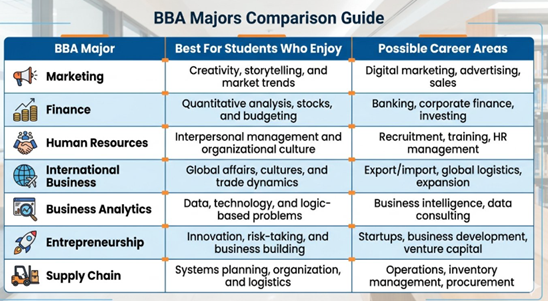
How BBA Specializations Affect Your Career Options
Selecting a major helps guide your initial entry into the job market, making it easier to qualify for targeted BBA career options straight out of university. However, a business major does not permanently lock you into a single industry.
Can You Change Careers After a BBA?
Yes. A BBA imparts foundational skill sets—such as business communication, project organization, critical thinking, and financial literacy—that are highly transferable across departments. It is common for professionals to start in marketing or sales and transition into general management, consulting, or operations over time.
Can You Pursue an MBA After Any BBA Major?
Virtually all Master of Business Administration (MBA) programs accept applicants regardless of their undergraduate business major. Admissions committees value relevant work experience, leadership potential, academic records, and strategic vision far more than your specific undergraduate specialization.
Which Is the Best BBA Specialization?
There is no universally best BBA specialization. The most rewarding major depends on aligning course content with your personal strengths and professional aspirations.
Choose Marketing If You Enjoy:
Building brand awareness, running promotional campaigns, analyzing audience behavior, and working in dynamic, creative team settings.
Choose Finance If You Enjoy:
Financial modeling, evaluating market trends, managing budgets, and assessing economic risks.
Choose HR If You Enjoy:
Fostering positive workplace environments, mentoring employees, optimizing organizational structures, and managing talent acquisition.
Choose Analytics If You Enjoy:
Working with data sets, discovering hidden operational patterns, leveraging statistical tools, and solving structural business problems.
Choose International Business If You Enjoy:
Exploring foreign business landscapes, understanding international economics, and managing cross-border commercial operations.
Skills to Build Alongside Your BBA Specialization
An academic specialization provides critical foundational knowledge, but practical skills are necessary to maximize employability.
To stand out to recruiters, aim to develop:
- Communication & Presentation: Master the ability to present business proposals clearly and persuasively.
- Data & Excel Literacy: Build strong proficiency in Microsoft Excel, data visualization software, and reporting tools.
- Problem-Solving & Critical Thinking: Demonstrate how you analyze complex business challenges and propose actionable solutions.
- Practical Experience: Secure internships, complete industry-recognized certifications, participate in case competitions, and build an active professional network.
Common Mistakes When Choosing BBA Specializations
Choosing Based Only on Salary
Salaries vary widely based on geographic location, company size, individual performance, and industry demand. Choosing a major strictly for starting pay can lead to dissatisfaction if the daily work does not align with your interests.
Following Friends
Enrolling in a major simply because your peers are choosing it ignores your unique skillset and long-term career aspirations.
Ignoring Personal Strengths
Pursuing a quantitative field like finance or analytics when you strongly prefer qualitative, creative work can create unnecessary academic strain.
Choosing Without Researching Careers
Selecting a major based on a vague idea of a job title rather than actual daily responsibilities often leads to unrealistic expectations. Always review entry-level job postings before making your final decision.
Final Verdict on BBA Specializations
Choosing between different BBA specializations comes down to matching your education with your personal interests and long-term career direction. Creative communicators often excel in marketing, analytical thinkers flourish in finance or business analytics, people-oriented leaders thrive in human resources, and strategy enthusiasts excel in international business, operations, or entrepreneurship.
Evaluating your strengths, researching real-world job responsibilities, and considering your ultimate career vision will lead you to the BBA major that best lays the groundwork for your future success.
FAQs About BBA Specializations
Which BBA specialization is best for future careers?
There is no single best BBA specialization for everyone. High-demand fields like business analytics, finance, marketing, and supply chain management all offer strong career trajectories. Select a major that aligns with your specific skills and interest area.
Which BBA major is best for students interested in finance?
A BBA in Finance is the ideal path for careers in corporate banking, financial planning, investment analysis, risk management, and wealth advisory services.
Can I change my career after choosing a BBA specialization?
Yes. A BBA equips graduates with broad, transferable business skills. While your major influences your initial entry-level job search, future certifications, career achievements, and professional networking make changing functional areas straightforward.
Are BBA specializations important for MBA admission?
MBA programs welcome applicants from all BBA majors—as well as non-business academic backgrounds. Admissions boards focus primarily on professional achievements, leadership record, academic performance, and career clarity.
How should I choose between different BBA majors?
Identify the tasks and work environments you enjoy, evaluate your numerical and communication strengths, research entry-level job descriptions, compare subject syllabi, and select the major that best supports your target career path.