
Understanding the OTHM Level 7 assignment vs dissertation difference is important before starting postgraduate level study. Although both require academic research and critical thinking, their structure, purpose, and assessment expectations can be very different.
For students progressing through an OTHM Level 7 qualification, this GL Campus guide helps in knowing what each format involves can make academic planning easier and reduce uncertainty about research based work.
7 Key Differences in OTHM Level 7 Assignment vs Dissertation
1. Purpose of the Assessment
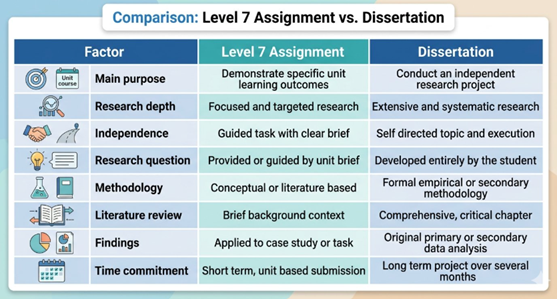
Assignments generally assess whether students can meet specific unit learning outcomes provided by the course specification. A dissertation focuses more heavily on original independent investigation, demonstrating a student capacity to design, manage, and execute an extensive research project from start to finish.
2. Research Depth
Research depth forms a primary distinction between the two assessment types. Level 7 assignments require research to support arguments, validate points, and critique theories. Dissertation work demands a much deeper, highly structured research methodology that includes:
- Comprehensive literature review identifying clear research gaps
- Explicitly formulated research questions or hypotheses
- Detailed qualitative or quantitative evidence analysis
- Original empirical findings grounded in data collection
- Critical discussion and actionable managerial recommendations
3. Level of Independence
Assignments provide clear instructions, set structures, and explicit prompts. Dissertation students must exercise total autonomy in choosing their topic, deciding their theoretical framework, selecting research instruments, and managing their project timelines.
4. Structure and Length
Typical assignments range between 2000 and 4500 words per unit, whereas a Level 7 dissertation or consultative project usually ranges between 10000 and 15000 words.
Standard Assignment Structure
- Introduction
- Main discussion
- Critical analysis and application
- Conclusion
- References
Standard Dissertation Structure
- Introduction and research background
- Literature review
- Research methodology
- Data analysis and findings
- Discussion of results
- Conclusion and recommendations
- References and appendices
5. Assessment Criteria
OTHM assessment for coursework units focuses heavily on learning outcomes, critical evaluation, theoretical application, academic sourcing, and structured formatting. Dissertation evaluation places greater weight on research design rigor, methodological justification, sample validity, analytical depth, research ethics, and contribution to practice or theory.
6. Time Commitment
Assignments are typically completed over a few weeks according to module delivery schedules. Dissertation projects require sustained long term planning, often extending over several months to allow time for proposal drafting, ethics approval, data collection, analysis, and extensive editing.
7. Research Skills Required
While both formats require academic research, dissertation work demands advanced postgraduate research skills. Students must master research paradigms, quantitative or qualitative data tools, thematic analysis, sampling techniques, and ethical research protocols.
Level 7 Assignments: What Should Students Expect?
Completing Level 7 assignments involves meeting high academic standards set by professional bodies and awarding organizations.
Critical Thinking
Students must move beyond simple descriptions and demonstrate evaluation, comparison, and critical discussion. Rather than explaining what a theory is, assignments require analyzing why it works, where it fails, and how it applies under different market conditions.
Evidence Based Arguments
Every claim made within an assignment must be backed by credible academic literature, peer reviewed journals, industry reports, or verified corporate data. Personal opinions without empirical backing carry little weight at Level 7.
Application to Real Situations
Assignments regularly demand that theoretical concepts be applied to contemporary business environments or specific case study organizations, illustrating practical management competence.
OTHM Assessment: What Do Tutors Usually Look For?
Understanding evaluator expectations helps students align their work with top grading criteria.
Knowledge and Understanding
Demonstrating a deep, accurate grasp of advanced subject matter without relying on superficial summaries or outdated sources.
Critical Analysis
Moving past narrative descriptions of concepts to evaluate competing perspectives, assess theoretical limitations, and synthesize multiple viewpoints.
Academic Evidence
Utilizing up to date peer reviewed journals, textbook literature, and professional standards formatted strictly according to Harvard referencing conventions.
Structure and Presentation
Maintaining logical layout, clear heading structures, professional academic register, precise vocabulary, and well rounded conclusions.
Dissertation Work and Postgraduate Research Skills
Executing a dissertation allows learners to develop and showcase crucial postgraduate research skills that enhance executive credibility.
Choosing a Research Topic
Selecting a focused, relevant, and manageable topic connected directly to academic interests or professional career pathways.
Developing Research Questions
Formulating narrow, researchable questions that guide the direction of data collection rather than attempting to resolve overly broad industry problems.
Reviewing Existing Research
Synthesizing published literature to establish context, identify gaps, build theoretical models, and justify the necessity of the current study.
Analyzing Evidence
Applying structured analytical frameworks, such as thematic analysis for qualitative interviews or statistical measures for quantitative surveys, to draw valid conclusions.
OTHM Level 7 Assignment vs Dissertation: Comparison Table
How to Approach a Level 7 Assignment Successfully
Start With the Assessment Criteria
Carefully review the unit descriptor, learning outcomes, and grading grids before starting research. Align your planned sections directly with what the markers evaluate.
Build a Clear Structure
Organize your response using logical headings and subheadings that map directly to the assignment task requirements, ensuring a natural narrative flow.
Use Relevant Academic Sources
Rely on high quality academic journals, foundational textbooks, and industry publications. Avoid informal websites, blogs, or unverified online summaries.
Prioritize Critical Analysis
Allocate majority word count to evaluating theories, comparing alternatives, and analyzing real world impact rather than defining basic concepts.
How to Prepare for a Level 7 Dissertation
Select a Focused Topic
Refine broad ideas into a highly targeted topic. A narrow, well defined study yields far deeper analytical quality than a broad, shallow review.
Create a Research Plan
Develop a detailed project timetable with milestones for literature drafting, methodology design, data gathering, analysis, and final proofreading.
Maintain Consistent Referencing
Keep detailed logs of every source, citation, and data reference from day one using reference management tools to prevent formatting errors later.
Common Mistakes Students Make
Describing Instead of Analyzing
Summarizing models or describing company histories instead of evaluating theoretical validity and strategic impact.
Using Weak Sources
Citing non academic sources or outdated textbooks instead of current peer reviewed journal articles and verified industry data.
Ignoring Assessment Criteria
Failing to cross check the completed draft against the explicit learning outcomes provided in the official assessment brief.
Starting Research Too Late
Underestimating the time needed for literature synthesis, survey distribution, interview transcription, or data coding.
Final Verdict on OTHM Level 7 Assignment vs Dissertation
An assignment generally provides a structured opportunity to demonstrate advanced knowledge, analysis, and application of concepts within a defined scope. A dissertation requires far greater independence and deeper research, with students taking full responsibility for developing, executing, and evaluating a focused research project.
Understanding the OTHM Level 7 assignment vs dissertation distinction helps students plan their workload, cultivate essential postgraduate research skills, and approach their assessments with confidence and clarity.
FAQs About OTHM Level 7 Assignment vs Dissertation
What is the main difference between an OTHM Level 7 assignment and a dissertation?
A Level 7 assignment generally responds to a defined assessment task and specific unit learning outcomes. A dissertation involves a larger, independent research project requiring a student formulated research question, structured methodology, data analysis, and original findings.
Are Level 7 assignments difficult?
Level 7 assignments are demanding because they require high level critical analysis, evaluation, evidence based arguments, and professional presentation. Success depends on moving beyond simple description to critique concepts and apply theoretical solutions to complex real world scenarios.
Does an OTHM Level 7 dissertation require research methodology?
Yes, if a qualification includes a dissertation or research project unit, a formal methodology section is essential. This chapter details how data was collected, selected, sampled, analyzed, and ethically managed.
What postgraduate research skills are needed for Level 7 study?
Essential skills include systematic literature searching, critical analysis, methodological selection, data coding or statistical analysis, academic writing, source synthesis, and research project management.
Which is harder, a Level 7 assignment or dissertation?
Neither is inherently harder, as difficulty depends on individual student strengths. However, a dissertation requires greater self discipline, long term time management, advanced research skills, and the capability to work independently without rigid assignment prompts.