Completing higher education in the USA opens doors to higher potential earnings and long term career security. For students holding a Higher National Diploma or equivalent qualification, meeting top up degree eligibility standards provides a direct pathway to upgrade an existing qualification into a full bachelor degree in just one year. Navigating entry guidelines can feel overwhelming when academic requirements vary between institutions.
This GL Campus guide breaks down essential academic standards, credit transfers, and documentation steps needed to qualify with confidence.
What Is Top Up Degree Eligibility and How Does It Work?
Understanding top up degree eligibility starts with recognizing how accelerated university pathways evaluate prior learning credentials. A top up program corresponds to the final year of an undergraduate degree, granting full graduate status upon successful completion.

Defining the Degree Completion Pathway
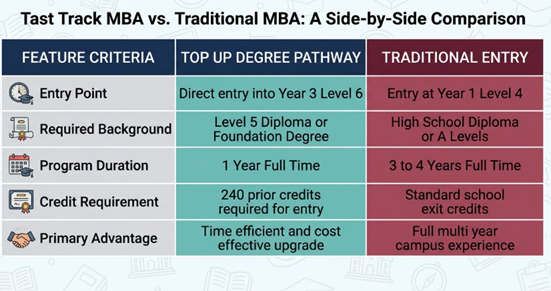
Top up programs allow students with existing higher education diplomas to enter directly into Year 3 of a university track. Instead of repeating foundational subjects, coursework focuses entirely on advanced modules, practical projects, and a final dissertation.
- Core Qualifications Required for Admission
Universities require applicants to hold a relevant Level 5 qualification. Standard accepted qualifications include:
- Higher National Diploma qualifications from recognized awarding bodies
- Foundation Degrees in a matching discipline
- Advanced Diplomas or Associate Degrees with equivalent academic credits
- Partial university credits equal to two full years of undergraduate study
2. Academic Credit Requirements and ECTS Transfer Verification
Academic credits form the structural foundation of top up degree eligibility assessments across international university systems.
Understanding Credit Accumulation
To qualify for final year entry, applicants must demonstrate completion of sufficient academic credits at Level 4 and Level 5. Most European and UK institutions require applicants to hold 240 academic credits or equivalent ECTS points.
Subject Alignment and Course Mapping Guidelines
Universities match previous course modules with the intended degree curriculum. Applicants must prove that their completed diploma covers sufficient foundational topics to handle advanced Year 3 modules without academic gaps.
Evaluating Transcript Credit Equivalencies
Admissions departments evaluate module contents to ensure that international diplomas mirror domestic study weights. Transcript evaluations confirm that completed laboratory hours, seminar credits, and lecture units align with the institution’s criteria.
3. English Language Proficiency Criteria and Waiver Guidelines
International applicants must satisfy language competency requirements to ensure full top up degree eligibility.
Standardized Language Tests
Applicants from non English speaking backgrounds must present valid proficiency scores. Commonly accepted examinations include:
- IELTS Academic overall score of 6.0 or higher
- TOEFL iBT overall score meeting institutional standards
- Pearson Test of English meeting baseline university thresholds
Alternative Language Waivers
Some institutions grant language waivers if your prior Level 5 qualification was taught and assessed entirely in English. Official documentation from your previous institution is required to confirm medium of instruction status.
Conditional Language Pathway Programs
If your standardized language test scores fall slightly below the cutoff, universities may offer conditional admission tied to pre-sessional English courses designed to bring your writing and speaking skills up to academic standards.
4. Professional Work Experience and Prior Learning Assessments
Workplace experience can reinforce your overall applicant profile when applying for professional degree tracks.
Recognition of Prior Experiential Learning
Certain universities evaluate relevant industry experience alongside formal diplomas. Applicants with significant technical experience may qualify if their portfolio proves mastery of fundamental concepts.
Supporting Professional Documentation
Candidates submitting work experience must provide detailed employment references, a professional resume, and work samples illustrating advanced technical or managerial skills.
Portfolio Submission and Technical Interviews
For technical fields like design, computer science, or engineering, universities may require a portfolio review or a technical interview to verify that practical skills match academic requirements.
5. Step by Step Application and Verification Process
Securing a study spot requires an organized submission of academic credentials and background verification documents.
Step 1: Gather Academic Transcripts
Obtain official transcripts detailing all completed course modules, individual unit grades, and overall credit distribution from your diploma program.
Step 2: Prepare Subject Syllabi
Include official module descriptions or syllabus outlines if your previous qualification was completed at an overseas or non partner institution.
Step 3: Write a Focused Personal Statement
Draft an academic statement outlining your professional motivations, previous study achievements, and reasons for selecting the specific top up pathway.
Step 4: Submit Institutional References
Provide academic or professional letters of recommendation attesting to your study discipline, academic performance, and readiness for final year honors work.
6. Financial Considerations, Tuition Requirements, and Funding
Planning study finances ensures your candidate status remains secure throughout the academic year.
Tuition Fee Structures
Top up programs cover one academic year of full time study or two years of part time study. Tuition fees vary based on study mode, subject field, and residency status.
Financial Aid and Scholarship Access
Many universities extend institutional scholarships, alumni discounts, and flexible payment plans to top up students. Research funding options early to lower total educational costs.
Calculating Living Expenses and Additional Academic Costs
In addition to tuition, budget for textbook materials, specialized software licenses, campus student union contributions, and personal daily living costs throughout your final study year.
7. Career Growth Outcomes and Post Graduation Pathways
Completing your qualification opens up new career advancement opportunities and further academic study paths.
Expanding Graduate Employment Opportunities
A full bachelor degree validates your skills to global employers, helping you qualify for graduate training schemes, mid-level management positions, and competitive salary bands.
Progression to Master Degrees and Post Graduate Research
Graduating with a recognized honors degree satisfies entry criteria for master programs globally, allowing you to specialize further or transition into specialized research roles.
Top Up Degree vs Traditional Degree Pathway
Common Mistakes That Delay Admission
Avoiding standard application pitfalls speeds up offer decisions and prevents unnecessary processing delays:
- Submitting incomplete transcripts without full unit breakdowns
- Applying to unrelated disciplines that do not align with prior diploma coursework
- Overlooking English language proof until close to enrollment deadlines
- Applying to non accredited institutions whose qualifications lack national recognition
Universities require applicants to hold a relevant Level 5 qualification. Standard accepted qualifications include:
- Higher National Diploma qualifications from recognized awarding bodies
- Foundation Degrees in a matching discipline
- Advanced Diplomas or Associate Degrees with equivalent academic credits
- Partial university credits equal to two full years of undergraduate study
Is a Top Up Degree Right for You?
Meeting top up degree eligibility guidelines provides a practical method to earn a recognized bachelor degree. It is an ideal choice for diploma holders aiming to expand employment prospects, qualify for master programs, or accelerate career growth in minimum time.
Review program entry criteria, organize your academic transcripts, and submit your application early to secure your spot.
Frequently Asked Questions
1. What qualifications meet top up degree eligibility standards?
Most universities require a relevant Level 5 qualification, such as a Higher National Diploma, Foundation Degree, or Associate Degree. Applicants must hold equivalent academic credits matching the first two years of a standard undergraduate degree.
2. Can I apply for a top up degree in a completely different subject?
Generally no. Top up degrees build directly on prior foundational knowledge, so your Level 5 qualification must closely relate to the target degree subject to satisfy transfer requirements.
3. How long does it take to complete a top up degree?
A full time top up program takes one academic year to complete. Part time options are also available and typically span two academic years.
4. Is a top up degree equal to a standard bachelor degree?
Yes, a top up degree awards the exact same final bachelor degree certificate as a traditional multi year program. Graduates receive full academic recognition and qualify for post graduate master degrees.
5. What if my prior qualification has fewer credits than required?
If your prior qualification falls short of required academic credits, universities may ask you to take extra bridging modules or evaluate relevant work experience to make up the credit difference.