

Are you an ambitious professional standing at a vital career crossroads? Deciding between advancing your executive leadership or building unmatched academic credibility can feel overwhelming. Many experienced leaders reach a point where they must choose between stepping into C-suite roles, launching high-level consulting careers, or driving industry research.
When evaluating a DBA vs Executive MBA, both options cater to seasoned professionals, yet they serve distinctly different long-term ambitions. Understanding these variations ensures your educational investment aligns perfectly with your goals. In this GL Campus guide, a comprehensive comparison is provided of these two premier qualifications based on seven practical factors.
DBA vs Executive MBA: What Is the Difference?
While both programs cater to high-achieving professionals, their core focus and academic structures diverge significantly.
What Is a DBA?
A Doctor of Business Administration is a terminal professional doctorate centered on applied business research. It enables senior leaders to address complex, real-world organizational problems through evidence-based methodologies.
- Level: Doctoral degree
- Core Focus: Applied business research and strategic decision-making
- Key Outcome: Original contributions to management practice and thought leadership
What Is an Executive MBA?
An Executive MBA is an advanced master’s level management program crafted for working managers and business leaders.
- Level: Postgraduate master’s degree
- Core Focus: Advanced management education and cross-functional leadership development
- Key Outcome: Immediate practical management skills and high-level networking
In short, a Doctor of Business Administration dives deeper into research and framework creation, whereas an Executive MBA concentrates heavily on multi-functional management execution.
DBA vs Executive MBA: 7 Key Differences
Selecting the right program requires assessing your professional experience, schedule, and future aspirations.
1. Career Goals
Your ultimate trajectory plays a major role when choosing between a DBA vs Executive MBA.
- Choose a DBA for: Senior advisory roles, high-ticket business consulting, C-suite positioning, thought leadership, or adjunct academic teaching opportunities.
- Choose an Executive MBA for: Senior management promotions, general manager positions, corporate career progression, and expanding operational influence.
2. Research vs Practical Management
- DBA: Focuses heavily on applied research, advanced methodology, and generating fresh business frameworks. It suits leaders who enjoy analyzing data to solve systemic challenges.
- Executive MBA: Emphasizes operational execution across finance, marketing, strategy, and leadership. It is ideal for managers seeking immediate corporate impact.
3. Duration and Study Commitment
Program structures vary, but the time investment differs substantially:
- DBA: Typically takes 3 to 5 years part-time, ending in a practical dissertation.
- Executive MBA: Usually completed within 12 to 24 months through flexible or weekend classes.
Prospective students evaluating flexible doctoral routes can explore specialized curricula, such as the GL Campus DBA Program, to balance research with professional demands.
4. Admission Requirements and Professional Experience
Both paths target experienced candidates, but expectations differ:
- DBA Eligibility: Usually requires a master’s degree (such as an MBA) alongside 8 to 10+ years of significant management experience.
- Executive MBA Eligibility: Generally requires a bachelor’s degree with 5 to 8+ years of professional work history, including leadership exposure.
5. Career Opportunities
- DBA Pathways: Business Consultant, Executive Advisor, Strategy Director, Chief Research Officer, University Lecturer.
- Executive MBA Pathways: General Manager, VP of Operations, Business Development Director, Managing Director, Corporate Entrepreneur.
6. Cost and Return on Investment
Evaluation goes beyond tuition fees to include duration and opportunity cost:
- DBA: Involves higher overall investment and long-term commitment, but delivers lasting positioning power and higher advisory authority.
- Executive MBA: Offers faster completion times with immediate promotional return on investment within corporate hierarchies.
7. Recognition, Reputation, and Future Value
Evaluating institution accreditation, university standing, and global employer perception is essential. A doctorate commands top-tier authority in international markets, while a top-ranked business school master’s offers immediate executive recognition.
DBA vs Executive MBA: Which One Is Better for You?
Choose a DBA If You Want To:
- Develop deep, research-backed business expertise.
- Solve complex organizational problems systematically.
- Establish authority as an industry thought leader or consultant.
- Gain a terminal degree that opens doors to advisory and academic roles.
Choose an Executive MBA If You Want To:
- Accelerate your growth into senior management roles.
- Broaden your knowledge across strategic corporate functions.
- Expand your professional executive network rapidly.
- Gain practical leadership skills without a long-term research commitment.
DBA vs Executive MBA: Comparison Table
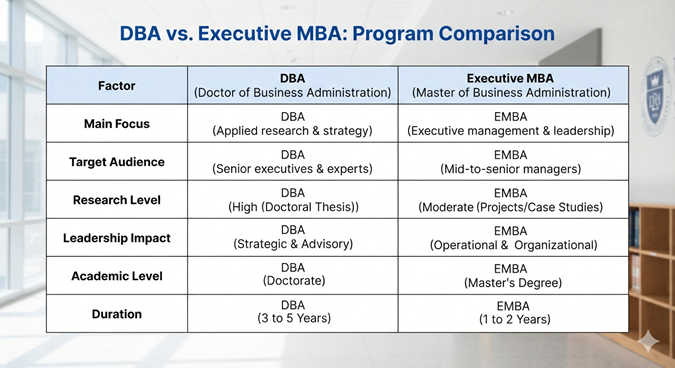
While the Executive MBA accelerates operational leadership, the DBA transforms executive experience into long-term strategic authority.
How to Choose the Right Qualification for Your Career
Ask yourself these five essential questions before enrolling:
- What is my current career level and academic foundation?
- Where do I see my career in five years?
- Do I prefer deep research or broad management execution?
- How many hours per week can I commit to study?
- Which qualification directly supports my long-term income and role aspirations?
Comparing curricula, total tuition, flexibility, and regional recognition will clarify your best path when deciding between a DBA vs Executive MBA.
Why Experienced Professionals Are Choosing Advanced Business Qualifications
Modern global markets, rapid digital transformation, and complex economic shifts demand continuous professional development. Executives can no longer rely solely on past achievements. Flexible and online study options now allow busy leaders to earn prestigious qualifications without stepping away from their current roles.
Final Verdict
Neither degree is universally superior; each serves a distinct professional vision. A Doctor of Business Administration offers deep research, specialized authority, and strategic distinction. An Executive MBA provides cross-functional mastery and fast-track leadership growth. Weighing a DBA vs Executive MBA comes down to whether you want to lead business decisions or shape the strategic frameworks behind them.
If you are still evaluating which path aligns with your background, review program structures, entry criteria, and flexible study models through GL Campus or speak with an education advisor today.
Frequently Asked Questions
1. Is a DBA better than an Executive MBA?
Neither degree is inherently better because they fulfill different career objectives. A DBA focuses on applied research, advanced strategic problem-solving, and theoretical application for senior advisors. An Executive MBA concentrates on practical leadership, cross-functional management, and rapid corporate advancement. Your choice depends on whether you seek research distinction or management growth.
2. Can an Executive MBA lead to a DBA?
Yes, an Executive MBA provides an ideal master’s-level foundation for entering a Doctor of Business Administration program. Many doctoral candidates complete an EMBA first to sharpen their broad management knowledge before undertaking advanced research. However, entry criteria vary, so candidates should confirm specific academic prerequisites with their target institution.
3. Is a DBA worth it for senior executives?
A DBA provides exceptional value for senior executives aiming to stand out in competitive global markets. It enhances strategic credibility, builds rigorous analytical capabilities, and qualifies leaders for high-value consulting, board seats, and adjunct faculty positions. It offers long-term differentiation beyond standard executive credentials.
4. Is an Executive MBA worth it for working professionals?
An Executive MBA is highly valuable for mid-to-senior professionals seeking upward mobility without pausing their careers. Flexible weekend or online schedules allow students to apply new strategic tools immediately in their current roles. It delivers strong networking opportunities and solid return on investment for ambitious managers.
5. Should I choose a DBA or Executive MBA?
You should base your decision on your primary professional goal. Choose a DBA if you want to conduct applied business research, solve systemic organizational issues, and achieve terminal academic distinction. Choose an Executive MBA if your immediate priority is mastering general management, expanding your network, and moving into C-suite roles.


