

For many international students, studying in Germany with financial support can feel like a life-changing opportunity. Learning how to get a DAAD scholarship in Germany starts with understanding the right program, eligibility criteria, documentation, selection standards, and the application process.
As one of the world’s largest funding organizations, the DAAD (Deutscher Akademischer Austauschdienst) offers tailored opportunities across degree levels. Because deadlines, prerequisites, and submission portals vary significantly by program, applicants must consult the official call before submitting their materials.
Understanding DAAD Scholarship Selection Criteria
Selection committees use holistic criteria to evaluate candidates:
- Academic Performance: Demonstrates subject-matter competence through past grades, academic awards, and steady educational development.
- Quality of the Study/Research Plan: Evaluates whether your research proposal or study roadmap is plausible, well-structured, and methodologically sound.
- Motivation and Career Potential: Assesses how effectively you articulate your goals and whether the qualification will advance your long-term career.
Personal and Extracurricular Development: Recognizes leadership skills, civic engagement, and social responsibility alongside academic record
How to Get a DAAD Scholarship in Germany in 7 Steps
Completing a successful application requires a structured approach. Follow this seven-step framework to navigate the process:
Step 1: Find the Right DAAD Scholarship Program
Begin by searching the official DAAD scholarship database rather than applying blindly. Use the portal filters to narrow options by:
- Academic Level: Master’s, Ph.D., or research stay
- Country of Origin: Eligibility can depend on your citizenship or current residence
- Subject Area: Engineering, Humanities, Social Sciences, STEM, or Arts
- Application Deadline: Timelines vary significantly across regional calls
Each funding option operates under a distinct announcement (the “call”), which serves as the authoritative source for eligibility and required documentation.
Step 2: Check the DAAD Scholarship Requirements
Before assembling your file, carefully review the DAAD scholarship requirements for your chosen path. Key criteria generally include:
- Academic Qualifications: A recognized bachelor’s degree (or equivalent) with strong academic standing.
- Language Proficiency: Proof of English (e.g., TOEFL/IELTS) or German (e.g., TestDaF/DSH) skills, tailored to the degree’s language of instruction.
- Professional Experience: Certain postgraduate schemes (such as the EPOS program) require a minimum of two years of relevant work experience.
While academic performance is critical, selection committees also evaluate motivation, research quality, extracurricular involvement, and potential societal impact.
Step 3: Choose Your German University and Program
You must establish a clear academic plan before submission. Research candidate universities based on course offerings, faculty expertise, language requirements, and enrollment processes. Note that some scholarship schemes require admission to a German university prior to applying, while others handle scholarship evaluation and academic placement simultaneously.
Step 4: Prepare Your Application Documents
Collate your materials early to ensure all specifications are met. Most programs require:
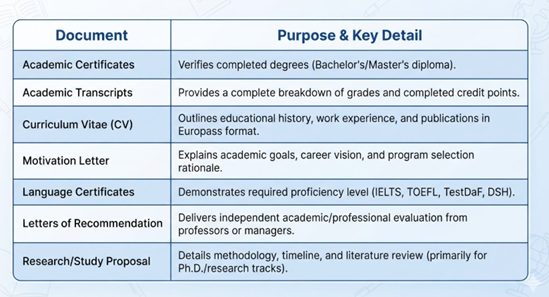
- Completed DAAD application form (generated via the online portal)
- Full Curriculum Vitae in Europass format
- Letter of Motivation detailing academic and career objectives
- Study or Research Proposal (essential for doctoral and advanced research schemes)
- Academic transcripts and graduation certificates
- Official language proficiency certificates
- Letters of recommendation from academic referees
Note: Documents not issued in English or German must be accompanied by certified translations.
Step 5: Write a Strong Motivation Letter
The motivation letter is a critical component of your application package. It should logically connect your academic history with your future career goals.
Address why Germany is your ideal destination, how the curriculum supports your personal development, and how you intend to apply your education professionally after graduation. Avoid generic phrasing; focus on specific academic and institutional alignment.
Step 6: Submit Through the Correct Application Route
Most submissions are processed digitally via the official DAAD Portal. Create an account, fill out the forms, upload all PDFs, and verify file readability before finalizing your application. Always submit ahead of the posted deadline to avoid potential server congestion.
Step 7: Prepare for the Selection Process
Once submitted, applications undergo administrative review before being evaluated by independent selection committees composed of university professors. For certain advanced research schemes, shortlisted candidates may be invited to an interview (conducted in-person or online).
DAAD Scholarship Documents Checklist
Use this reference table to track required documentation:
How to Build a Winning DAAD Scholarship Application
- Connect Past and Future: Clearly explain how your prior studies prepare you for the intended course, and how this qualification supports your future career steps.
- Focus on Academic Rationale: Frame your decision to study in Germany around specific research centers, unique course modules, or industry exposure rather than general lifestyle preferences.
- Formulate Concrete Objectives: Define clear milestones for your study period and explain how your training will address relevant academic or professional challenges.
- Review Thoroughly: Check all documents for correct spelling, consistent dates, clear formatting, and complete certified translations.
Can You Study in Germany for Free With a DAAD Scholarship?
A common objective for prospective international students is securing free study in Germany options. In Germany, most public universities charge no tuition fees for undergraduate and standard consecutive Master’s programs for both domestic and international students (though administrative semester fees ranging from €150 to €400 per term still apply).
However, public institutions in certain federal states (such as Baden-Württemberg) and non-consecutive or private degree programs do charge tuition fees. Scholarship candidates must confirm whether their target university charges tuition and verify if their specific DAAD funding scheme covers those extra costs.
What Financial Support Can a DAAD Scholarship Provide?
DAAD scholarships offer comprehensive financial support tailored to your academic level. They serve as a reliable source of German academic funding, with benefits typically including:
- Monthly Stipend: Standard monthly allowances designed to cover accommodation and daily living expenses (typically around €934 for Master’s students and €1,300 for Ph.D. candidates).
- Travel Allowance: Lump-sum grants to assist with round-trip international travel costs.
- Health and Accident Insurance: Coverage provided directly or subsidized through a dedicated group health insurance policy.
- Research and Study Subsidies: Annual allowances to help cover books, conference attendance, or academic materials.
Exact benefit packages are specified in each program’s official call.
Common Mistakes to Avoid When Applying for DAAD Funding
Avoid these frequent errors during the application process:
- Applying to an Incompatible Call: Submitting materials to a program that does not match your current degree level or geographic region.
- Missing Document Deadlines: Uploading files after the portal closes or omitting mandatory items, which leads to automatic disqualification.
- Submitting Generic Letters: Reusing standardized motivation essays that fail to address the specific university or program.
- Overlooking Language Prerequisites: Submitting language scores that fall below specified minimum score thresholds.
How to Get a DAAD Scholarship in Germany Without Last-Minute Stress
Before final submission on the portal, run through this pre-submission check:
- Selected the correct DAAD program call matching your background.
- Confirmed you satisfy every posted eligibility requirement.
- Assembled all required documents with certified translations where necessary.
- Tailored your motivation letter specifically to your chosen degree and career trajectory.
- Verified that your language certificates meet minimum institutional scores and remain within valid date windows.
- Checked all PDFs for clean formatting and accurate dates.
- Uploaded all materials well before the portal deadline.
Final Thoughts
Securing funding through the DAAD requires careful preparation, clear academic vision, and meticulous attention to application detail. By choosing the right program call, assembling well-organized documents, and presenting a compelling motivation letter, you build a strong case for your candidacy. Treat your application as an opportunity to articulate your long-term goals and demonstrate your readiness for higher education in Germany.
Frequently Asked Questions
How can I get a DAAD scholarship in Germany?
Identify an appropriate DAAD program matching your field of study, nationality, and degree level through the official database. Carefully review the program call, gather required academic and language documents, write a tailored motivation letter, and submit your file through the DAAD portal before the deadline.
What are the main DAAD scholarship requirements?
Core requirements usually include a recognized prior degree with strong grades, verified language proficiency (English or German), a tailored motivation letter, academic recommendations, and a detailed study or research plan. Specific criteria vary by individual program.
Can I study in Germany for free with a DAAD scholarship?
Most public German universities charge no general tuition fees, making higher education largely tuition-free. DAAD scholarships provide a monthly stipend to cover personal living costs, travel, and health insurance. If your course does charge tuition (e.g., specialized Master’s degrees or private institutions), verify whether your scholarship call covers those fees.
When should I apply for a DAAD scholarship?
Application deadlines vary by program and region, often falling between September and November for studies beginning the following winter semester. Begin your preparation 6 to 9 months in advance to complete language testing, draft research proposals, and secure referee letters.
Is IELTS required for a DAAD scholarship?
If your chosen degree program is taught in English, you must demonstrate English proficiency. IELTS and TOEFL are widely accepted. However, if your program is taught in German, you will need a recognized German certificate (such as TestDaF or DSH) instead. Always consult your specific program’s language guidelines.




