

Choosing between an accelerated business degree and an executive program can feel confusing, especially when an upcoming university intake is approaching. Fast Track MBA vs Executive MBA is an important comparison for students and professionals who want the right qualification without making the wrong investment of time and money.
This GL Campus guide compares both options based on duration, admission requirements, study schedules, costs, career goals, and professional experience to help you make an informed decision for your future.
What Is a Fast Track MBA?
A fast-track MBA is an accelerated graduate business program designed to compress a traditional two-year curriculum into 9 to 12 months. It provides an intensive academic framework for high-achieving candidates looking to minimize time away from the workforce.

How Fast Track MBA Programs Work
These programs deliver rigorous coursework through condensed semesters, summer modules, and continuous study tracks. By cutting out long-term breaks, students absorb essential business fundamentals at an accelerated pace.
Who Should Consider a Fast Track MBA?
This format is ideal for early-to-mid-career professionals, recent graduates, or career changers who can commit to full-time, immersive study and want to re-enter the job market as quickly as possible.
Main Benefits of a Fast Track MBA
- Faster Completion: Graduate in 12 months or less compared to traditional two-year tracks.
- Focused Learning: Immersive, uninterrupted curriculum keeps momentum high.
- Earlier Career Progression: Re-enter the workforce faster to resume earning potential.
- High ROI for Early-Career Applicants: Excellent choice for candidates seeking accelerated MBA programs without years of managerial experience.
What Is an Executive MBA?
An executive MBA (EMBA) is a specialized master’s degree tailored for mid-to-senior-level leaders who intend to continue working full-time while pursuing advanced business qualifications.

How Executive MBA Programs Work
EMBA programs utilize flexible part-time structures, offering evening, weekend, or block modular classes (e.g., one intensive weekend per month). The curriculum emphasizes high-level strategy, organizational leadership, and executive decision-making.
Who Is an Executive MBA Designed For?
It is explicitly engineered for experienced managers, corporate directors, business owners, and C-suite aspirants who typically possess 7 to 15+ years of professional work experience.
Why Professionals Choose Executive MBAs
Executives select EMBAs to sharpen strategic capabilities, expand elite professional networks, secure internal promotions, or transition into general management roles without stepping away from active employment.
Fast Track MBA vs Executive MBA: 7 Key Differences
Understanding the structural differences between these two pathways is critical before submitting university applications:
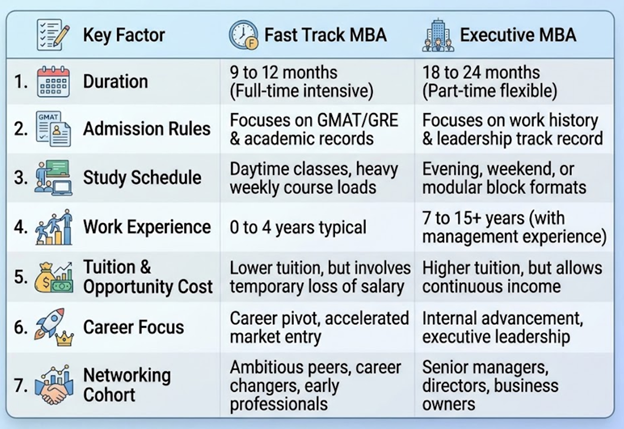
Navigating Fast Track MBA vs Executive MBA options requires weighing these core structural trade-offs against your immediate lifestyle and career stage.
Fast Track MBA vs Executive MBA: Which One Costs More?
Evaluating total financial outlay requires analyzing both direct tuition and indirect opportunity costs.
Fast Track MBA Cost Factors
While direct tuition for a one-year program is often lower than two-year traditional degrees, key cost factors include:
- Full tuition and university administrative fees
- Intensive study materials and tech resources
- Living expenses during full-time study
- Opportunity Cost: Temporarily giving up a full-time salary while enrolled
Executive MBA Cost Factors
Top executive programs command higher tuition fees due to specialized executive coaching, global residency trips, and high-level networking amenities. However:
- Students maintain full-time employment and continuous salary flow
- Employers frequently provide partial or total corporate tuition sponsorship
- Travel and weekend accommodation expenses must be budgeted
Fast Track MBA vs Executive MBA: Entry Requirements
Admission criteria reflect the target demographic for each degree track:
Academic Requirements
Both tracks require an accredited undergraduate degree, official transcripts, and proof of English proficiency (TOEFL/IELTS) where applicable. Fast Track programs place heavier weight on GPA performance.
Professional Experience
Fast Track programs accept candidates with modest work histories. In contrast, EMBA admissions boards mandate substantial experience—often requiring a minimum of 5 to 8 years, including proven managerial or budgetary oversight.
GMAT and Other Admission Tests
Fast Track MBAs frequently require standardized test scores (GMAT or GRE) to evaluate quantitative readiness. Executive MBAs often offer test waivers, prioritizing professional accomplishments, executive interviews, and letters of recommendation instead.
Fast Track MBA vs Executive MBA: Which Fits Your Career Goals?
Aligning your degree with your multi-year professional vision ensures a strong return on educational investment.
Choose a Fast Track MBA If You Want:
- To complete your degree as rapidly as possible
- To make a quick functional or industry career pivot
- An intensive academic immersion without long-term multi-year commitments
Choose an Executive MBA If You Want:
- To maintain your current job, income, and career trajectory while studying
- Access to high-level corporate networks and peer executive insights
- To qualify for C-suite, VP, or board-level promotions within your sector
Consider Your Long-Term Career Plan
Assess where you stand today versus where you plan to be in five years. If you need foundational business training to step up quickly, an accelerated path works best. If you require strategic polish to lead organizations, choose an executive path. Evaluating Fast Track MBA vs Executive MBA through this lens brings immediate clarity to your application strategy.
Fast Track MBA vs Executive MBA for Working Professionals
Balancing professional responsibilities with academic rigor requires careful evaluation:
- Work Commitments: Fast Track programs generally preclude full-time work due to heavy daytime schedules. EMBAs are explicitly structured to accommodate full-time work schedules.
- Family & Personal Life: Accelerated programs are short but incredibly intense. Executive programs spread the workload over two years, requiring sustained weekend planning.
- Financial Stability: Sustaining personal finances without a steady paycheck favors an EMBA, whereas candidates with financial reserves can leverage the speed of a Fast Track degree.
Ultimately, evaluating Fast Track MBA vs Executive MBA for working professionals comes down to whether you can afford to pause your career temporarily or need to study alongside your current job.
How to Choose Between These Two MBA Routes
Use this practical decision framework to simplify your selection process:
Ask Yourself These 5 Questions:
- How quickly do I need to earn this qualification?
- How many years of management experience do I currently possess?
- Can I afford to take a 12-month break from full-time employment?
- Will my current employer sponsor part of my tuition?
- Do I need entry-level management skills or senior executive polishing?
Compare Universities Before Applying
Once you pick a direction, evaluate target institutions based on:
- International accreditation (AACSB, AMBA, EQUIS)
- Faculty credentials and practical industry experience
- Alumni network strength and regional reputation
- Total program cost including travel and materials
Common Mistakes Students Make When Choosing an MBA
Avoid these frequent missteps during your evaluation process:
- Choosing Solely on Duration: Selecting a Fast Track degree just because it is shorter, despite having 10+ years of executive experience that fits an EMBA better.
- Ignoring Hidden Costs: Calculating tuition while forgetting living expenses and lost wages during full-time study.
- Overlooking Accreditation: Enrolling in unaccredited business degree options that lack global corporate recognition.
- Underestimating Workload: Assuming a part-time EMBA requires minimal effort; executive coursework demands substantial weekly prep time.
Fast Track MBA vs Executive MBA: Final Decision Guide
Fast Track MBA May Be Better For:
Early-career professionals, career switchers, and ambitious applicants who want a fast, full-time, highly immersive business education to jumpstart their momentum.
Executive MBA May Be Better For:
Experienced managers, corporate leaders, and entrepreneurs who want to earn a prestigious qualification, expand senior networks, and secure leadership roles without leaving their current positions.
There Is No Single Best MBA for Everyone
The optimal choice depends entirely on your current career stage, financial flexibility, professional background, and future aspirations.
Conclusion
Both academic pathways offer powerful advantages for career growth. Navigating Fast Track MBA vs Executive MBA comes down to balancing your immediate availability against your long-term career objectives.
Evaluate program schedules, entry rules, total financial costs, and prospective alumni networks carefully. Choose the format that aligns with your lifestyle today and prepares you for the leadership roles of tomorrow before applying for your next university intake.
Frequently Asked Questions
1. What is the main difference between a Fast Track MBA and an Executive MBA?
A Fast Track MBA is an intensive, full-time program designed to be completed in 9 to 12 months, ideal for early-to-mid-career professionals. An executive MBA is a part-time program spanning 18 to 24 months, structured specifically for experienced managers who continue working full-time.
2. Is a Fast Track MBA better than an Executive MBA?
Neither program is inherently superior; they cater to different professional stages. Fast Track MBAs suit candidates seeking rapid completion and early career progression, whereas Executive MBAs serve senior professionals pursuing organizational leadership and executive networking.
3. Can working professionals choose a Fast Track MBA?
While working professionals can enroll in accelerated programs, the intense daytime class schedules and heavy course loads usually require taking a full leave of absence from employment. Working professionals who cannot step away from their jobs usually prefer an EMBA.
4. Does an Executive MBA require work experience?
Yes, most top executive programs require a minimum of 5 to 8 years of professional experience, including demonstrated managerial or leadership responsibilities. Admissions committees focus heavily on the practical industry insights applicants bring to cohort discussions.
5. How should I choose between these MBA programs?
Assess your total years of work experience, financial ability to take time off, daily schedule flexibility, and long-term career goals. Comparing these factors against institution requirements will clearly indicate whether a Fast Track MBA or an Executive MBA is your best fit.




