

The OTHM Level 6 Occupational Health and Safety qualification provides a structured pathway for professionals seeking advanced knowledge in workplace health, safety, and environment (HSE). It is particularly relevant for learners planning to build or advance careers in occupational safety, compliance, risk management, and strategic safety governance.
This GL Campus guide explores the structure of the OTHM qualification, its position on the Regulated Qualifications Framework (RQF), entry requirements, flexible study options, potential career opportunities, and key considerations to review before enrolling in the next intake.
OTHM Level 6 Occupational Health and Safety and RQF Criteria
The Regulated Qualifications Framework (RQF) categorizes qualifications in England, Wales, and Northern Ireland based on their difficulty and level of learning.

Is OTHM Level 6 a Degree?
No, an OTHM Level 6 Diploma is not automatically a university bachelor’s degree.
- Qualification Level: It sits at Level 6 on the RQF, matching the academic challenge of final-year undergraduate work.
- Institutional Equivalence: It is a vocational diploma awarded by a regulated awarding body (OTHM), whereas a bachelor’s degree is awarded directly by a university.
- Recognition: Recognition for top-up degrees or direct employment depends on the specific university, country, or employer.
Why RQF Level Matters
Understanding RQF levels ensures prospective students can compare educational options accurately. Knowing that a program is benchmarked at RQF Level 6 confirms that the curriculum meets strict quality standards set by educational regulators.
7 Powerful Benefits of OTHM Level 6 Occupational Health and Safety
1. Strengthen Your HSE Knowledge
The curriculum moves beyond foundational safety rules, diving deep into organizational culture, behavioral safety, ergonomics, and advanced risk profiling. Learners gain an end-to-end understanding of how health and safety integrates into broader corporate governance.
2. Improve Career Progression
Completing a Level 6 qualification signals to employers that a practitioner is equipped for leadership roles. It positions professionals to move from entry-level or mid-level safety inspector roles into strategic positions such as HSE Manager, Safety Director, or Compliance Lead.
3. Develop Practical Risk Management Skills
The assessment methodology focuses on real-world applications. Learners complete practical projects requiring them to analyze actual workplace environments, perform root-cause analyses on real incident data, and draft actionable risk mitigation policies.
4. Support International Career Goals
Offered by OTHM, an established UK awarding organization regulated by Ofqual (Office of Qualifications and Examinations Regulation), this diploma provides a transparent, regulated educational profile recognized by international employers and recruitment agencies.
5. Access Flexible Study Options
Approved learning centers offer online, distance, and blended learning formats. Dedicated online portals allow students to access lectures, learning materials, and assignment briefs at their own pace.
6. Prepare for Higher Level Study
Earning an RQF Level 6 diploma provides an academic foundation for higher-level qualifications. Graduates frequently use this diploma as an entry credential for Level 7 postgraduate diplomas or specialized Master’s (MSc) degree top-up programs, depending on university admission policies.
7. Build Professional Confidence
Mastering legal frameworks, risk evaluation theories, and safety leadership strategies instills the professional confidence needed to advise corporate executives, manage regulatory audits, and lead emergency response operations.
OTHM Level 6 Occupational Health and Safety and RQF Criteria
The Regulated Qualifications Framework (RQF) categorizes qualifications in England, Wales, and Northern Ireland based on their difficulty and level of learning.
OTHM Level 6 Occupational Health and Safety Course Structure
While specific module structures and assessment tasks are determined by the awarding body and delivered via approved centers, typical subject areas covered in the qualification include:
- Occupational Health Principles: Promoting wellbeing, managing occupational hygiene, and mitigating workplace health hazards.
- Workplace Risk Assessment: Quantitative and qualitative risk assessment techniques across complex work environments.
- Safety Management Systems: Designing and evaluating safety frameworks aligned with standards like ISO 45001.
- Health and Safety Legislation: Legal liabilities, regulatory compliance, and international safety conventions.
- Environmental Management: Integrating environmental management systems (e.g., ISO 14001) with safety protocols.
- Incident Investigation: Advanced root-cause analysis, reporting frameworks, and corrective action planning.
- Emergency Planning: Developing business continuity plans, disaster response management, and crisis communication strategy.
Always verify the active syllabus with your chosen approved center, as module delivery arrangements and assessment formats can vary.
Entry Requirements for OTHM Level 6 Occupational Health and Safety
Admission standards are designed to ensure learners possess the academic grounding or practical experience required to succeed at an advanced level.
- Academic Requirements
Most approved centers require applicants to hold an RQF Level 5 qualification (such as an OTHM Level 5 Diploma, HND, or equivalent foundation degree) in a related discipline.
- Professional Experience
Candidates without formal Level 5 academic qualifications may be admitted based on relevant professional experience. Mature applicants (typically aged 21 or older) with several years of verifiable HSE experience are frequently evaluated via CV review and professional references.
- English Language Requirements
Because teaching and assessments are conducted in English, learners whose primary language is not English must demonstrate adequate proficiency (typically equivalent to IELTS 5.5 or through an approved center assessment).
How Long Does OTHM Level 6 Occupational Health and Safety Take?
There is no single fixed duration for the program, as completion times vary based on individual circumstances and study formats.
Factors influencing program length include:
- Study Mode: Full-time vs. part-time distance learning.
- Center Schedule: Fixed-term intake schedules vs. open-enrollment formats.
- Learner Pace: How quickly a student completes written assignments and practical projects.
Typically, most working professionals complete the diploma within 6 to 12 months of flexible part-time study.
Online and Flexible Study
Online study formats remove geographical boundaries, letting students complete coursework outside standard working hours. Interactive student portals, digital libraries, and asynchronous tutor support make balancing work and study manageable.
When evaluating safety training online, it is important to distinguish between short professional courses and comprehensive Level 6 diplomas.
Diploma Versus Short Safety Course
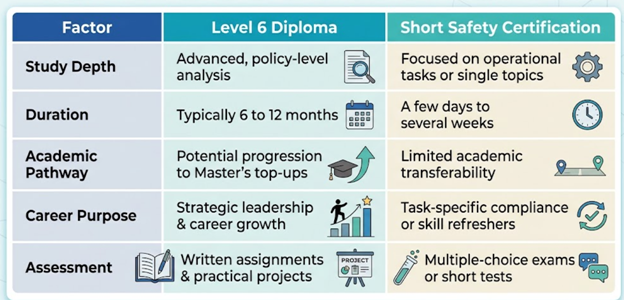
Is OTHM Level 6 an HSE Degree Equivalent?
The term “degree equivalent” is frequently used in job descriptions and course marketing, but it requires careful interpretation.
Academic Equivalence Versus Professional Recognition
- Qualification Level: A Level 6 Diploma reflects an academic standard equivalent to undergraduate-level complexity.
- Academic Equivalence: Universities evaluate Level 6 diplomas individually when considering students for Master’s degree entry.
- Professional Recognition: Professional bodies evaluate qualifications based on their own membership criteria (e.g., IOSH or BCSP recognition tracks).
- Employer Acceptance: Global employers may view a Level 6 Diploma as meeting the educational requirement for managerial HSE roles, though specific regional regulations vary.
Career Opportunities After OTHM Level 6 Occupational Health and Safety
Graduating with an OTHM Level 6 qualification can open doors to diverse safety management roles:
- Health and Safety Officer / Manager: Overseeing organizational safety policies and daily compliance.
- HSE Coordinator: Managing integrated health, safety, and environmental initiatives.
- Safety Supervisor / Auditor: Conducting workplace risk audits and enforcing safety protocols.
- Risk Management Officer: Evaluating operational hazards and designing risk mitigation strategies.
- Occupational Health Specialist: Focusing on workplace wellness, hygiene, and ergonomic standards.
Industries That Need HSE Professionals
HSE professionals are required across high-risk and regulated industries globally:
- Construction & Infrastructure
- Manufacturing & Heavy Industry
- Oil, Gas & Renewable Energy
- Logistics, Shipping & Supply Chain
- Healthcare & Pharmaceuticals
- Facilities Management & Commercial Real Estate
OTHM Level 6 Occupational Health and Safety in the UAE
The Middle East—particularly Dubai, Abu Dhabi, and the wider UAE—has seen strong demand for qualified HSE professionals due to mega-infrastructure projects, strict municipal safety standards, and expanding industrial sectors.
Health and Safety Courses UAE
Learners in the UAE looking at health and safety qualifications should verify key factors before enrolling with a provider:
- Center Accreditation: Ensure the learning provider is an authorized OTHM center.
- Local Attestation: Confirm whether the qualification certificate can be attested by relevant educational and foreign affairs authorities if required by local employers.
- Employer Recognition: Check how regional employers in your target sector view UK RQF qualifications.
Career Growth in the UAE
With the UAE enforcing stringent occupational safety standards across construction, aviation, and oil and gas, holding a recognized UK Level 6 qualification provides job seekers with a competitive edge when pursuing managerial safety roles in the region.
- OTHM Safety Training and Further Study Options
Completing an OTHM Level 6 qualification serves as a valuable stepping stone within a broader professional development trajectory.
- Progression to Higher Qualifications
Graduates can explore higher education and professional body membership pathways:
- Level 7 Qualifications: Progressing to an OTHM Level 7 Diploma in Risk Management or related fields.
- Master’s Degree Top-Up: Applying for MSc top-up programs at participating UK universities.
- Professional Memberships: Applying for graduate or chartered memberships with global professional safety institutions, subject to individual membership body criteria.
How to Apply Before the Next Intake
Following a structured step-by-step application process ensures a smooth enrollment experience.
Step 1: Check Entry Requirements
Review your academic transcripts and professional CV to confirm you meet the center’s entry requirements.
Step 2: Verify the Approved Centre
Confirm that your chosen study provider is actively authorized by OTHM to deliver the Level 6 Occupational Health and Safety program.
Step 3: Review Course Structure
Compare delivery formats, assignment support, assessment submission timelines, and total qualification time (TQT).
Step 4: Confirm Fees and Intake Dates
Inquire about tuition fees, flexible payment plans, and upcoming registration deadlines for the next intake cohort.
Step 5: Prepare Your Documents
Gather required documentation, including:
- Passport or national ID copy
- Academic transcripts and certificates
- Updated professional CV
- Proof of English proficiency (if applicable)
How to Choose the Best OTHM Provider
Selecting the right learning provider significantly impacts your educational experience and completion rate.
Verify Qualification Details
Ensure the center provides the official regulated qualification title and awarding organization details, rather than an unaccredited internal certificate.
Compare Support and Learning Resources
Inquire about tutor responsiveness, access to online learning libraries, assignment feedback timelines, and academic guidance services.
Check Progression Opportunities
If your goal is to pursue a university Master’s degree later, check whether the provider has established progression pathways or guidance for university applications.
Is OTHM Level 6 Occupational Health and Safety Worth It?
The OTHM Level 6 Occupational Health and Safety Diploma is a worthwhile investment for professionals who want to move into managerial safety roles without spending multiple years in a full-time university degree program. It offers a clear, regulated, and flexible pathway to build advanced HSE competency.
However, its overall value depends on your specific goals. Learners should carefully verify local employer expectations, regulatory attestation requirements, and prospective university progression policies before enrolling.
Final Thoughts
The OTHM Level 6 Occupational Health and Safety qualification offers a practical, internationally recognized pathway for advancing your safety career. By delivering flexible study options, advanced risk management training, and a clear link to higher education, it enables working professionals to elevate their skills while maintaining their careers.
As you prepare for the upcoming intake, research approved providers carefully, verify entry criteria, and select a study route that aligns directly with your long-term career aspirations.
FAQs
1. What is OTHM Level 6 Occupational Health and Safety?
It is an advanced regulated qualification (RQF Level 6) focused on workplace safety management, risk assessment, legal compliance, and occupational health governance.
2. Is OTHM Level 6 equivalent to a bachelor’s degree?
It sits at Level 6 on the UK framework, matching the academic difficulty of final-year undergraduate study. However, it is a professional diploma awarded by OTHM, not a degree conferred by a university.
3. Can I study OTHM Level 6 Occupational Health and Safety online?
Yes. Many OTHM-approved centers offer fully online or distance-learning formats, allowing students to access course materials and submit assignments remotely.
4. What careers can I pursue after OTHM Level 6?
Graduates can pursue roles such as Health and Safety Manager, HSE Coordinator, Safety Auditor, Risk Management Officer, and Environmental Health & Safety Consultant.
5. Can OTHM Level 6 lead to further education?
Yes. Graduates can potentially progress to RQF Level 7 postgraduate qualifications or apply for Master’s (MSc) top-up programs at participating universities, subject to institutional entry requirements.




