

Choosing to pursue higher education in the UAE while maintaining full-time employment is one of the most effective strategies for career advancement. Opportunities to study in the UAE for Working Professionals have expanded rapidly, allowing ambitious employees to acquire advanced qualifications without taking a costly career break.
The universities in the UAE offer flexible schedules, evening classes, weekend executive sessions, and hybrid learning models. This GL Campus guide explains the perks of higher education in Dubai, Abu Dhabi, and across the UAE, which is now more accessible than ever for working adults.
Why Study in the UAE for Working Professionals Is Becoming Popular
In a fast-paced economy like the UAE, standing out in the job market requires continuous skill upgrades. Modern universities in the UAE offer flexible degrees and scholarships so that full-time professionals cannot drop their employment obligations to attend traditional day classes.

Continue Working While Studying
Flexible degree structures enable professionals to sustain their primary income, keep their job security, and apply theoretical classroom concepts immediately to their workplace responsibilities.
Build Skills Without Taking a Career Break
Stepping away from the workplace for one to two years can lead to missed promotions, gaps on resumes, and significant loss of income. Adult learning options allow you to build credentials concurrently with your professional experience.
7 Powerful Benefits of Studying in the UAE for Working Professionals
- Advance Your Career: Earning an accredited bachelor’s, master’s, or executive diploma demonstrates dedication, making you eligible for internal promotions and leadership opportunities.
- Learn Around Your Work Schedule: Universities offer tailored timetables, including weekday evening lectures, intensive weekend modules, and online self-paced coursework.
- Gain International Exposure: The UAE’s higher education landscape hosts branch campuses of top-tier global universities, providing exposure to multicultural business insights and international standards.
- Expand Your Professional Network: Studying alongside fellow professionals from diverse industries opens doors to corporate partnerships, job referrals, and executive networking.
- Develop Practical Business Skills: Courses focus heavily on practical tools like strategic management, financial analysis, corporate communication, digital transformation, and executive leadership.
- Access Flexible Qualifications: From short-term certificates to full-degree programs, professionals can select options tailored to their time budget and long-term career trajectory.
- Prepare for Future Leadership Roles: Higher-level qualifications bridge the gap between operational expertise and strategic management, preparing you for senior governance roles.
Part-Time Degrees Dubai for Working Professionals
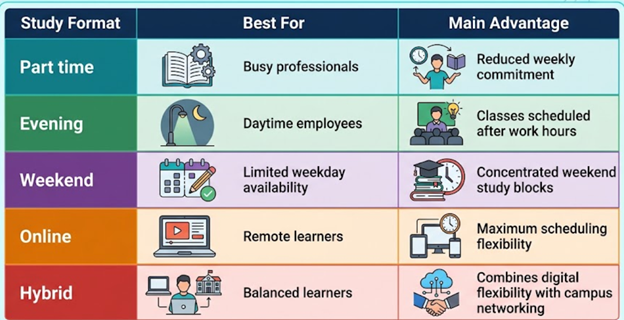
Part-time degrees in Dubai cater to employees who need to spread their academic workload over a longer period to manage work-life balance effectively.
- Reduced Course Load: Enrolling in fewer modules per semester compared to full-time students.
- Flexible Class Schedules: Classes scheduled during non-working hours, such as evenings or weekends.
- Extended Duration: Completing a master’s program over two to three years instead of one year full-time.
- Blended Delivery: Accessing digital lectures online while attending periodic face-to-face seminars.
Who Should Consider a Part-Time Degree?
Part-time degrees are ideal for full-time managers, working parents, entrepreneurs, and mid-career professionals with demanding schedules who need a manageable academic pace.
Evening Classes UAE: A Practical Option for Employees
Evening programs allow professionals to complete their regular workday before stepping into the classroom.
Benefits of Evening Study
Attending classes after 6:00 PM ensures your daily work commitments remain completely uninterrupted. It also allows you to interact directly with instructors and peers without taking time off work.
Challenges to Consider
- Fatigue: Managing brainpower after a long corporate workday can be demanding.
- Time Management: Balancing homework, family commitments, and work projects during weeknights requires discipline.
- Commuting: Navigating peak evening traffic in major UAE city centers requires careful planning.
Weekend and Executive Classes for Busy Professionals
For those whose weeknights are unpredictable or spent on work commitments, weekend study schedules offer an efficient alternative.
Weekend Learning Formats
Many universities in Dubai and Abu Dhabi hold concentrated lectures on Saturdays or Sundays. These sessions often run as half-day or full-day workshops, leaving weeknights free for rest, work, and assignment preparation.
Executive Education for Experienced Professionals
Executive programs (such as Executive MBAs) are tailored for mid-to-senior managers with several years of leadership experience. They feature condensed, high-impact modules, peer-to-peer case studies, and networking sessions centered around practical corporate strategy.
Online and Hybrid Options to Study in UAE for Working Professionals
Digital transformation in higher education has introduced unprecedented learning flexibility.
Online Learning
Fully online degrees allow students to review recorded lectures, submit assignments, and participate in discussion forums from anywhere, eliminating commute times entirely.
Hybrid Learning
Hybrid or blended learning combines online self-paced modules with periodic on-campus workshops, giving students the best of both worlds: digital convenience and in-person engagement.
Choosing the Right Delivery Format
Flexible Degrees Dubai: Which Program Should You Choose?
Selecting the right academic discipline depends directly on your career goals:
- Business and Management Degrees (MBA, MSc Management): Ideal for professionals aiming to transition into team leadership, strategic management, operations, or entrepreneurship.
- Technology and Digital Programs (Computer Science, Cybersecurity, Data Analytics): Designed for professionals seeking technical upskilling in high-growth digital sectors.
- Finance and Accounting Programs (MSc Finance, ACCA/CIMA preparation): Tailored for professionals targeting corporate financial management, investment banking, or auditing roles.
Study in UAE for Working Professionals: How to Balance Work and Education
Successfully managing work and higher education comes down to organized execution:
- Build a Weekly Study Schedule: Block out dedicated hours in your digital calendar for reading, attending classes, and writing assignments. Treat these time slots as non-negotiable appointments.
- Use Your Commute and Breaks Wisely: Leverage your daily commute or lunch breaks to review lecture slides, read course materials, or listen to educational podcasts.
- Set Realistic Academic Goals: Avoid overloading yourself with too many modules at once. It is better to make steady progress than to burn out trying to finish quickly.
Admission Requirements for Study in UAE for Working Professionals
While entry criteria vary by institution and academic level, common requirements include:
- Recognized high school diploma (for undergraduate) or bachelor’s degree (for postgraduate study).
- Official academic transcripts.
- Valid identification (Emirates ID, passport, and residence visa copies).
- Proof of English language proficiency (IELTS, TOEFL, or university placement tests).
- Relevant professional work experience (especially for executive programs and MBAs).
Can Working Professionals Apply?
Yes, most universities catering to working adults explicitly consider managerial experience as a valuable component of your overall application.
Costs of Studying in the UAE While Working
Pursuing higher education involves financial planning beyond standard tuition.
Key expenses to factor into your budget:
- Tuition Fees: Payable per semester, module, or yearly installments.
- Registration & Application Charges: Initial administrative costs.
- Learning Materials: Textbooks, digital software, and library access fees.
- Technology Costs: Reliable laptop, high-speed internet, and specialized software licenses.
How to Compare Programs by Value
Evaluate programs based on accreditation status, faculty reputation, scheduling flexibility, career support services, and total cost rather than tuition prices alone.
Corporate Education Options for UAE Professionals
Many employers in the UAE actively support workforce upskilling through professional development initiatives.
Employer-Sponsored Education
Check whether your corporate HR policy includes tuition assistance, study leave allowances, or education sponsorship. Many companies cover course fees if the degree directly enhances your performance in your current role.
Corporate Training vs. Formal Degrees
While internal corporate training provides short-term skill refreshers, accredited formal degrees provide recognized qualifications that stay on your resume permanently.
How to Choose the Best Program to Study in the UAE for Working Professionals
Follow this step-by-step framework to pick the right program:
- Check the Schedule: Ensure class times do not conflict with your core working hours.
- Verify Recognition: Confirm that the university is accredited by official education bodies (such as the UAE Ministry of Education / CAA or KHDA in Dubai).
- Evaluate Career Relevance: Choose a program whose curriculum directly matches your target job description.
- Compare Flexibility: Determine if online, evening, or hybrid delivery suits your personal life best.
- Review Total Costs: Compare overall program fees, available payment installment plans, and potential scholarships for working professionals.
7 Questions to Ask Before Enrolling
- Does the class schedule realistically fit my working hours and family life?
- Is the qualification officially accredited locally and recognized internationally?
- Can I study part-time or adjust my module intake if work demands increase?
- Are evening, weekend, or online classes available for all core modules?
- What digital platforms and student support services are provided for remote learners?
- What is the total cost, including administrative fees and materials?
- How will this specific qualification accelerate my career growth over the next 3 to 5 years?
Final Thoughts
Opportunities to Study in the UAE for Working Professionals have made higher education adaptable to modern corporate life. Through part-time degrees, evening classes, weekend executive blocks, and hybrid formats, you no longer have to choose between keeping your job and continuing your education.
Plan your schedule carefully, verify university accreditations, and choose a study pathway that aligns with your professional ambitions.
FAQs
1. Can I study in the UAE while working full time?
Yes, many accredited UAE universities offer flexible study formats—including evening, weekend, part-time, online, and hybrid options—designed specifically around corporate working hours.
2. Are part-time degrees available in Dubai?
Yes, higher education institutions across Dubai offer part-time undergraduate and postgraduate degrees across fields such as business, finance, information technology, and engineering.
3. Are evening classes suitable for working professionals?
Evening classes are ideal for professionals working regular daytime hours, allowing you to attend lectures after 6:00 PM without disrupting your employment.
4. Are online degrees flexible for UAE professionals?
Online degrees provide high flexibility by enabling you to complete coursework remotely. Be sure to check that the institution’s online programs are officially recognized by relevant accrediting bodies.
5. How can I balance work and study in the UAE?
Create a dedicated weekly study schedule, communicate your academic goals with your family and employer, use free time efficiently during breaks, and avoid taking on more course modules than you can realistically manage.




