
Choosing the right undergraduate qualification can influence your skills, career direction and future opportunities. Understanding the dual specialization BBA degree benefits can help students see why a Bachelor of Business Administration remains a popular choice for business focused careers. A BBA with dual specialization can provide broader business knowledge while allowing students to develop expertise in two related areas.
This GL campus guide explores the career benefits, skills, specialization opportunities and potential career paths available to BBA graduates.
How Does Dual Specialization Strengthen a BBA?
A traditional BBA allows students to select one major or specialization. A dual specialization structure, however, enables students to major in two distinct yet complementary business disciplines simultaneously.

Popular dual specialization combinations include:
- Marketing and Finance: Combines analytical budgeting with revenue-generating growth strategies.
- Finance and Accounting: Provides deep technical capabilities in corporate auditing and financial forecasting.
- Marketing and Human Resources: Balances external brand communication with internal corporate communication and culture management.
- Business Management and Entrepreneurship: Prepares founders with operational control and venture-scaling methodology.
- International Business and Marketing: Equips professionals to manage global supply chains and cross-border commercial campaigns.
7 Key BBA Degree Advantages for Career Growth
The following benefits represent the core reason a Bachelor of Business Administration remains a benchmark undergraduate qualification globally.
1. Develops Versatile Business Skills
Students gain an adaptable repertoire of core competencies usable across corporate, non-profit, and public sectors. Learning how organizations operate financially, strategically, and operationally ensures long-term professional adaptability.
2. Supports Multiple Career Options
A BBA graduate is not restricted to a single job profile. Qualifications open doors in digital marketing, corporate sales, equity analysis, recruitment, supply chain coordination, and general operations management.
3. Builds Professional Confidence
Through continuous exposure to classroom presentations, group discussions, business case studies, and corporate simulations, students develop articulate communication and public presentation capabilities early in their careers.
4. Provides Specialization Opportunities
Specializations allow learners to align their academic output with market demand. Whether focusing on fintech, digital analytics, or talent management, students can tailor their degree to target specific growth industries.
5. Supports Entrepreneurship
For aspiring business owners, a BBA provides the fundamental toolkit required to launch a startup. Understanding cash flow management, legal compliance, market positioning, and team management significantly lowers entrepreneurial failure rates.
6. Creates a Foundation for Further Education
A BBA serves as an ideal academic stepping stone for advanced business degrees such as an MBA, Master of Science in Finance, or professional charter qualifications like ACCA, CIMA, and CFA.
7. Develops Transferable Workplace Skills
Beyond technical knowledge, the degree focuses heavily on soft skills highly valued by corporate recruiters, including critical thinking, collaborative teamwork, conflict resolution, and project time management.
BBA Specializations and Potential Career Paths
Aligning specialization options with market demand helps students target deliberate career trajectories upon graduation:
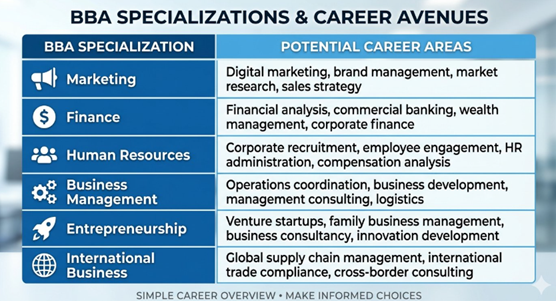
While degree completion opens opportunities, final career outcomes depend on internship experience, practical skill application, networking, and regional hiring demands.
How BBA Graduates Can Prepare for Entry Level Jobs UAE
For graduates entering competitive employment hubs, targeting entry level jobs UAE requires translating academic knowledge into practical industry readiness.
Marketing and Sales Roles
The active UAE corporate landscape presents opportunities for marketing assistants, digital content coordinators, and junior sales executives. Candidates who demonstrate digital tool proficiency alongside commercial awareness stand out to employers.
Finance and Administration Roles
Junior roles such as finance assistant, accounts payable coordinator, and administrative officer regularly seek BBA graduates. Highlighting analytical coursework and accounting software knowledge strengthens application positioning.
Human Resources Roles
Organisations across Dubai and Abu Dhabi actively recruit entry-level HR assistants, talent sourcing specialists, and onboarding coordinators with structured management training.
Business Development Roles
Junior business development executives and client relationship associates benefit directly from a BBA candidate’s training in negotiation, professional pitching, and market research.
How Business Administration Courses Build Workplace Skills
Higher education institutions design business administration courses to blend academic theory with real-world application.
- Communication Skills: Developed through research report writing, formal executive presentations, and group project negotiations.
- Analytical Skills: Refined by analyzing company financial statements, reviewing market data sets, and solving quantitative case studies.
- Leadership and Teamwork: Fostered through mandatory collaborative assignments, peer assessments, and group leadership roles.
- Problem Solving: Built by evaluating actual corporate case studies and formulating strategic remedies for organizational failures.
BBA Degree Advantages for Future Career Flexibility
Long-term career agility is among the most practical BBA degree advantages. A professional who starts their career in corporate sales can leverage foundational business knowledge to transition into brand management, business development, or operational leadership.
Career mobility pathways often include:
- Transitioning from Marketing to General Management
- Moving from HR Administration to Corporate Talent Strategy
- Shifting from Financial Analysis to Strategic Business Development
- Transitioning from Corporate Employment to Independent Entrepreneurship
Adding industry certifications, completing target internships, and participating in continuous learning programs further accelerates mid-career pivots.
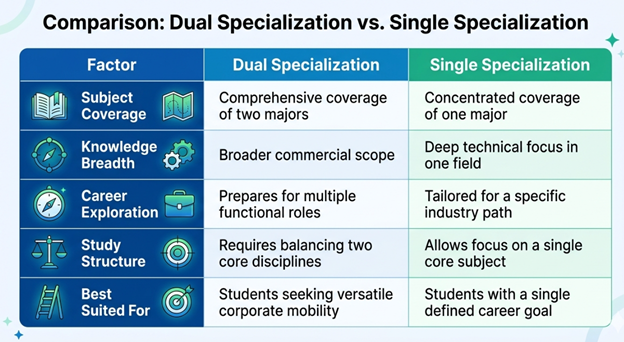
Dual Specialization vs Single Specialization BBA
Evaluating program structures helps prospective candidates choose the optimal academic model for their objectives:
How to Choose the Right BBA Program
Making an informed choice requires systematic evaluation of university offerings:
- Check the Curriculum: Ensure core modules, elective choices, and practical internship components align with current industry practices.
- Review Specialization Options: Verify that the university offers major combinations relevant to your career path.
- Consider Industry Exposure: Look for institutions providing corporate mentorship, career fairs, employer workshops, and practical internship placements.
- Verify Recognition: Confirm institutional accreditation with national education authorities and international quality assurance bodies.
- Consider Future Education: Check whether the credit structure aligns with entry standards for leading postgraduate universities.
Are the BBA Degree Advantages Worth Considering?
The BBA degree advantages make this qualification an ideal choice for students seeking a versatile business education with early career flexibility.
While a dual specialization provides a broader knowledge footprint across two distinct functional areas, candidates should evaluate their personal career goals, preferred study load, tuition costs, and long-term academic plans before selecting a specific university format.
Final Thoughts on BBA Degree Advantages
Understanding the primary BBA degree advantages highlights why this degree remains a popular choice for aspiring business professionals. By offering exposure to foundational business management concepts alongside options for dual specialization, a BBA equips students with practical tools for immediate employment or advanced postgraduate studies.
Ultimate career success depends on combining academic credentials with proactive networking, hands-on internship experience, and continuous skill refinement. Research accredited university curricula today and explore specialization structures to start building your career path.
FAQs About BBA Degree Advantages
1. What are the main BBA degree advantages?
The primary BBA degree advantages include acquiring broad business knowledge, building practical workplace skills, and gaining exposure to core corporate functions like finance, marketing, and HR. Students develop communication, analytical, and leadership abilities that serve as a strong foundation for corporate careers or entrepreneurial ventures.
2. Is a dual specialization better than a single specialization?
A dual specialization offers broader career versatility by covering two distinct business majors, whereas a single specialization provides deeper technical focus in one field. The best choice depends on whether a student prefers flexible entry options across multiple functional departments or targeted entry into a single specialized industry.
3. What career paths can BBA graduates pursue?
BBA graduates can enter a wide range of fields, including digital marketing, brand management, corporate sales, financial analysis, HR management, supply chain coordination, and management consulting. Specific opportunities depend on chosen specializations, practical experience, and employer hiring requirements.
4. Can a BBA help students find entry level jobs in the UAE?
Yes, a BBA degree prepares graduates for entry-level opportunities across commercial hubs in Dubai, Abu Dhabi, and the wider UAE region. Qualifications demonstrate foundational business literacy valued for junior roles in sales, marketing, finance support, administrative management, and recruitment.
5. Can I pursue an MBA after completing a BBA?
Yes, BBA graduates are well-prepared to pursue an MBA or specialized Master’s degree. While some executive programs require a few years of professional work experience before enrollment, the undergraduate business foundation helps students excel in postgraduate business education.