
For students seeking global career opportunities, choosing to study business in USA in 2027 can open access to a wide range of academic programmes and professional pathways. From undergraduate business degrees to MBA programmes, the USA offers diverse options for international students planning their studies in 2027.
This GL Campus guide explains degree choices, tuition costs, admission requirements, applications, and important considerations before choosing a US business school.
USA Business Universities: How to Choose the Right One
Choosing a institution requires looking beyond overall national rankings. A lower-ranked university with stronger regional corporate connections may yield better career outcomes than a higher-ranked university with limited employer recruitment in your targeted sector.

Check Programme Curriculum
Examine individual course syllabi, available electives, capstone requirements, and teaching formats (case-study vs. lecture vs. project-based). Look for flexible degree structures that let you take electives outside the business school.
Consider Location
Geography impacts your living expenses and professional network:
- East Coast (NY, MA): Major hubs for corporate finance, banking, consulting, and fintech.
- West Coast (CA, WA): Centers for technology, venture capital, and innovative tech startups.
- Midwest & South (IL, TX, GA): Growing business hubs offering lower living costs combined with major corporate headquarters.
Review Accreditation and Recognition
Ensure the business school holds premier programmatic accreditation from body like AACSB (Association to Advance Collegiate Schools of Business) or ACBSP (Accreditation Council for Business Schools and Programs). Programmatic accreditation ensures rigorous academic standards and employer recognition worldwide.
Compare Career Support
Inquire about designated international student career advisors, campus interview schedules, target employer lists, alumni networking platforms, and job placement rates within 3 months of graduation.
Cost to Study Business in USA in 2027
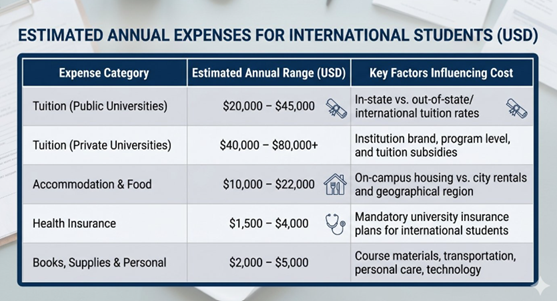
Financing a business degree requires calculating total expenses rather than looking solely at published tuition rates.
Tuition Fees
Tuition costs vary based on whether an institution is public or private. Public universities receive state funding and generally offer lower base rates, though international students pay out-of-state rates. Private universities maintain uniform tuition rates regardless of student residency.
Living Expenses
Metropolitan locations like New York City, San Francisco, and Boston carry significantly higher rents and daily living expenses than college towns in the Midwest or South. Standard budget items include rental contracts, meal plans, utility bills, mobile phone plans, and regional public transit passes.
Additional University Costs
Factor in mandatory non-tuition fees charged by institutions, including international student processing fees, campus facility access fees, student health services fees, orientation costs, and course material fees.
How to Create a Realistic Budget
Build an annual budget outline that includes a 5–7% buffer for yearly tuition increases and inflation. Subtract guaranteed merit scholarships or funding from the total institutional cost of attendance to estimate your net annual financial obligation.
Admission Requirements to Study Business in USA
Admissions committees evaluate candidate profiles holistically. Strong professional experience, leadership potential, and clear career goals can offset minor gaps in standard academic scores.
Academic Qualifications
Applicants need a completed secondary diploma for undergraduate admissions or a recognized 4-year bachelor’s degree (or international equivalent) for graduate studies. Grade Point Averages (GPA) are generally calculated on a 4.0 scale, with competitive programs seeking GPAs of 3.0 or higher.
English Language Requirements
Non-native English speakers must submit valid language test scores unless they hold a prior degree from an English-medium institution in an exempt country. Commonly accepted assessments include:
- TOEFL iBT: Typically 80–100+
- IELTS Academic: Typically 6.5–7.5 overall
- Duolingo English Test (DET): Typically 115–135+
- PTE Academic: Typically 58–70+
Standardised Tests
Graduate programs may require or optionalize test scores such as the GMAT (or GMAT Focus Edition) or GRE. Undergraduate applicants may submit SAT or ACT scores where required. Many US universities maintain test-optional policies, but strong scores can enhance scholarship applications for international candidates.
Supporting Documents
All applications require a core set of supporting materials:
- Academic Transcripts: Official translated records of past academic coursework.
- Statement of Purpose (SOP) / Essays: Personal essays outlining academic achievements, career goals, and motives for selecting the institution.
- Resume or CV: Detail academic accomplishments, work experience, internships, and extracurricular leadership.
- Letters of Recommendation (LORs): 2 to 3 evaluations from academic instructors or professional supervisors.
- Copy of Passport: Valid for at least 6 months beyond intended enrollment.
How to Apply to Business Schools in USA
Following a deliberate, step-by-step process keeps applications organized and on schedule:
Step 1: Research Your Programmes
Select 6 to 10 universities across three tiers: target programs, reach programs, and safety programs. Evaluate curriculum fit, tuition expenses, geographical preference, and career outcomes.
Step 2: Check Entry Requirements
Confirm deadline dates, prerequisites, minimum language thresholds, and standardized test score policies for each target school.
Step 3: Prepare Your Application
Request official transcripts early, draft and refine personal essays, update your professional resume, and secure letters of recommendation at least 8 weeks prior to the application deadline.
Step 4: Submit Applications
Complete online application forms via individual university portals or common portals like Common App (for undergraduate studies). Pay required application fees or request fee waivers where eligible.
Step 5: Wait for Admission Decisions
Track application submission status via student portals. Complete video interviews if invited, submit updated academic records if requested, and monitor registered email accounts for decision letters.
Scholarships and Financial Aid for Business Students
While full funding is competitive, international students can access multiple funding sources to help offset study costs in the US.
University Scholarships
Institutional merit scholarships are awarded by admissions committees based on academic performance, standardized test scores, and application strength. These awards usually do not require a separate application and are awarded alongside the offer of admission.
External Scholarships
Government organizations, private foundations, and international agencies sponsor study opportunities in the US. Examples include the Fulbright Foreign Student Program, AAUW International Fellowships, and country-specific educational grants.
Assistantships and Other Funding
Graduate students can apply for Graduate Assistantship (GA), Teaching Assistantship (TA), or Research Assistantship (RA) roles. These positions provide a partial or full tuition waiver plus a monthly living stipend in exchange for part-time administrative or academic work.
Student Visa Considerations for Studying Business in USA
Securing university admission and obtaining student immigration authorization are distinct procedures handled by separate entities.
Receive Your Admission Documentation
Once admitted and after submitting proof of sufficient funds for the first year of study, the university issues an official Form I-20 (for F-1 student visas). Verify that all personal data on the Form I-20 matches your passport exactly.
Plan Your Financial Documentation
US consular officers require verifiable evidence showing immediate liquid funds to cover tuition, fees, and living costs for your first academic year, along with proof of funding sources for the remainder of the program.
Prepare for Your Visa Process
Pay the required SEVIS I-901 fee, complete the online DS-160 visa application form, and schedule an interview appointment at the nearest US Embassy or Consulate. Be prepared to clearly articulate your academic goals, program choice, and ties to your home country during the visa interview.
Career Opportunities After a Business Degree in USA
Graduating from a US business program provides access to corporate career paths across multiple sectors.
Business Career Paths
Graduates enter diverse professional roles based on their chosen specialization:
- Management Consulting: Strategic advisory roles across technology, operations, or corporate restructuring.
- Corporate & Investment Banking: Financial modeling, mergers and acquisitions, capital markets, and asset management.
- Brand & Product Management: Product lifecycle strategy, market entry planning, and digital marketing execution.
- Business & Data Analytics: Optimizing operations through data infrastructure, forecasting, and consumer profiling.
- Supply Chain & Operations: Managing global logistics, procurement, and enterprise processes.
Importance of Internships and Networking
Completing a summer internship provides practical exposure and serves as a major pathway to full-time job offers post-graduation. Leverage university career fairs, alumni databases, and student club events to establish professional relationships early in your degree program.
How to Choose the Best Business Course for Your Goals
Finding the ideal business degree requires evaluating options through a personal framework:
- Degree Level: Match your entry point to your prior education and professional experience.
- Specialisation Alignment: Select a domain that targets growing job market demand.
- Curriculum Structure: Decide between theoretical coursework, quantitative analysis, or hands-on practical projects.
- Total Cost vs. ROI: Balance initial tuition costs against average starting salaries for graduates of the program.
- Geographical Fit: Match university locations to regional industry hubs that hire in your field.
- Career Infrastructure: Choose programs with dedicated international student career services and active alumni networks.
Common Mistakes International Students Should Avoid
Avoiding common planning errors saves time, reduces unnecessary expense, and improves your admissions outcome:
- Focusing Only on University Rankings: Top-ranked overall universities may not offer the best programmatic fit or regional employment connections for your specific discipline.
- Ignoring Total Costs: Failing to account for local cost-of-living differences, health insurance, and annual tuition increases can lead to budget shortfalls.
- Applying Without Checking Requirements: Submitting incomplete applications or missing programmatic prerequisites leads to immediate processing delays or rejections.
- Missing Application Deadlines: Delaying document collection, translation, or test score sends can jeopardize your consideration for competitive scholarship funds.
- Waiting Too Long for Visa Preparation: Delaying visa appointment scheduling after receiving your Form I-20 can result in processing delays that conflict with university start dates.
Final Thoughts on Studying Business in USA
Choosing to study business in USA requires careful planning rather than simply selecting a university based on brand recognition alone. Prospective students should weigh academic specializations, total cost of attendance, program accreditation, campus location, and career development support before committing to an institution.
For international students planning to study business in USA in 2027, beginning research early provides the time needed to build a strong application profile, secure funding, and navigate the student visa process smoothly. Selecting a program aligned with your budget, academic background, and long-term career vision sets the foundation for a rewarding academic and professional journey.
Frequently Asked Questions
How much does it cost to study business in USA?
Total annual costs generally range from $35,000 to $90,000+ USD, depending on the institution, location, and degree level. Public universities often offer lower tuition rates than private institutions, but students must budget for living expenses, health insurance, textbooks, and university fees alongside base tuition.
What are the requirements to study business in USA?
Requirements vary by institution and program level. Applicants generally need official academic transcripts, proof of English proficiency (TOEFL, IELTS, DET, or PTE), a statement of purpose, 2–3 letters of recommendation, and an updated resume. Some programs may also require or recommend standardized test scores like the GMAT, GRE, SAT, or ACT.
Can international students study business in USA?
Yes, international students can enroll in eligible US business programs. You must meet your chosen university’s academic and language admission criteria, receive a Form I-20 upon acceptance, and secure an F-1 student visa from a US Embassy or Consulate prior to enrollment.
What are the best business degrees USA offers?
Popular options include the Bachelor of Business Administration (BBA), Master of Business Administration (MBA), and specialized Master of Science (MS) degrees in Business Analytics, Finance, Accounting, Marketing, and Supply Chain Management. The best choice depends on your prior academic qualifications and career goals.
When should I apply to study USA 2027?
Start researching programs and preparing for tests 12 to 15 months before your intended start date. For the Fall 2027 intake (starting August/September 2027), application deadlines typically fall between December 2026 and March 2027, with priority scholarship deadlines occurring even earlier.