
Planning to study in Germany in 2027 starts with understanding the before submitting an application. From academic qualifications and language proficiency to documents and deadlines, every requirement can affect your admission journey.
This GL Campus guide explains the key requirements international students Germany bound should know before applying to German universities, helping you prepare with greater confidence and avoid common application mistakes.
1. Academic Qualifications Required for German Universities

Your previous educational background determines your eligibility for direct entry into a German higher education programme.
Undergraduate Admission Requirements
To study for a Bachelor’s degree, you must hold a recognized Higher Education Entrance Qualification, known in Germany as a Hochschulzugangsberechtigung (HZB).
- Direct Entry: If your secondary school diploma (e.g., A-Levels, IB Diploma, or equivalent) is recognized as equal to the German Abitur, you can apply directly to a university.
- Indirect Entry (Studienkolleg): If your secondary qualification is not directly recognized, you must attend a one-year foundation course (Studienkolleg) in Germany and pass the assessment exam (Feststellungsprüfung) before entering a degree programme.
- Grade Point Average (GPA): Many popular courses have a Numerus Clausus (NC), meaning entry is competitive and based on your overall GPA.
Postgraduate Admission Requirements
For Master’s degree programmes, universities evaluate your undergraduate background strictly:
- Recognised Bachelor’s Degree: You must hold an accredited Bachelor’s degree equivalent to a 3- or 4-year German undergraduate qualification.
- Subject Compatibility: German universities require your previous degree to be in a closely related discipline.
- Credit Point Allocation (ECTS): Programmes often require a minimum number of European Credit Transfer System (ECTS) points in specific subjects (e.g., mathematics or research methodology).
- Minimum GPA Thresholds: Competitive programmes, such as a Master’s business degree Germany route, frequently set strict minimum grade benchmarks.
2. Language Requirements for Studying in Germany
Depending on the primary language of instruction, you must provide valid proof of language proficiency.
German Language Requirements
For programmes taught in German, you must demonstrate upper-intermediate to advanced skills (typically CEFR Level C1) through recognized certificates:
- TestDaF (Test Deutsch als Fremdsprache): Usually requires Level 4 across all four testing sections.
- DSH (Deutsche Sprachprüfung für den Hochschulzugang): DSH-2 or DSH-3 is standard for university entry.
- Goethe-Zertifikat: C1 or C2 level certificates.
- telc Deutsch C1 Hochschule: Widely accepted across German academic institutions.
English Language Requirements
For international degree programmes taught entirely in English, you do not need German proficiency for academic entry. Instead, you must present valid English test scores:
- IELTS Academic: Minimum overall score typically between 6.5 and 7.0.
- TOEFL iBT: Minimum score usually between 80 and 100 points.
- PTE Academic / Duolingo English Test: Accepted by an increasing number of universities, though score thresholds vary.
Note: Always verify language requirements on the official course portal, as individual departments establish their own minimum benchmarks.
3. Documents Needed for a Germany University Application
Gathering and certifying your application portfolio well in advance is essential. Incomplete applications are frequently rejected without evaluation.
A standard Germany university application dossier includes:
- Certified Transcripts & Degree Certificates: Official copies of high school diplomas or undergraduate mark sheets.
- Official Translations: Documents not originally in English or German must be translated by a certified court translator.
- Valid Passport: Clear copy of the personal details page.
- Proof of Language Proficiency: Official score reports from TestDaF, IELTS, TOEFL, or equivalent tests.
- Curriculum Vitae (CV): Structured in tabular format focusing on academic history, work experience, and extra-curricular achievements.
- Statement of Purpose (SOP) / Letter of Motivation: A well-crafted personal essay explaining your choice of programme, academic background, and professional goals.
- Letters of Recommendation: 1–2 academic or professional reference letters (required primarily for Master’s applications).
- Portfolio / Work Samples: Essential for specialized fields like architecture, design, or fine arts.
4. Germany University Application Process for International Students
Navigating the application process requires attention to specific platform workflows and strict institutional deadlines.
Step 1: Programme Research ──> Step 2: Route Verification ──> Step 3: Submission & Fees
• Check HZB Status • Direct University Portal • Complete Dossier
• Language Rules • uni-assist Platform • Submit Before Deadline
Choose the Right University and Programme
Search official databases like the DAAD (Deutscher Akademischer Austauschdienst) to verify course entry prerequisites, course delivery language, location, semester fees, and departmental research focuses.
Check Whether You Apply Directly or Through a Central Application Service
- uni-assist: Many German universities use this central service to evaluate international qualifications. You submit your documents to uni-assist, which verifies their validity before forwarding them to the university.
- Direct Application Portals: Certain institutions host their own independent online application systems (e.g., AlmaWeb, Campus Portal).
- Foundation for University Admission (Hochschulstart): Used primarily for nationally restricted subjects like medicine, pharmacy, and dentistry.
Submit the Application
Complete all online application forms accurately and upload certified documents. When using uni-assist or direct portals, ensure processing fees are paid well before the official deadline. Meeting these procedural steps fulfills a critical part of the overall Germany university admission requirements.
5. Financial Requirements for International Students
While university admission reflects your academic eligibility, obtaining your official visa and student status requires proving your ability to cover living costs.
Key financial elements to prepare include:
- Proof of Financial Resources (Blocked Account): International students from non-EU/EEA countries must prove sufficient funds for living expenses. The standard method is a German Blocked Account (Sperrkonto), which requires depositing a set yearly amount (approximately €11,904 per year or €992 per month).
CBS+ 1
- Semester Contribution (Semesterbeitrag): Public institutions do not charge tuition fees in most states, but students pay a mandatory semester fee (€150–€400 per term) that covers administrative costs and regional public transportation passes.
- Health Insurance: Proof of comprehensive health insurance coverage is mandatory for university enrollment. Under-30s can enroll in statutory health insurance (Gesetzliche Krankenversicherung), while older students use recognized private insurance.
- Living Expenses: Budget for accommodation, food, study supplies, and personal leisure (typically €900–€1,200 per month depending on the city).
6. Student Visa Requirements After University Admission
Receiving an official admission letter (Zulassungsbescheid) is a milestone, but non-EU students must secure a National Student Visa (Category D) before traveling to Germany.
To apply for your student visa at a German embassy or consulate, you will typically need:
- A fully completed national visa application form.
- A valid passport (valid for at least 3 to 6 months beyond your intended stay).
- The official university admission letter or Studienkolleg confirmation.
- Proof of financial resources (e.g., official Sperrbestätigung from your blocked account provider).
- Proof of health insurance coverage valid from your arrival date.
- Proof of academic certificates, language proficiency, and a detailed motivation letter.
Important: University admission alone does not guarantee a student visa. Consular officers evaluate your financial preparation, academic background consistency, and genuine study motivation independently.
7. Germany University Admission Requirements for Business Students
Business degrees remain among the most popular academic pathways for international students. Whether you are applying for a Bachelor in International Business or a Master in Finance, specific departmental requirements apply.
If you are pursuing a business degree Germany track, pay close attention to these specialized requirements:
- Quantitative Background: Graduate business programs often require minimum credits in higher mathematics, statistics, microeconomics, and quantitative analysis.
- Professional Work Experience: While standard Master of Science (M.Sc.) programs focus on academic theory, Master of Business Administration (MBA) programs typically require 1 to 3 years of full-time professional work experience.
- Standardised Test Scores: Competitive business schools may require or strongly recommend GMAT or GRE scores to demonstrate analytical aptitude.
- Practical & Intercultural Aptitude: Business faculties place strong weight on active extracurricular participation, internships, and intercultural experience detailed in your CV and statement of purpose.
Meeting these targeted study Germany requirements ensures your application stands out in competitive selection pools.
Germany University Admission Requirements Checklist for 2027
Use this concise checklist to track your preparation progress for 2027 entry:
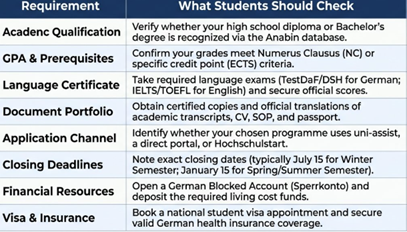
Common Mistakes International Students Should Avoid
Avoiding these critical planning mistakes will keep your application timeline on track:
Applying Without Checking Qualification Recognition
Do not assume your local qualification automatically qualifies you for direct university entry. Check your diploma status on official databases like Anabin before applying to avoid unexpected rejections or last-minute foundation course requirements.
Missing Programme-Specific Requirements
Relying solely on general university entry guidelines can lead to missed requirements. Individual faculties often mandate specific course prerequisites, minimum credit hours in specific subjects, or practical work experience.
Waiting Until the Application Deadline
Document certification, official translations, language test scoring, and uni-assist evaluation can take weeks or months. Starting your file submission right at the deadline leaves zero margin for correcting missing records.
Assuming Every German University Has the Same Requirements
Germany’s decentralized higher education system means entry policies, document requirements, and language cutoffs vary significantly across institutions. Always verify specifications directly on the official portal of your target faculty.
How to Prepare for Your 2027 Germany University Application
Following a structured, step-by-step roadmap makes managing your Germany university admission requirements straightforward.
6 to 12 Months Before Applying
- Research target universities, academic disciplines, and specific course modules.
- Check your qualification eligibility on Anabin or uni-assist.
- Register for and take required language proficiency exams (IELTS, TOEFL, TestDaF).
- Request official transcripts from previous school or university authorities.
3 to 6 Months Before Applying
- Prepare certified true copies and official English/German translations of all academic files.
- Draft, refine, and finalize your Statement of Purpose (SOP) and CV.
- Request academic or professional letters of recommendation.
- Open your online application profiles on uni-assist or individual university portals.
Before Final Submission
- Review every uploaded file against the university’s document checklist.
- Pay necessary processing fees to ensure your application is processed promptly.
- Begin organizing your financial documentation and opening a German blocked account.
Final Thoughts on Germany University Admission Requirements
Successfully securing a study spot in Germany requires careful research, accurate document preparation, and strict adherence to institutional timelines. From confirming academic recognition and passing language exams to organizing your visa file and blocked account, thorough preparation is key to a smooth journey.
Always verify the latest Germany university admission requirements directly with your chosen university or faculty department, as entry criteria, portal procedures, and documentation guidelines can update between academic terms. Beginning your preparation early ensures you enter the 2027 admission cycle with confidence.
FAQs About Germany University Admission Requirements
What are the main Germany university admission requirements for international students?
Most international applicants need a recognized higher education entrance qualification (or Studienkolleg completion), certified academic transcripts, valid language proficiency scores (German or English), a structured CV, a statement of purpose, and proof of sufficient financial resources.
CBS
Can international students study in Germany without knowing German?
Yes. Germany offers thousands of fully English-taught Bachelor’s and Master’s degree programmes. For these courses, you must provide proof of English proficiency (such as IELTS or TOEFL) rather than German certificates. However, learning basic everyday German is recommended for daily life.
What documents are required for a Germany university application?
Standard required documents include certified copies and translations of school/degree certificates, academic mark sheets, a valid passport, official language test results, a tabular CV, and a statement of purpose. Some programmes may also require recommendation letters, GMAT/GRE scores, or a professional portfolio.
What are the requirements to study for a business degree in Germany?
Applicants for a business degree must hold a recognized secondary or undergraduate qualification. Master’s programmes often require a strong background in business administration, economics, mathematics, and statistics. Professional MBA programmes may also require 1 to 3 years of relevant work experience.
When should international students start preparing for Germany university admission?
Students should start preparing 12 to 15 months before their target intake start date. This provides ample time to verify qualification recognition, take language exams, gather certified translations, apply through uni-assist, and navigate the student visa process.