Choosing the right early childhood teaching courses in Australia involves much more than comparing university rankings or tuition costs. For prospective educators, building a sustainable career requires a clear understanding of qualification frameworks, accreditation pathways, teacher registration bodies, and practical workplace requirements.
Whether you are a local student or planning to study in Australia as an international applicant, understanding how university degrees connect with official regulatory frameworks will ensure your study investment leads directly to professional employment.
What Are Early Childhood Teaching Courses in Australia?
Early childhood teaching courses prepare educators to support the learning, development, and well-being of children from birth to age eight. These tertiary and vocational programs combine academic theory, child development research, curriculum planning, and supervised workplace placements.

Key areas of study typically include:
- Child Development & Psychology: Understanding physical, cognitive, emotional, and social development milestones.
- Early Childhood Pedagogy: Designing play-based learning frameworks aligned with the Early Years Learning Framework (EYLF).
- Inclusive Education: Developing strategies to support neurodiverse children, children with disabilities, and diverse cultural backgrounds.
- Child Safety & Safeguarding: Implementing ethical guidelines, child protection laws, and health and safety policies.
- Leadership & Professional Practice: Managing early learning environments, mentoring staff, and communicating effectively with families.
Common Types of Early Childhood Qualifications
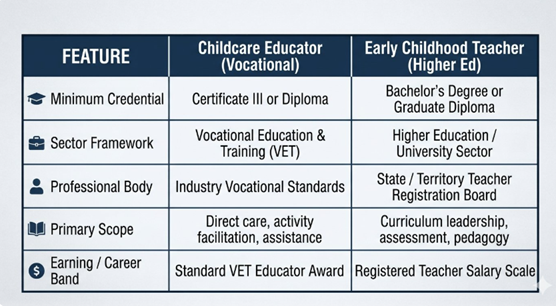
- Certificate III & Diploma in Early Childhood Education and Care: Vocational qualifications that qualify individuals for roles as early childhood educators, room leaders, or center assistants. Note: These are non-teaching qualifications.
- Bachelor of Education (Early Childhood / Primary): A four-year undergraduate degree that fully qualifies graduates as registered early childhood teachers across preschools, kindergartens, and early learning centers.
- Graduate Diploma in Early Childhood Education: An accelerated 1-year postgraduate pathway designed for individuals who already hold a bachelor’s degree in another discipline and wish to transition into teaching.
- Master of Teaching (Early Childhood): A 2-year postgraduate degree combining advanced pedagogical research, leadership training, and required teaching placements.
Teaching Qualification vs Childcare Qualification
A common misconception is treating childcare educators and registered early childhood teachers as identical roles:
What Is ACECQA and Why Does It Matter?
The Australian Children’s Education and Care Quality Authority (ACECQA) is the independent national authority that oversees the National Quality Framework (NQF) for early childhood education and care across Australia.
Understanding ACECQA Accreditation
ACECQA assesses and approves higher education and vocational courses to ensure they meet mandatory national standards. Their approval process evaluates course content, structural design, faculty qualifications, and the quality of supervised professional placements.
Why Course Approval Matters
Enrolling in an unapproved degree can prevent you from working as a recognized Early Childhood Teacher (ECT) under NQF staffing ratios. Australian law requires early learning centers, long day care facilities, and preschools to employ a specific ratio of ACECQA-approved ECTs based on service size.
ACECQA and Professional Recognition
While ACECQA approves the qualification, it does not directly register individual teachers. ACECQA sets the benchmark for educational qualifications nationwide, while state and territory bodies handle formal teacher registration.
How Early Childhood Teaching Courses Connect With Teacher Registration
Securing your qualification is the first major milestone, but working in many Australian states requires official Australian teacher registration.
State and Territory Registration Requirements
Teacher registration is regulated at the state and territory level, meaning rules and processes vary depending on where you intend to practice:
- New South Wales (NSW): Regulated by the NSW Education Standards Authority (NESA).
- Victoria (VIC): Overseas and local ECT registration is managed by the Victorian Institute of Teaching (VIT).
- Queensland (QLD): Regulated by the Queensland College of Teachers (QCT).
- Western Australia (WA): Managed by the Teacher Registration Board of Western Australia (TRBWA).
- South Australia (SA): Regulated by the Teachers Registration Board of South Australia (TRBSA).
Qualification Assessment and Registration Criteria
Beyond holding an approved degree, registration authorities evaluate:
- Working with Children Checks (WWCC): Valid state-based background clearance.
- Suitability and Professional Fitness: Declarations of character, health, and clean criminal history records.
- English Language Proficiency: Non-native English speakers typically must demonstrate high band scores on tests like IELTS Academic (or present proof of recognized studies in an English-speaking country).
7 Things to Check Before Choosing Early Childhood Teaching Courses
1. Course Recognition and Accreditation Status
Ensure the program is recognized by both ACECQA for national early childhood staffing requirements and your local state teacher registration authority for school/kindergarten teaching.
2. Verified ACECQA Approval
Confirm the degree title appears explicitly on the official ACECQA approved qualifications list. Institutions may offer general “Education Studies” degrees that do not qualify you as an ECT.
3. Study Duration and Delivery Mode
Compare program timelines. Undergraduate bachelor degrees usually take 3 to 4 years full-time, while graduate diplomas (1 year) and master’s degrees (2 years) offer faster pathways for existing degree holders.
4. Supervised Practical Placement Hours
Supervised professional experience is mandatory. ACECQA requires a minimum number of supervised placement days (typically 60 to 80 days depending on the degree structure) in approved birth-to-five and school settings.
5. Entry and English Language Requirements
Check minimum academic entry benchmarks, prerequisite units (such as high school mathematics and English), and specific language proficiency scores required for admission.
6. State-Specific Registration Pathways
Verify whether the degree qualifies you to teach across both early childhood settings (0–5 years) and early primary school grades (Prep–Year 2), as this varies by state registration rules.
7. Post-Graduation Career Outcomes
Look into employment placement rates, career support services, university employer partnerships, and regional job demand in your target location.
What Are ACECQA Approved Degrees?
ACECQA approved degrees are specific higher education qualifications formally assessed and recognized as meeting the national criteria for Early Childhood Teacher status under the NQF.
How to Check a Degree Before Enrolling
- Visit the Official ACECQA Portal: Access the ACECQA Approved Qualifications Database.
- Search by Exact Degree Title: Type in the complete qualification title (e.g., Bachelor of Education (Early Childhood)).
- Filter by Institution: Select your target university to ensure their exact delivery mode and campus location are listed.
- Review Specific Approval Dates: Check that the approval covers your intended start year, as accreditations are periodically renewed.
- Confirm State Registration Match: Cross-reference the degree with your local state teacher regulatory board.
Why the Exact Qualification Title Matters
Universities often offer similar-sounding degrees with vastly different career outcomes. For instance, a Bachelor of Early Childhood Studies might focus on policy and administration without granting teaching status, whereas a Bachelor of Education (Early Childhood) grants full teaching recognition. Always verify the exact title.
Curriculum Covered in Early Childhood Teaching Courses
An accredited curriculum equips educators with theoretical insights and hands-on teaching skills tailored to young learners.
Child Development
Courses dive into brain development, emotional self-regulation, motor skill milestones, and language acquisition during the foundational early years.
Early Learning and Curriculum Frameworks
Students learn how to implement the Early Years Learning Framework (EYLF) and state primary school curricula. You learn to turn play into intentional learning experiences covering early literacy, numeracy, science, and creative arts.
Inclusion and Diversity
Educators are trained to build culturally responsive classrooms. Coursework focuses on incorporating Aboriginal and Torres Strait Islander perspectives, supporting neurodivergent children, and working with culturally and linguistically diverse (CALD) communities.
Professional Practice and Placements
Placements provide structured mentorship in real-world settings. Students practice documentation, lesson planning, behavioral support, parent communication, and reflective teaching practices.
From Graduation to Nursery Employment
Graduating from an approved course opens up diverse career environments across Australia’s growing early education sector.
Employment Settings
- Long Day Care Services: Leading educational programs for children aged 0 to 5 in full-day centers.
- Stand-Alone Preschools & Kindergartens: Delivering structured sessional kindergarten programs (3- and 4-year-old rooms).
- Early Childhood Intervention Services: Supporting children with developmental delays or specialized learning needs.
- Primary Schools: Teaching Foundation/Prep through Year 2 (if holding a dual-accredited Early Childhood/Primary degree).
- Center Management & Leadership: Progressing into Educational Leader, Assistant Director, or Center Director roles.
What Employers Look For
- Recognized Qualifications: Proof of an ACECQA-approved degree or current enrollment status.
- Teacher Registration or Eligibility: Active state teacher registration or official eligibility documentation.
- Child Safety Clearances: Valid Working with Children Check (WWCC) and First Aid/CPR certifications.
- Practical Experience: Demonstrated success during teaching placements and strong professional references.
- Strong Communication: Ability to collaborate with colleagues, engage young children, and build trust with parents.
Early Childhood Teaching Courses for International Students
Australia remains a major destination for international students pursuing early education qualifications due to high industry demand and clear post-study pathways.
International Entry Requirements
- Academic Prerequisites: Equivalent completion of Australian Year 12 or a recognized undergraduate degree for postgraduate courses.
- English Proficiency Benchmarks: Higher education entry usually requires an overall IELTS Academic score of 6.5 to 7.0 (or equivalent TOEFL/PTE scores), with specific minimums in speaking and listening.
- Student Visa (Subclass 500) Compliance: Enrolling in a registered CRICOS course and meeting financial and health insurance obligations.
Registration and Post-Study Work Considerations
International graduates planning to apply for Australian teacher registration must pay close attention to English language standards. Registration bodies like VIT or NESA often require high English proficiency scores (e.g., IELTS Academic scores of 7.0 in Reading/Writing and 8.0 in Speaking/Listening) unless you meet specific exemptions, such as completing at least 3 to 4 full years of higher education in an approved English-speaking nation.
Australian Teacher Registration Explained
Navigating Australian teacher registration requires understanding that Australia operates a state-based regulatory framework rather than a centralized national registration board.
Why Location Matters
If you graduate in Victoria and plan to work in New South Wales, you must apply directly for registration with NESA using Mutual Recognition provisions. Each state board maintains its own fee schedules, continuing professional development (CPD) quotas, and administrative deadlines.
Registration Is Separate From University Admission
Gaining admission to a university education program does not automatically guarantee teacher registration upon graduation. You must independently satisfy all police checks, child protection screenings, and language requirements set by your state’s registration board at the time of application.
How to Choose the Right Early Childhood Teaching Course
Use this simple decision matrix when evaluating your options:
- Clarify Your Long-Term Career Goal: Determine whether you want to teach exclusively in early learning centers (0–5 years) or preserve the option to teach in primary schools (Prep–Year 2).
- Match Degree Level to Previous Studies: If you already hold an unrelated bachelor’s degree, look for accelerated 1-year Graduate Diplomas or 2-year Master of Teaching programs instead of starting a 4-year bachelor’s degree from scratch.
- Verify Current Accreditation: Always check the live ACECQA database and state registration websites directly rather than relying solely on university brochures.
Common Mistakes to Avoid
- Enrolling in a Non-Approved Program: Assuming every degree with “Early Childhood” in its title leads to registered teacher status.
- Confusing Educators with Teachers: Assuming a Certificate III or Diploma in Childcare allows you to work as an Early Childhood Teacher (ECT).
- Ignoring State English Standards: Failing to plan for strict state registration English proficiency requirements early in your studies.
- Selecting Courses Based On Fees Alone: Choosing the cheapest course without verifying whether it includes the required placement support and state accreditation.
Final Thoughts
Enrolling in the right early childhood teaching courses lays the foundation for a impactful career in Australia’s early education sector. By verifying ACECQA course approval, understanding state-specific Australian teacher registration rules, and completing required practical placements, you can step confidently into early learning centers, preschools, and kindergartens across the country.
FAQs About Early Childhood Teaching Courses
1. What are early childhood teaching courses?
Early childhood teaching courses are accredited higher education degrees (such as a Bachelor of Education or Master of Teaching) that prepare educators to teach young children from birth to age eight. They cover child psychology, curriculum planning, play-based learning, inclusion, and supervised classroom placements.
2. What does ACECQA do in early childhood education?
ACECQA (Australian Children’s Education and Care Quality Authority) is the national statutory body that oversees the National Quality Framework (NQF). ACECQA assesses and approves higher education and vocational qualifications to ensure they meet national standards for early childhood educators and teachers.
3. Are ACECQA approved degrees enough for teacher registration?
While holding an ACECQA-approved degree satisfies the educational qualification requirement, it is only one step. To receive official teacher registration, applicants must also meet state-based requirements, including Working with Children Checks, suitability assessments, and English language proficiency standards.
4. Can international students work in Australian early childhood education?
Yes. International students who complete recognized qualifications can work in Australian early learning centers and preschools. However, they must satisfy visa conditions, English language requirements for teacher registration, and hold valid state child safety clearances.
5. What careers can follow early childhood teaching courses?
Graduates can work as Early Childhood Teachers (ECTs), Room Leaders, or Educational Leaders in preschools, kindergartens, long day care centers, and early intervention facilities. Those holding dual-accredited degrees can also teach in early primary school grades (Prep/Foundation to Year 2).