After more than a decade in the workplace, going back to business school can feel like a major commitment. A fast track MBA for working professionals offers a shorter route to advanced business knowledge, strategic decision-making skills, leadership opportunities, and career growth.
This GL Campus guide explores when a fast track MBA makes sense and when a traditional or executive program may be a better option.
7 Reasons to Choose a Fast Track MBA for Working Professionals
Whether an accelerated MBA fits your goals after 10 or more years of professional experience depends on your career objectives, previous qualifications, industry, and preferred learning format.

1. Accelerate Your Leadership Development
An accelerated MBA strengthens strategic thinking, financial acumen, decision-making frameworks, and organizational leadership capabilities.
It helps bridge the gap between functional execution and macro-level corporate leadership, preparing professionals for: • Senior management positions • Departmental and division leadership • General management oversight • Executive and C-suite placement
2. Turn Professional Experience Into Strategic Knowledge
Experienced specialists often understand their specific functional role exceptionally well—whether in engineering, IT, operations, or marketing—but may lack broader mastery across corporate finance, global strategy, supply chain management, and organizational dynamics. A fast track MBA transforms tactical expertise into comprehensive business strategy.
3. Support MBA Career Progression
Earned credentials directly support MBA career progression by opening doors to general management, management consulting, corporate strategy, or entrepreneurial pathways. While an MBA is not an automatic promotion, combining a recognized credential with 10+ years of operational experience creates a highly competitive executive profile.
4. Save Valuable Time
An accelerated MBA allows professionals to complete formal business education in 10 to 12 months rather than two full years. This significantly reduces opportunity costs, enabling students to minimize career interruption and apply new frameworks to their work almost immediately.
5. Strengthen Your Executive Profile
A master’s degree complements years of practical experience, demonstrating to corporate boards, headhunters, and executive recruiters that your practical achievements are backed by formal knowledge in business administration and corporate governance.
6. Expand Your Professional Network
Studying alongside a selective cohort connects you with senior peers, industry experts, faculty, and cross-sector leaders. Networking after 10 years of professional experience is particularly powerful because classmates are often in positions to partner on business ventures, share executive talent, or influence hiring decisions.
7. Prepare for a Major Career Change
A fast track MBA for experienced professionals provides the foundational business knowledge and credibility required when pivoting into a new industry, transitioning from technical roles to business operations, or launching an entrepreneurial venture.
Is a Fast Track MBA for Experienced Professionals Worth It After 10 Years?
Professional experience changes the fundamental value proposition of a business degree. Someone with 10 or more years of experience already possesses strong practical skills, industry knowledge, and operational confidence. However, they may benefit significantly from structured business education, advanced financial frameworks, and executive management training.
Your Experience Can Make the MBA More Valuable
Working professionals connect academic concepts directly with real workplace situations. Instead of learning strategy theoretically, experienced students analyze case studies using their own history of corporate successes, project failures, and market challenges. This peer-to-peer exchange elevates classroom discussions beyond basic textbook knowledge.
You May Not Need a Traditional Entry Level MBA
Traditional full-time MBAs often cater to early-career professionals seeking entry-level management positions or basic corporate exposure. Professionals with substantial experience gain far greater return on investment from programs designed specifically for managers and senior leaders.
MBA for Senior Professionals vs Fast Track MBA
An MBA for senior professionals emphasizes executive decision-making, governance, and high-level strategic alignment, whereas a fast track MBA for experienced professionals focuses primarily on rapid completion timelines and condensed learning schedules.
When a Fast Track Format Makes Sense
• You possess 8 to 12+ years of workplace experience. • You prioritize faster program completion and lower opportunity costs. • You have clear career goals and do not require extensive exploration time. • You can manage an intensive, high-density study schedule.
When a Traditional MBA May Be Better
• You require extended time for summer internships or industry pivots. • You seek extensive elective customization and academic research depth. • You prefer a slower academic pace spread over two full years.
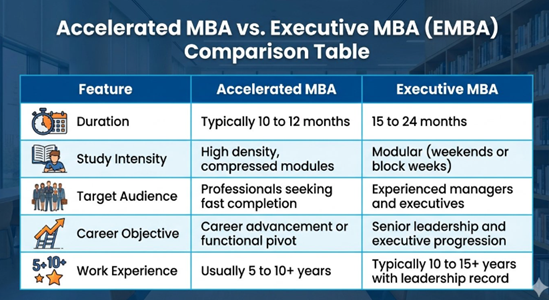
Accelerated MBA vs Executive MBA
Understanding the structural differences between an accelerated MBA and an Executive MBA (EMBA) helps candidates choose the format that aligns best with their schedule and seniority.
Pursuing an executive MBA Dubai positions professionals inside a premier global commercial hub connecting Middle Eastern, Asian, African, and European markets.
What Should You Check Before Choosing a Fast Track MBA for Experienced Professionals?
Accreditation and Institutional Recognition
Verify international program accreditations—such as AACSB, AMBA, or EQUIS—before enrolling in any fast track MBA for experienced professionals to ensure global recognition
Admission Requirements
Check specific candidate criteria regarding minimum years of managerial experience, undergraduate academic performance, English proficiency, and professional references.
Program Duration and Study Intensity
A shorter timeline means a heavier weekly academic workload. Ensure the study commitments align with your current professional demands and personal life.
Curriculum Relevance
Review the syllabus to confirm that core modules and electives cover strategic business subjects aligned with your long-term career goals.
Return on Investment (ROI)
Evaluate total tuition costs, potential salary increases, career advancement opportunities, and time saved to assess overall professional value.
How to Decide if a Fast Track MBA for Experienced Professionals Fits Your Career
Where Do You Want to Be in 3 to 5 Years?
Identify whether your primary target is senior corporate management, general executive leadership, management consulting, or entrepreneurship.
What Is Missing From Your Current Profile?
Determine whether your profile lacks formal business credentials, cross-functional strategic knowledge, advanced corporate finance skills, or executive network access.
Can You Manage an Intensive Program?
Evaluate your current workload, travel schedule, family commitments, and available weekly study hours against the demands of a fast track timeline.
Will the MBA Support Your Long Term Goals?
Choose a program because it directly supports a defined career outcome rather than simply because it offers a quick completion time.
Final Verdict: Is a Fast Track MBA for Experienced Professionals a Smart Move?
A fast track MBA for experienced professionals offers a highly effective pathway to executive leadership, strategic mastery, and accelerated MBA career progression. For candidates with 10 or more years of experience, balancing speed, rigorous curriculum, accreditation, and cost ensures your business degree delivers lasting executive value.
FAQs About Fast Track MBA for Experienced Professionals
Is a fast track MBA suitable after 10 years of work experience?
Yes, a fast track MBA for experienced professionals is tailored for mid-to-senior candidates who want to strengthen leadership credentials and strategic knowledge without taking a multi-year break from their careers.
Is an accelerated MBA better than an Executive MBA?
Neither option is inherently better. An accelerated MBA suits candidates who prioritize faster completion, while an Executive MBA fits working managers seeking a lower weekly course density spread over a longer period.
Can an MBA improve career progression for senior professionals?
An MBA supports MBA career progression by pairing formal strategic management knowledge with existing operational experience, helping candidates qualify for senior general management and executive positions.
Should experienced professionals consider an Executive MBA Dubai?
An executive MBA Dubai is ideal for candidates seeking international business exposure, access to multinational corporate networks, and career opportunities across high-growth GCC markets.
How quickly can an accelerated MBA be completed?
Most accelerated MBA programs can be completed within 10 to 12 months, depending on the academic institution and course delivery structure.