
I’m Saad Asif, the CEO of Directions Solutions, and in my experience of more than a decade, SaaS buyers rarely purchase software on impulse. They search with specific problems, feature requirements, and product comparisons in mind. In SEO, Competitor keyword analysis for SaaS helps you uncover those exact search opportunities by evaluating where competing software brands gain organic and paid visibility.
Instead of guessing which keywords might drive qualified traffic, analyzing your search competitors lets you identify proven demand, find traffic gaps, and construct a search engine strategy optimized for pipeline growth.
What Is Competitor Keyword Analysis for SaaS?
Competitor keyword analysis for SaaS is the process of discovering, analyzing, and targeting the search terms driving organic rankings and paid ad traffic to competing software platforms.

SaaS companies face distinct customer acquisition challenges that standard SEO approaches do not always solve:
- Long sales cycles: Buyers perform multi-stage research across awareness, consideration, and decision phases.
- High Customer Acquisition Costs (CAC): Bidding on generic terms without intent analysis quickly burns ad spend.
- Aggressive commercial competition: Top-performing transactional terms are saturated with review sites, direct rivals, and aggregators.
- Specific search patterns: Potential buyers heavily search for feature comparisons, problem-solving software, and alternative solutions.
3 Steps for Effective Competitor Keyword Analysis for SaaS
To build an efficient search strategy, you need a structured workflow that translates raw keyword data into clear marketing priorities.
1. Identify Your Real SaaS Search Competitors
Your business competitors are not always your search competitors. A company offering an enterprise CRM might compete with you commercially, but review platforms or industry publications might dominate the SERPs for your primary search terms.
Analyze two distinct categories of search competitors:
- Direct SaaS competitors: Products offering similar functionality to the same target audience.
- Indirect & SERP competitors: Review aggregators, industry blogs, alternative solution lists, and comparison websites taking up valuable SERP real estate.
2. Build a Competitor Keyword List
Collect organic and paid keyword export data from direct and indirect competitor domains. Once gathered, categorize the keywords into structured buckets:
- Product & Solution Keywords: Terms describing core software functionality.
- Feature-Specific Keywords: Long-tail queries around specific capability requirements.
- Problem-Solving Keywords: Pain-point queries focused on a challenge your software solves.
- Comparison Keywords: Queries comparing two or more solutions side by side.
- Alternative Keywords: High-intent searches looking for alternatives to established market leaders.
- Pricing Keywords: Bottom-of-funnel searches seeking tier breakdowns, cost estimates, or demo options.
Tip: Cross-reference competitor keyword lists with your internal Google Search Console and Google Ads data to validate search volume and baseline performance.
3. Find Keyword Gaps Your Competitors Own
Keyword gap analysis highlights terms where competitors receive search visibility while your SaaS platform has zero coverage or low ranking positions. Focus on discovering:
- Bottom-of-funnel queries driving trial or demo conversions for rivals
- Relevant low-competition, long-tail search terms
- Feature-level queries where competitors lack dedicated landing pages
- Direct comparison and “versus” search queries
Look Beyond Search Volume
Search volume can be misleading in B2B SaaS SEO. A keyword with 100 monthly searches containing strong commercial intent often delivers significantly higher ROI than an informational query with 10,000 monthly searches.
When analyzing competitor terms, evaluate:
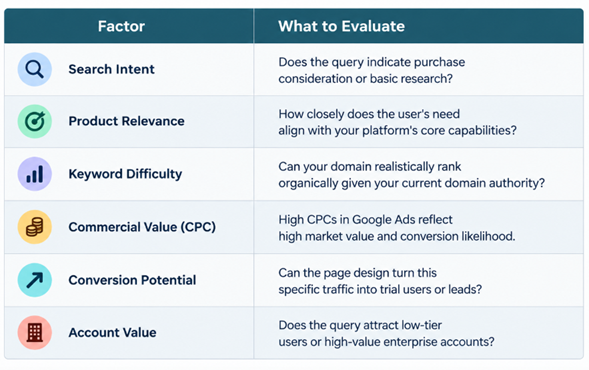
- Search Intent: Does the user want information, or are they actively evaluating software?
- Conversion Potential: Can this query realistically generate sign-ups, leads, or demo requests?
- Customer Lifetime Value (LTV): Does this term attract target accounts matching your ideal customer profile (ICP)?
How to Use Competitor Keyword Analysis for SaaS for Paid Search
Competitor keyword data provides direct insight into your rivals’ paid search strategies, allowing you to optimize your Google Ads budget and capture ready-to-buy prospects.
Discover High-Intent PPC Keywords
Identify the exact terms your competitors pay to target continuously. Persistent paid ad spend generally indicates profitable conversion rates. Look for:
- Pricing and subscription cost queries
- Direct software comparison terms
- Solution-focused queries targeting urgent pain points
- Enterprise-level software queries
Analyze Competitor Ad Messaging
Examine the search copy, ad extensions, and landing page offers your competitors deploy for specific keyword clusters:
- Headlines & Angles: Note whether competitors emphasize ease of use, lower price, setup speed, or specific features.
- Value Propositions: Identify unique selling points highlight in primary ad copy.
- Calls to Action (CTAs): See if they promote free trials, interactive demos, ROI calculators, or custom quotes.
Use these insights to position your SaaS offer distinctively rather than simply copying competitor ad copy.
Use Competitor Data to Discover Content Opportunities
Competitor keyword intelligence should form the backbone of your inbound content marketing roadmap.
Create Content Around Buyer Questions
Build dedicated landing pages and blog content matching specific stages of user research:
- SaaS Comparison Pages: Transparent breakdown pages comparing your tool against key competitors.
- Alternative Pages: Dedicated landing pages optimized for searchers looking for alternatives to market leaders.
- Feature Guides & Use Cases: Deep-dive guides explaining how your product solves specific industry problems.
- Integration Pages: Pages targeting queries for software tools your platform connects with natively.
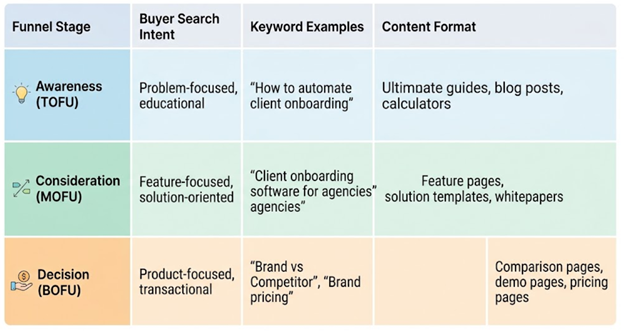
Target Different SaaS Funnel Stages
Align keyword selection with the buyer journey:
How to Prioritize Competitor Keyword Opportunities
Uncovering thousands of competitor search terms can lead to analysis paralysis. Use a structured framework to prioritize which opportunities to tackle first:
Focus on Commercial Intent
Always prioritize bottom-of-funnel (BOFU) terms over broad top-of-funnel (TOFU) topics when launching new campaigns. High-intent terms convert faster and produce a direct impact on monthly recurring revenue (MRR).
Common Mistakes in Competitor Keyword Analysis for SaaS
Avoid these frequent pitfalls when building your SaaS keyword strategy:
- Copying Every Competitor Keyword: Targeting terms outside your product’s core capabilities leads to high bounce rates and low conversion metrics.
- Ignoring Search Intent: Driving traffic to a landing page that fails to fulfill the user’s specific stage in the research process wastes resources.
- Focusing Only on High-Volume Keywords: Overlooking low-volume, high-intent queries leaves profitable conversion opportunities on the table.
- Forgetting Your Unique Value Proposition (UVP): Competitor research should guide strategy, but your positioning must highlight your product’s distinct advantages.
Tools for Competitor Keyword Analysis for SaaS
Executing competitor keyword intelligence effectively requires specialized SEO and PPC platforms:
- Semrush: Excellent for keyword gap analysis, organic position tracking, and paid search campaign monitoring.
- Ahrefs: Ideal for deep content gap exploration, backlink intelligence, and organic keyword discovery.
- Google Ads Keyword Planner: Provides official Google search volume estimates and CPC benchmarks for paid targets.
- Google Search Console: Essential for comparing competitor search opportunities against your existing organic performance.
- SpyFu: Useful for historical PPC campaign data, competitor ad copy analysis, and search spend tracking.
Turn Competitor Keyword Data Into SaaS Growth
Keyword intelligence only drives business growth when translated into an organized marketing workflow:
Competitor Analysis⟶Keyword Discovery⟶Intent Classification⟶Prioritization⟶Execution⟶Conversion Tracking
- Research & Uncover: Identify competitor search terms across paid and organic channels.
- Classify & Map: Organize keywords by search intent and buyer journey stage.
- Prioritize: Select terms based on conversion potential, CPC, and product relevance.
- Publish & Launch: Build optimized landing pages, comparison content, and targeted Google Ads campaigns.
- Analyze & Refine: Track demo/trial conversion rates and continually refine page messaging.
Final Takeaway
Conducting competitor keyword analysis for SaaS provides a clear roadmap to capture market share across organic search, paid campaigns, and targeted content. Focus on evaluating search intent, commercial value, and customer needs rather than simply duplicating competitor strategies.
Actionable Strategy: Identify what market rivals capture, discover the intent gaps they overlook, and build a targeted search strategy around the high-value keywords that best reflect your product’s core strengths.
Frequently Asked Questions
What is competitor keyword analysis for SaaS?
Competitor keyword analysis for SaaS is the structured process of evaluating the organic rankings, paid advertising terms, and content strategies of competing software companies. It allows SaaS marketers to identify high-value search terms, uncover keyword gaps, and launch higher-performing SEO and PPC campaigns.
How do I find SaaS competitor keywords?
You can discover competitor keywords by running domain comparisons using research platforms such as Semrush, Ahrefs, or SpyFu. Input competitor URLs into keyword gap features to extract terms where rivals receive search visibility, then filter the results by intent, search volume, CPC, and relevance.
Why is competitor keyword analysis important for SaaS companies?
Because SaaS customer acquisition costs can be exceptionally high, competitor keyword analysis helps teams avoid wasting budget on low-converting queries. It reveals existing search demand, clarifies buyer intent, and highlights conversion opportunities that competing platforms miss.
Should SaaS companies target competitor brand keywords?
Targeting competitor brand keywords—such as competitor name alternatives or comparison terms—can capture prospects actively evaluating software choices. However, running paid campaigns on competitor brand names requires clear legal compliance, high landing page relevance, and careful ROI evaluation.
How often should SaaS companies perform competitor keyword analysis?
SaaS marketing teams should conduct a comprehensive competitor keyword analysis quarterly, while monitoring high-priority paid keywords and main SERP ranking fluctuations monthly. Regular updates ensure your content strategy adapts as competitors release new features and change campaign messaging.