
Choosing where to pursue higher education abroad is no longer just about university rankings or tuition fees. For ambitious international students, what happens after graduation is equally critical. Understanding post study work rights helps students compare how long they can remain, how much they can work, and what professional pathways exist after graduation in the UK and Australia.
This GL Campus comprehensive guide evaluates both destinations across visa durations, working conditions, graduate routes, regional opportunities, and long-term migration considerations.
Post Study Work Rights in the UK

How the UK Graduate Route Works
The UK Graduate visa offers eligible international graduates the permission to stay and work, or look for work, following the successful completion of an eligible course at an approved UK higher education provider.
- No Sponsorship Required: Graduates do not need a job offer or an employer endorsement to apply.
- Study Levels: Available to students who completed a bachelor’s degree, master’s degree, or doctoral qualification.
- Single-Use Route: The Graduate visa can only be granted once in a student’s lifetime.
How Long Can Graduates Stay in the UK?
The validity period of the UK Graduate visa depends on the qualification level and application date:
- Bachelor’s and Master’s Degrees: Grants 2 years of stay (for applications lodged on or before December 31, 2026). For applications lodged on or after January 1, 2027, the duration changes to 18 months.
- PhD / Doctoral Qualifications: Grants 3 years of stay, regardless of the application date.
The Graduate Route is remarkably flexible. Graduates can work in almost any sector at any skill level, engage in self-employment, or undertake freelance work. This versatility makes it an appealing choice for foreign scholars looking to build early-career UK work experience.
Post Study Work Rights in Australia
Understanding the Temporary Graduate Visa
Australia’s Temporary Graduate visa (subclass 485) allows international students who have completed at least two academic years of CRICOS-registered study in Australia to live and work temporarily.
- Primary Streams: The Post-Higher Education Work stream applies to higher education graduates, while the Post-Vocational Education Work stream caters to trade and vocational qualifications.
- Age Limits: Applicants must generally be aged 35 or under at the time of application.
How Long Can International Graduates Stay in Australia?
Under Australia’s updated regulations, stay durations for the Post-Higher Education Work stream depend directly on the degree level:
- Bachelor’s Degree (including Honours): 2 years.
- Master’s by Coursework: 2 years.
- Master’s by Research: 3 years.
- PhD / Doctoral Degree: 3 years.
- Passport-Specific Provisions: Extended durations apply for select passport holders (e.g., up to 5 years for Hong Kong and BNO passport holders, and specific extensions under trade agreements such as AI-ECTA for Indian nationals).
Holders of the Subclass 485 visa receive full, unrestricted work rights. They can work full-time for any employer across any industry, providing vital opportunities to gain Australian workplace experience.
UK vs Australia Graduate Visa Comparison
The structured matrix below breaks down key differences between the two post-graduation schemes:
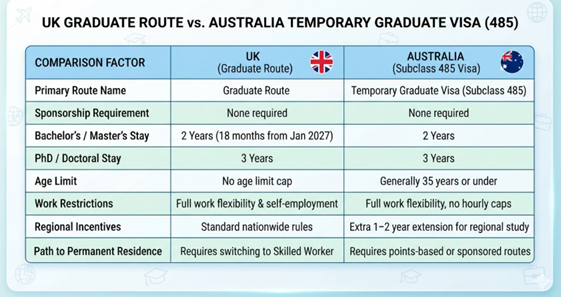
Post Study Work Rights and Working Hours
UK Working Conditions for International Students
There is a strict operational distinction between student visa conditions and post study work rights:
- While Studying: Student visa holders are limited to working a maximum of 20 hours per week during term time, with full-time work permitted only during official university vacation periods.
- After Graduation: Upon transitioning to the Graduate Route, all hourly restrictions are lifted, allowing full-time employment, freelancing, and business operations.
Australia Working Conditions for International Students
Australia maintains clear boundaries between study-phase and post-study phase employment:
- While Studying: Student visa (Subclass 500) holders face a work cap of 48 hours per fortnight during study terms, with unrestricted hours during formal study breaks.
- After Graduation: Subclass 485 visa holders enjoy unrestricted full-time work rights with no fortnightly hour caps.
Focusing solely on working hours during study is a common misstep. A comprehensive graduate visa comparison considers long-term earning potential, local employment demand, average salary benchmarks, and cost-of-living overheads.
UK vs Australia Stay Back Options
Understanding available stay back options helps international students map out realistic multi-year plans.
UK Stay Back Options
The UK Graduate Route provides a temporary bridge. To stay long-term, graduates must transition to another visa category before their Graduate visa expires:
- Skilled Worker Visa: Requires sponsorship from an approved UK employer meeting minimum skill and salary threshold requirements.
- Global Talent or Innovator Founder Routes: Targeted at exceptional talent or entrepreneurs establishing innovative businesses.
Australia Stay Back Options
Australia provides structured avenues for graduates looking to extend their stay:
- Second Post-Higher Education Work Stream: Provides an extra 1 to 2 years of stay for graduates who studied and lived in designated regional areas.
- General Skilled Migration (GSM): Points-based pathways (Subclasses 189, 190, 491) evaluating age, English proficiency, education, and skilled work experience.
- Employer Sponsored Visas: Options like Subclass 482 (TSS) for graduates securing sponsorship from Australian businesses.
Regional Pathways After Graduation
Regional Opportunities in Australia
Regional Australia plays a central role in graduate migration strategies. Graduates who complete their studies at regional campus locations and maintain regional residence can qualify for a Second Temporary Graduate visa, adding 1 to 2 additional years of post-study work rights. Regional state nominations also frequently offer lower points thresholds for permanent residence pathways.
Regional Considerations in the UK
Unlike Australia, the UK immigration system does not offer duration extensions based on regional university locations. However, studying and working in regional UK cities often offers lower living costs and lower local competition for graduate roles, making employer sponsorship through the Skilled Worker route more accessible.
7 Factors to Compare Before Choosing the UK or Australia
Evaluating post study work rights requires balancing several interconnected criteria:
- Graduate Visa Duration: Compare the length of initial stay granted for your specific degree level.
- Age Eligibility Caps: Check whether age caps (such as Australia’s 35-year limit) affect your qualification timing.
- Job Market Alignment: Assess industry demand in your target field within both countries.
- Living Expenses and Visa Fees: Account for visa application charges, medical surcharges, and local living expenses.
- Regional Extension Avenues: Evaluate if extended stay options in regional locations align with your lifestyle preferences.
- Permanent Migration Clarity: Review how straightforward it is to transition from temporary post-study visas into permanent residence.
- Long-Term Career Goals: Consider whether international work experience in the UK or Australia carries greater weight in your home country or target industry.
Which Destination Offers More Flexible Graduate Options?
Neither country is universally superior; the ideal destination depends on your profile and long-term aspirations:
Choose the UK If:
- You prefer nationwide flexibility without age limits on graduate work routes.
- You want the freedom to undertake freelance work, self-employment, or start a company.
- You are targeting career experience in major global financial, tech, or creative hubs.
Choose Australia If:
- You seek extended visa durations through regional study incentives.
- You are under 35 and aiming for point-based permanent residency pathways.
RACC Australia
- You prefer outdoor lifestyle options combined with strong starting salaries in engineering, healthcare, or trades.
Common Mistakes Students Make When Comparing Post Study Work Rights
Avoid these frequent pitfalls during your planning phase:
- Focusing Exclusively on Visa Length: A longer visa duration does not guarantee finding high-quality professional employment if industry demand is low.
- Confusing Student Work Caps with Graduate Rights: Assuming post-study work rights carry the same hourly restrictions as student visas leads to incorrect career expectations.
- Assuming Graduate Visas Guarantee Permanent Residence: Post-study visas are strictly temporary permissions; long-term stay requires meeting separate visa requirements.
- Overlooking Policy Updates: Immigration rules, age limits, and fees change frequently. Always verify requirements on official immigration portals before enrolling.
How to Choose Between the UK and Australia
To make a well-informed decision regarding post study work rights, follow this step-by-step evaluation framework:
- Step 1: Confirm your qualification level and check exact stay durations under current rules.
- Step 2: Verify your age eligibility for Australian visa streams.
IDP Education
- Step 3: Calculate the full cost of study, visa application fees, and healthcare surcharges.
IDP Education
- Step 4: Investigate whether your target profession is listed on Australia’s skilled occupation lists or qualifies for UK Skilled Worker sponsorship.
IDP Education
- Step 5: Select the destination that best aligns with your long-term career and residency objectives.
Final Takeaway
Both the UK and Australia offer robust post-study work frameworks designed to retain foreign talent. While the UK provides uniform, nationwide route flexibility without age caps, Australia offers regional extensions and structured points-based migration options. Evaluating post study work rights early ensures your education investment translates into valuable global career growth.
FAQs About Post Study Work Rights
1. What are post study work rights?
Post study work rights are legal permissions granted by host governments that allow international graduates to stay, live, and work after completing an eligible degree. These provisions allow foreign students to gain professional international work experience without requiring immediate employer sponsorship.
2. Is the UK or Australia better for international graduates?
The ideal choice depends on individual priorities such as career goals, field of study, age, and long-term residency plans. The UK offers flexible nationwide work options without age limits, whereas Australia provides regional visa extensions and structured skilled migration points systems.
3. Can international students work after graduating in the UK?
Yes, eligible international graduates can apply for the UK Graduate Route after completing an undergraduate, master’s, or doctoral degree. This visa allows graduates to work, look for work, or engage in self-employment for 2 years (or 3 years for PhD holders).
4. What are Australia’s stay back options after graduation?
Australia offers the Temporary Graduate visa (subclass 485), granting 2 to 3 years of work rights depending on the qualification level. Graduates who live and study in regional areas may qualify for an additional 1 to 2 year visa extension.
5. Do graduate visas lead directly to permanent residence?
No, post-study graduate visas are temporary stay permissions and do not automatically grant permanent residency. To remain permanently, graduates in both countries must transition into skilled work visas or permanent migration streams meeting specific eligibility criteria.