Choosing an American university can feel overwhelming when prestigious private institutions and top-tier public universities are both on your shortlist. A detailed Ivy League vs Public Ivy US universities comparison between Ivy League and Public Ivy universities helps reveal the core differences in cost, admissions, academic environment, and long-term career outcomes beyond simple brand recognition.
This GL Campus guide explains that both university categories offer exceptional academic rigor, world-class faculty, extensive research infrastructure, and influential global alumni networks.
Ivy League vs Public Ivy Admissions
If you are planning to study in the USA, admissions criteria represent a crucial benchmark when conducting a US university comparison.
Academic Requirements
Both categories demand exemplary academic performance, including top high school GPAs, rigorous coursework (AP, IB, or Honors classes), and strong standardized test scores (SAT/ACT) where submitted. Demonstrating academic mastery and subject-specific passion is non-negotiable for both tiers.
Holistic Admissions in the Ivy League
Ivy League universities evaluate candidates using a deeply holistic review process. Admission officers look far beyond test scores, seeking exceptional leadership, specialized talents, compelling personal essays, strong letters of recommendation, and unique background perspectives that contribute to a vibrant campus community.
Public University Admissions Dynamics
Public Ivies also practice holistic review, but state mandates often influence their selection process. Many public flagships are required to reserve a majority of their seats for instate residents, making out-of-state and international admissions significantly more competitive. Furthermore, public universities often evaluate applicants directly based on their intended major or specific college within the university (e.g., Engineering or Business).
US University Comparison at a Glance
Cost of Studying at Ivy League and Public Ivy Universities
Understanding the distinction between published tuition rates and the actual out-of-pocket cost is essential for financial planning.
Tuition and Fees
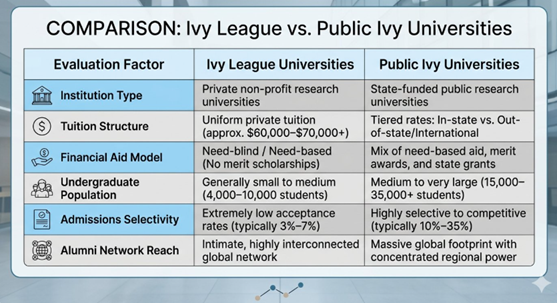
- Ivy League: Published tuition rates are uniformly high across all students, regardless of state or national origin, typically exceeding $60,000 annually for tuition alone.
- Public Ivies: Offer heavily discounted tuition rates for in-state taxpayers (often $10,000–$15,000 per year), while out-of-state and international students pay rates comparable to private universities ($40,000–$55,000 per year).
Living Expenses & Total Cost of Attendance (COA)
Tuition is only one part of the equation. A complete US university comparison must account for room and board, health insurance, technology fees, textbooks, travel, and personal living expenses. In major metropolitan areas (e.g., Columbia in New York City), living costs can substantially increase the overall annual bill.
Financial Aid in a US University Comparison
Financial aid policies vary drastically between private Ivy League institutions and state-funded Public Ivies.
Need-Based Financial Aid
Ivy League institutions possess multi-billion-dollar endowments, allowing them to offer some of the most generous need-based aid packages in the world. Most Ivies are 100% grant-based (no loans required) and cover full demonstrated financial need, often offering free tuition to families earning below specific income thresholds (e.g., under $85,000/year).
Merit Scholarships
- Ivy League: The Ivy League agreement strictly prohibits awarding academic or athletic merit scholarships. All financial assistance is based solely on calculated financial need.
- Public Ivies: Offer competitive merit-based scholarships, honors college stipends, and talent awards designed to attract top-performing students regardless of family income.
International Student Funding
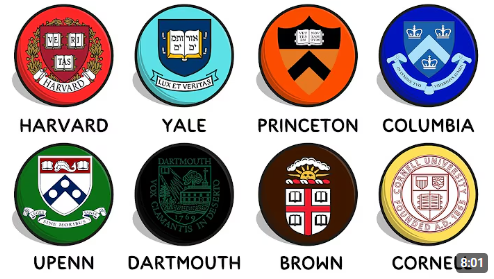
- Ivy League: Select Ivy League schools (such as Harvard, Princeton, Yale, Dartmouth, and MIT) maintain need-blind admission policies for international students while meeting 100% of demonstrated financial need.
- Public Ivies: Financial aid for international students is extremely limited at public universities, as state funds are legally prioritized for local residents. International applicants must usually demonstrate full self-funding capabilities.
Campus Culture and Student Experience
The day-to-day student experience varies based on institutional size, traditions, and campus culture.
Ivy League Campus Culture
Ivy League campuses feature tight-knit undergraduate communities, historical architecture, rich traditions, and an academically intense environment. With smaller student bodies, undergraduates often benefit from high levels of institutional funding per student, seamless access to professors, and a collaborative yet challenging academic climate.
Public Ivy Campus Culture
Public Ivies boast vibrant, high-energy campus environments characterized by diverse student populations, sprawling campuses, extensive school spirit, major NCAA Division I athletics, and hundreds of student organizations. The atmosphere combines academic rigor with a traditional American college town experience.
Academic Programs and Research Opportunities
Academic flexibility and research access define the educational value of both school types.
Undergraduate Majors & Academic Flexibility
Ivy League universities often emphasize flexible liberal arts curricula or open core structures that encourage interdisciplinary exploration. Public Ivies offer an expansive range of specialized majors, professional undergraduate programs (e.g., Nursing, Architecture, Supply Chain Management), and direct-entry professional schools.
Research Infrastructure
Both Ivy League and Public Ivy schools are tier-one research powerhouses. Public Ivies frequently host massive, state-backed research facilities, agricultural centers, and medical complexes, offering extensive undergraduate research positions across engineering, natural sciences, and social sciences.
Student-to-Faculty Ratio and Class Experience
Classroom dynamics differ between smaller private universities and large public institutions.
Smaller Classes in the Ivy League
Ivy League universities maintain low student-to-faculty ratios (often 6:1 to 8:1), meaning the majority of undergraduate classes have fewer than 20 students. Seminars and discussion-based learning led directly by tenured professors are standard practice.
Classroom Dynamics at Public Ivies
Public Ivies feature a blend of class formats. While upper-level major courses and honors seminars are small and collaborative, introductory foundational lectures can seat several hundred students and may feature graduate teaching assistants leading discussion sections.
Career Opportunities and Employer Networks
Career outcomes and recruitment channels remain a primary driver for prospective applicants.
Ivy League Alumni Networks
The global prestige of Ivy League institutions grants graduates access to an exceptionally influential and tight-knit alumni network. Top-tier management consulting firms, bulge-bracket investment banks, elite tech firms, and competitive graduate programs actively target Ivy League campuses during on-campus recruiting.
Public Ivy Employer Connections
Public Ivies maintain massive, highly active alumni networks with dominant footprints in major regional economic hubs and major corporate sectors. Their career centers organize large-scale career fairs attracting thousands of regional and national employers, providing excellent pathways into industry.
Location Matters in a US University Comparison
Geographic setting impacts internships, personal lifestyle, and post-graduation job placement.
- Urban Universities (e.g., Columbia, UPenn): Offer direct access to global corporate headquarters, cultural institutions, networking events, and year-round local internships.
- College Towns (e.g., Cornell, UVA, UNC Chapel Hill): Provide immersive, community-centric campus environments where university life serves as the cultural center of the town.
International Students and US Universities
Navigating US higher education requires careful attention to immigration and support systems.
Student Visa Considerations
International students attending either university type receive administrative backing to obtain F-1 student visas. Both school categories provide access to Optional Practical Training (OPT) and STEM OPT extensions, enabling international graduates to work in the United States post-graduation.
Support Services & Campus Integration
Leading universities offer dedicated international student centers that assist with visa compliance, cultural transition, academic advising, and career workshops tailored to non-US citizens.
Ivy League or Public Ivy: Which Is Better for Your Goals?
Choose an Ivy League University If:
- You qualify for substantial need-based financial aid or require need-blind admission as an international student.
- You thrive in smaller, seminar-style classes with direct professor access.
- You prefer a smaller undergraduate community with specialized liberal arts focus.
- You aim to enter industries with highly centralized campus recruiting (e.g., elite strategy consulting, high finance).
Consider a Public Ivy If:
- You qualify for in-state tuition or secure significant merit scholarships.
- You want a broad choice of specialized technical or professional majors.
- You seek a dynamic campus life with major college sports and large-scale student activities.
- You want strong career placement within specific geographic regions or large industrial networks.
Mistakes to Avoid When Comparing US Universities
- Choosing Based Only on Prestige: Selecting a school solely for its brand name rather than program quality, faculty alignment, and cultural fit can lead to dissatisfaction.
- Ignoring the Net Price Calculator: Looking only at published sticker prices instead of calculating your actual net cost after financial aid can mislead your financial planning.
- Comparing Universities Instead of Programs: An institution’s overall ranking matters less than the specific reputation, resources, and faculty of your intended major.
- Overlooking Location and Regional Hiring: Ignoring where an institution’s employer network is strongest can impact post-graduation job opportunities.
Final Verdict
There is no single university model that works best for every student. A thorough US university comparison demonstrates that both Ivy League and Public Ivy schools deliver elite academic standards and outstanding career launchpads.
Ivy League universities excel in providing intimate academic settings, generous need-based financial aid, and global network density. Public Ivies offer vast program choices, vibrant campus communities, strong regional career pipelines, and excellent value—especially for in-state applicants and merit award recipients. The best choice ultimately depends on which university offers the optimal alignment with your academic goals, personal preferences, and financial situation.
FAQs About US University Comparison
What is a US university comparison?
A US university comparison evaluates higher education institutions across metrics such as tuition costs, financial aid availability, academic requirements, campus culture, class sizes, location, and career placement outcomes to help students make informed enrollment decisions.
Are Public Ivy universities as prestigious as Ivy League universities?
Public Ivies match or exceed Ivy League standards in many academic departments, research output, and specialized fields (such as STEM, business, and computer science). While Ivy League schools carry distinct global brand equity, top employers view Public Ivies with equal academic respect.
Which is more affordable: Ivy League or Public Ivy?
For in-state students, Public Ivies are almost always more affordable upfront. However, for low- to middle-income students (including out-of-state and eligible international applicants), Ivy League schools can sometimes be cheaper due to their robust grant-based financial aid packages.
Do Ivy League schools offer merit-based scholarships?
No. Ivy League institutions do not offer merit, academic, or athletic scholarships. All financial assistance is distributed strictly on the basis of demonstrated financial need.
How should international students compare US universities?
International applicants should prioritize checking financial aid eligibility, visa support services, STEM-OPT designation for their major, total cost of attendance, and campus safety when conducting a US university comparison.