Relocating from Dubai does not always mean starting your academic journey from the beginning. Experienced professionals frequently possess alternative routes into advanced business education. An executive entry MBA provides a strategic pathway for professionals whose executive work experience, leadership history, or professional certifications support advanced academic admission.
This GL Campus guide helps in Understanding which international institutions recognise managerial experience and alternative qualifications allows foreign professionals to access high-value business credentials efficiently.
5 Executive Entry MBA Routes Professionals Can Explore
When seeking advanced business education, professionals transitioning out of Dubai can evaluate five distinct pathways:

An executive entry MBA provides a strategic pathway for professionals whose executive work experience, leadership history, or professional certifications support advanced academic admission. Understanding which international institutions recognise managerial experience and alternative qualifications allows foreign professionals to access high-value business credentials efficiently.
5 Executive Entry MBA Routes Professionals Can Explore
When seeking advanced business education, professionals transitioning out of Dubai can evaluate five distinct pathways:
1. Professional Experience Based Admission
Certain universities offer direct entry into an executive entry MBA based entirely on significant managerial tenure. Candidates without an undergraduate degree usually submit:
- A comprehensive professional CV highlighting leadership milestones.
- Proof of managerial responsibilities and budget control.
- Professional reference letters from senior leadership or board members.
- A reflective personal statement detailing executive readiness.
2. Professional Certificate Based Entry
Specialized professional entry pathways allow professionals holding recognized charterships or certifications to enter postgraduate programs directly. For instance, completing Level 7 executive diplomas or holding chartered accounting credentials often satisfies academic prerequisites for master’s programs.
3. Advanced Standing or Prior Learning Assessment
Recognition of Prior Learning (RPL) allows business schools to evaluate informal and non-formal workplace training. By auditing workplace achievements, universities grant advanced standing, reducing the overall course units required to graduate.
4. Pre MBA or Graduate Level Pathways
For candidates needing an academic bridge, taking a postgraduate certificate or diploma provides a structured route. These short bridging frameworks allow candidates to complete introductory postgraduate modules before transitioning directly into a fast track masters degree completion stage.
5. Executive MBA Through Experience Based Assessment
Top-tier business schools offer Executive MBA (EMBA) programs engineered specifically around peer-level executive learning. These programs place higher weight on executive track records, professional references, and corporate impact than on traditional undergraduate transcripts.
Can You Skip a Bachelor Degree for an MBA?
Bypassing a formal bachelor’s degree to enter a postgraduate program is a major priority for working professionals considering a global career transition. Many accredited universities across the UK, Australia, Europe, and North America offer non-standard entry frameworks that recognize equivalent learning gained through career achievements.
The Role of Professional Experience
Substantial, documented work experience can serve as a primary foundation for postgraduate admission. Universities offering non-degree pathways assess:
- Scope of Responsibility: Strategic oversight, team leadership, and revenue generation.
- Career Trajectory: Steady progression from entry-level roles into decision-making capacities.
- Industry Standing: Recognised performance in competitive sectors like finance, technology, logistics, and real estate.
Can Professional Certificates Replace a Degree?
Professional certifications (such as ACCA, CIMA, PMP, or CIM) demonstrate rigor and subject mastery. While a certificate rarely replaces a degree on a 1:1 basis automatically, universities frequently accept high-level professional qualifications as academic equivalents under formal recognition schemes.
Executive Entry MBA Options When Relocating From Dubai
Relocating from the UAE requires aligning your educational goals with international qualification frameworks.
Moving to regions like Europe, North America, or Australasia alters how your credentials are evaluated:
- Qualification Recognition: Regional accreditation bodies apply strict rules regarding direct degree entry.
- Work Experience Verification: International universities require detailed documentation verifying past roles in the UAE.
- Visa and Migration Rules: Certain post-study work visas require enrollment in specific accredited degree levels.
Documents Professionals Should Prepare Before Moving
Before leaving Dubai, assemble a complete portfolio of professional credentials:
- Service letters and employment verification from past UAE employers.
- Official transcripts or certificates for any completed higher education or diploma courses.
- Verified copies of professional licenses, charters, and technical certifications.
- Updated professional CV mapped to international corporate standards.
- Written references on official company letterheads from senior directors or stakeholders.
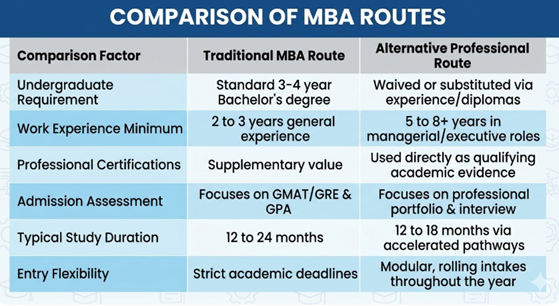
Fast Track Masters Degree vs Traditional MBA Route
The breakdown below contrasts traditional master’s entry against professional admission frameworks:
How to Choose the Right Executive Entry MBA Path
Selecting the correct postgraduate path requires thorough diligence to ensure your degree delivers long-term global value.
Check Accreditation
Ensure the institution holds recognised institutional accreditation and, where applicable, international business school accreditations (such as AACSB, AMBA, or EQUIS). Proper accreditation guarantees global employer recognition and qualification transferability.
Review Entry Requirements
Carefully review eligibility details on official university portals:
- Minimum years of documented leadership experience.
- English language proficiency requirements (such as IELTS Academic or PTE).
- Specific criteria for Recognition of Prior Learning (RPL).
Check Whether the Qualification Supports Your Career Goal
Determine if an executive entry MBA aligns with your ultimate destination:
- Corporate Promotion: Validating executive competence for director-level roles.
- International Career Transition: Securing an internationally recognized credential for new job markets.
- Entrepreneurship: Gaining practical strategic knowledge to scale business ventures.
Common Mistakes Professionals Make
- Assuming Work Experience Automatically Replaces a Degree: Experience strengthens applications, but admissions boards still require structured portfolio evidence.
- Choosing Unaccredited Programs: Enrolling in unaccredited “degree mills” offering instant qualifications leads to non-recognition by employers and visa authorities.
- Confusing Program Duration With Direct Entry: Assuming a fast track masters degree implies simplified academic standards rather than accelerated module pacing.
- Ignoring Country-Specific Recognition Rules: Failing to verify whether your destination country’s immigration framework recognizes alternative-entry degrees.
Is an Executive Entry MBA Right for You?
Ask yourself these core questions before submitting applications:
- Do you possess at least 5 years of documented management or business leadership experience?
- Do you hold professional certifications, charters, or executive diplomas in your field?
- Are you relocating from Dubai and planning to study while working internationally?
- Does your preferred university provide transparent RPL or professional entry guidelines?
- Is the target business program fully accredited by recognized educational authorities?
If you answered yes to most of these questions, exploring alternative professional entry routes is a viable strategy.
How to Plan Your MBA Journey Before Relocating From Dubai
Follow this step-by-step roadmap when preparing your business school applications:
- Step 1: Identify Your Target Destination: Research higher education frameworks and visa policies in your destination country.
- Step 2: Perform a Credential Audit: Compile all academic documents, professional certificates, and employment records.
- Step 3: Evaluate University Prerequisites: Compare official university entry requirements rather than relying on third-party marketing claims.
- Step 4: Verify Accreditation Status: Confirm institutional accreditation through official government education registries.
- Step 5: Prepare Your Executive Portfolio: Draft an executive CV, secure reference letters, and write a compelling statement of purpose highlighting your leadership journey.
Final Takeaway
Professionals departing Dubai do not need to restart their higher education journey from scratch. An executive entry MBA offers a legitimate, high-value avenue for experienced managers to convert years of practical leadership and professional qualifications into a globally recognised postgraduate degree.
Prioritize thorough research, verify institutional accreditation, and prepare a comprehensive professional portfolio to ensure your path to an executive master’s degree is seamless and effective.
FAQs About Executive Entry MBA
1. What is an executive entry MBA?
An executive entry MBA is a postgraduate business degree designed for working professionals that evaluates leadership experience, managerial history, and professional certifications alongside or in place of traditional undergraduate academic qualifications.
2. Can I enter an MBA without a bachelor’s degree?
Yes, selected universities offer alternative admission pathways for candidates without a bachelor’s degree, provided they can demonstrate significant, documented management experience, executive leadership, or equivalent professional qualifications.
3. Can professional certificates help with MBA admission?
High-level professional certifications (such as ACCA, CIMA, or Level 7 executive diplomas) can significantly strengthen your application and often serve as qualifying evidence for professional entry pathways or course exemptions.
4. Is a fast track masters degree suitable for working professionals?
A fast track masters degree is well-suited for experienced professionals seeking an efficient learning format, provided the program is fully accredited and maintains rigorous academic standards.
5. What should professionals relocating from Dubai check first?
Professionals relocating from Dubai should first verify the target university’s accreditation, exact entry requirements, document translation needs, and whether the degree complies with immigration and employment standards in their destination country.