Understanding the study in Singapore cost is essential before choosing Singapore for higher education. Tuition is only one part of the budget, with accommodation, food, transport, and daily expenses also shaping the overall student experience.
With the right financial plan, this GL Campus guide helps international students to estimate their expenses more realistically and avoid unexpected financial pressure during their studies.
Average Tuition Fees for International Students in Singapore
Tuition fees form the baseline of educational costs in Singapore and differ significantly across institution types and academic disciplines.

Public University Tuition Fees
Singapore’s public autonomous universities—including the National University of Singapore (NUS), Nanyang Technological University (NTU), Singapore Management University (SMU), and Singapore University of Technology and Design (SUTD)—offer subsidized and non-subsidized tuition structures. Undergraduate tuition for international students generally ranges from SGD 17,000 to SGD 47,000 per year. Postgraduate degree fees often range from SGD 25,000 to over SGD 55,000 per year, depending on whether the program is classroom or lab-based.
Private University and Institution Fees
Private tertiary institutions and foreign university branch campuses (such as SIM Global Education, Kaplan Singapore, James Cook University Singapore, and PSB Academy) set independent fee structures. Tuition at private institutions typically spans SGD 14,000 to SGD 32,000 per year. Payment schedules at private schools are often tied to specific academic trimesters or individual modules.
Programs With Higher Tuition Costs
Certain professional disciplines require higher institutional investment and carry premium tuition rates:
- Business and MBA: SGD 20,000 to SGD 55,000+ per year
- Computing and Data Science: SGD 21,000 to SGD 40,000+ per year
- Engineering: SGD 21,000 to SGD 40,000 per year
- Medicine and Dentistry: SGD 37,000 to over SGD 85,000 per year (subsidized)
When examining Asia higher education fees, Singapore ranks among the higher-tier study destinations due to its world-renowned academic rankings, global industry connections, and high-tech campus infrastructure.
Study in Singapore Cost for Accommodation
Housing is typically the largest recurring monthly expense for international students.
University Accommodation
On-campus halls of residence and residential colleges offer the most affordable option, usually costing SGD 400 to SGD 1,100 per month. Benefits include:
- Unmatched convenience and walking access to lecture halls
- Direct access to campus dining halls, sports facilities, and study lounges
- Shared facilities (kitchens, laundromats, communal lounges)
- An active social environment for international networking
On-campus spaces are limited and often prioritized for first-year undergraduate students.
Private Student Accommodation
Purpose-built private student hostels and co-living spaces (such as Lyf or Hmlet) cater to international students seeking fully furnished rooms with flexible leases. Prices generally range from SGD 900 to SGD 1,800 per month, inclusive of utilities, Wi-Fi, and cleaning services.
Shared Apartments and Rooms
Renting a room in a public Housing & Development Board (HDB) flat is a common choice for long-term international students. A shared HDB room costs SGD 500 to SGD 900 per month, while a single private room in an HDB flat averages SGD 800 to SGD 1,200 per month. Private condominium rooms range from SGD 1,200 to SGD 2,000 per month.
Monthly International Student Budget Singapore
Planning an international student budget Singapore profile requires balancing essential necessities with secondary lifestyle spending.
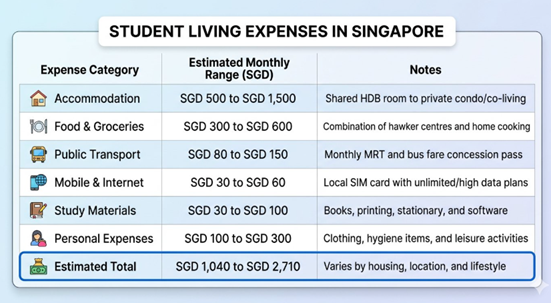
Note: These figures serve as general planning estimates. Actual personal expenses depend on individual habits and living arrangements.
Food and Grocery Expenses for Students
Food is a flexible spending category where students can exert direct control over their monthly outflow.
Eating at Hawker Centres
Singapore’s hawker centres and university canteens offer delicious, high-quality, and affordable meals. A complete meal at a local hawker centre costs SGD 3 to SGD 6, making it possible to eat out daily without inflating your student lifestyle budget.
Cooking at Home
Preparing meals at home using ingredients bought from local supermarkets (such as FairPrice, Giant, or Shen Siong) helps lower monthly food costs. Combining batch meal prepping with hawker meals provides a balanced nutritional and financial routine.
Restaurant and Delivery Spending
Frequent dining at Western-style cafes, sit-down restaurants (where 10% service charge and 9% GST apply), or using food delivery apps can double or triple a student’s monthly food budget. Treating restaurant dining as an occasional reward preserves your primary savings.
Public Transport Costs in Singapore
Singapore features an efficient public transit network consisting of the Mass Rapid Transit (MRT) rail system and extensive bus routes.
MRT and Bus Expenses
Public transport fares are distance-based and cost-effective. Full-time tertiary students can apply for a Monthly Concession Pass, which allows unlimited travel on buses and the MRT for approximately SGD 85 to SGD 90 per month.
Choosing Accommodation Near Campus
Living within walking distance or a short direct bus ride from your university campus reduces transit time and daily transportation costs. However, accommodation rent immediately adjacent to major universities (like NUS in Clementi or SMU in Central Singapore) can be higher than housing in suburban outskirts.
Other Expenses International Students Should Plan For
Beyond tuition and rent, several mandatory and secondary overheads impact the study in Singapore cost baseline.
Health Insurance
International students holding a Student’s Pass are required to subscribe to their institution’s mandatory medical insurance scheme. Premium fees average SGD 150 to SGD 300 per year, covering basic hospitalization, emergency care, and outpatient medical visits at designated campus clinics.
Books and Academic Materials
While many academic papers and textbooks are digitized through university library portals, specialized software subscriptions, printing credits, and lab materials require a annual reserve of SGD 300 to SGD 600.
Personal and Entertainment Costs
To maintain a well-rounded student lifestyle, budget for mobile phone plans (SGD 15 to SGD 30/month for SIM-only data plans), clothing, fitness passes, movie tickets, and weekend social outings. Setting a strict secondary spending limit prevents budget overruns.
Scholarships and Financial Support to Reduce Study in Singapore Cost
Applying for financial aid and work schemes can offset living and educational expenses.
University Scholarships
Public and private universities offer merit-based scholarships to outstanding international applicants. Schemes such as the NUS Global Merit Scholarship, NTU Nanyang Scholarship, and ASEAN Undergraduate Scholarship provide full or partial tuition coverage alongside annual living allowances.
Tuition Grants
The Ministry of Education (MOE) Tuition Grant Scheme provides significant fee subsidies (covering up to 50%–70% of tuition) for eligible international students enrolled in public autonomous university degree programs. In exchange for the grant, international recipients sign a service obligation agreeing to work for a Singapore-registered company for three years post-graduation.
Part-Time Work
Full-time international students holding a valid Student’s Pass at approved public universities are permitted to work part-time up to 16 hours per week during term time and full-time during official vacation periods without a separate work pass. Students attending private institutions must verify whether their specific pass conditions allow off-campus work.
How to Create a Realistic Student Budget
Follow this simple framework to construct a stable financial plan before arrival:
1. Calculate Your Fixed Costs
Total your non-negotiable yearly expenses: annual tuition fees (after scholarship/grant deductions), mandatory administrative charges, health insurance, and annual housing rent.
2. Estimate Your Monthly Living Costs
Combine variable daily operational costs including grocery budgets, public transportation passes, mobile data plans, personal care, and academic supplies.
3. Build an Emergency Fund
Maintain a separate liquid reserve equal to at least 2 to 3 months of living expenses (approx. SGD 3,000 to SGD 5,000) to cover sudden medical needs, travel changes, or lease security deposits.
7 Smart Ways to Manage Your Study in Singapore Cost
- Compare Accommodation Options Early: Research on-campus dorms, HDB rooms, and co-living housing months before departing to secure budget-friendly rates.
- Utilize Public Transit Passes: Leverage student tertiary concession cards for unlimited travel across the MRT and bus systems.
- Set a Daily Food Allowance: Prioritize campus canteens and neighborhood hawker centres over Western cafes and high-end restaurants.
- Track Daily Micro-Transactions: Use budgeting apps to log minor purchases like daily bubble tea or coffee runs, which accumulate quickly over time.
- Take Advantage of Student Discounts: Carry your university ID pass to unlock student pricing on movie tickets, software, gym passes, and museum entries.
- Avoid Unplanned Lifestyle Expenses: Establish explicit monthly limits for leisure activities, retail shopping, and regional weekend getaways.
- Conduct Monthly Financial Audits: Review your actual bank expenditure against your projected monthly budget at the end of every month and adjust habits accordingly.
How Much Money Do You Need Before Studying in Singapore?
Financial planning requires preparing both upfront startup costs and recurring monthly reserves.
Initial Expenses
Before arriving in Singapore, students should prepare funds for one-off startup costs:
Study-abroad.org
- First semester tuition deposit
- Student’s Pass processing fee (ICA fee)
- International flight booking
- Accommodation security deposit (typically 1 to 2 months’ rent)
- Annual medical insurance lump sum
- Initial settling-in allowance (bedding, cookware, SIM card)
Monthly Expenses Calculation
To establish your target financial budget for a full academic year, apply this formula:
Annual Budget=Annual Tuition+Accommodation+(Monthly Living Expenses×12)+Emergency Fund
Is Singapore Affordable for International Students?
Affordability depends on institution choice, housing selection, and individual spending habits. While Singapore is one of Asia’s premier global financial hubs, its educational ecosystem accommodates diverse financial profiles through MOE Tuition Grants, campus hall housing, and affordable food centers.
By carefully managing accommodation choices and everyday living expenses, students can obtain a world-class degree within a predictable financial framework.
Final Study in Singapore Cost Checklist
Before confirming your enrollment, verify these core budget items:
- Total annual tuition fees calculated (subsidized vs non-subsidized)
- MOE Tuition Grant and university scholarship eligibility checked
- Accommodation type and lease terms finalized
- Monthly food and grocery allocation established
- Public transit concession pass application prepared
- Mandatory university health insurance confirmed
- Student’s Pass visa processing fees accounted for
- Textbook, printing, and software allowances reserved
- Secondary personal spending limits set
- Liquid emergency reserve fund established
Calculating your total financial footprint before arrival ensures a smooth and focused transition into your university studies.
Conclusion
Planning your higher education journey in Singapore requires looking beyond base tuition rates. By assessing housing choices, leveraging local hawker dining, securing transport concessions, and exploring tuition grants, international students can easily balance top-tier academic rigor with a well-managed monthly budget.
FAQs About Study in Singapore Cost
1. What is the average study in Singapore cost for international students?
Combining tuition fees and living costs, the total study in Singapore cost typically ranges between SGD 30,000 and SGD 55,000 per year for subsidized public university programs, and SGD 45,000 to SGD 75,000+ per year for non-subsidized or specialized postgraduate degrees.
2. How much should an international student budget for living expenses in Singapore?
An international student should budget between SGD 1,200 and SGD 2,500 per month for living expenses, depending primarily on accommodation type, location, and individual personal lifestyle choices.
3. Is accommodation expensive for international students in Singapore?
Housing is one of the largest single monthly expenses. On-campus university halls (SGD 400–1,100/month) and shared HDB flat rooms (SGD 500–900/month) provide the most cost-effective arrangements compared to private condominiums or studio apartments.
4. Can international students reduce their study in Singapore cost?
Yes. Students can lower expenses by applying for MOE Tuition Grants, securing merit scholarships, living in shared HDB housing, dining at local hawker centres, and utilizing student concession passes for public transit.
5. What should be included in an international student budget Singapore plan?
A comprehensive international student budget Singapore plan must cover tuition fees, housing rent, groceries, public transportation, medical insurance, academic materials, mobile utility plans, personal leisure expenses, and a dedicated emergency fund.