
Understanding study in Germany costs is essential for international students planning a Bachelor of Science (BSc) degree. While many public universities have low or no tuition fees for certain students and programs, other expenses can significantly affect your total budget.
From semester contributions and accommodation to blocked account requirements and everyday spending, this GL Campus guide knowing the full financial picture can help you plan your German education with greater confidence.
Bachelor of Science Germany Tuition Fees Explained
Navigating higher education fees when planning to study in Germany requires distinguishing clearly between different ownership models and regional regulations.

Public University Tuition Fees
The vast majority of public universities in Germany do not charge traditional tuition fees for undergraduate degree programs, including Bachelor of Science tracks. This rule applies to both domestic and international students in most cases. However, studying at a public university is not completely free, as every enrolled student is required to pay a semester contribution twice per year.
Private University Tuition Fees
Private higher education institutions set their own fee structures independently. Annual tuition at private German universities can range from €5,000 to €20,000+ per year depending on the institution, degree specialization, and facilities. When evaluating private programs, look closely at the complete multi-year cost of attendance rather than comparing annual tuition in isolation.
Tuition Differences by Federal State
Germany’s higher education system is decentralized, meaning each of the 16 federal states (Bundesländer) establishes its own tuition policies.
- Baden-Württemberg: Introduced tuition fees for non-EU/EEA international students studying at state public universities. Non-EU students generally pay a fixed rate of €1,500 per semester in tuition, on top of regular semester contributions.
- Other Federal States: States like Bavaria (where universities like TUM have implemented targeted international tuition for select programs) allow individual institution-level policies, while most other states currently maintain tuition-free public education for international undergraduates.
Semester Contributions and Other University Fees
Even when public university tuition is zero, paying your semester contribution (Semesterbeitrag) is mandatory to remain officially enrolled.
What Does the Semester Contribution Cover?
The semester contribution typically ranges between €100 and €400 per semester, depending on the university and location. The contribution is not tuition; rather, it funds non-academic student infrastructure. Common components include:
- Student Services (Studierendenwerk): Funding for student cafeterias (Mensa), housing administration, and psychological counseling.
- Student Union (AStA): Supporting student representation, political advocacy, and campus activities.
- Administrative Costs: Fee for handling enrollment, transcripts, and student ID issuance.
- Public Transportation Ticket (Semesterticket): Often grants discounted or unlimited access to local and regional buses, trams, and trains within the regional transit network.
Why Students Should Budget Separately for Semester Fees
It is vital to distinguish between tuition fees and semester contributions. Tuition goes directly toward instructional delivery and academic overhead. Semester contributions fund campus life and local transit benefits. Budgeting for this fee twice a year prevents unexpected cash flow interruptions during re-registration (Rückmeldung).
Blocked Account Requirements for International Students
For non-EU/EEA students who require a visa to study in Germany, proving financial capability is a strict legal prerequisite.
What Is a Blocked Account?
A blocked account (Sperrkonto) is a specialized bank account designed to demonstrate to German diplomatic missions and local immigration authorities (Ausländerbehörde) that you have sufficient funds to cover living expenses for at least your first year of study.
How Much Money Is Required?
The official required blocked account amount is tied directly to federal BAföG student assistance rates. The standard required amount is €11,904 per year, which releases a maximum payout of €992 per month into your regular current bank account once you arrive.
Because financial proof requirements update periodically to reflect inflation, always verify the exact current threshold directly through official German government portals or your local German embassy prior to initiating a wire transfer.
Is the Blocked Account an Additional Cost?
No. The money deposited into a blocked account is not a fee paid to the university or government. It remains your money, returned to you in twelve equal monthly disbursements to pay for housing, food, insurance, and personal spending. The only direct out-of-pocket extra costs associated with this process are the setup and monthly maintenance fees charged by approved digital account providers (such as Fintiba, Expatrio, or Coracle).
Accommodation Costs for BSc Students in Germany
Housing constitutes the single largest monthly expense for almost every international student in Germany.
Student Dormitories
Student residences operated by the local Studierendenwerk are the most affordable housing option, with average monthly rents running between €250 and €450. However, demand heavily outweighs supply, and waiting lists can extend across multiple semesters. Apply for housing the moment you receive your academic acceptance.
Shared Apartments (Wohngemeinschaft / WG)
Sharing a private flat with flatmates is the most common student living arrangement in Germany. Rent for a single room in a WG ranges from €350 to €700+ per month, depending on the city and location. Rent typically includes utilities, internet, and heating (Warmmiete).
Private Accommodation
Renting a private single apartment (1-Zimmer-Wohnung) offers privacy but comes at a premium, usually starting from €600 to over €1,200 per month in major urban centers. Landlords often require proof of income, a local guarantor (Bürgschaft), and a security deposit (Kaution) equivalent to one to three months of base rent (Kaltmiete).
Monthly Living Expenses for International Students
Building a comprehensive, personalized monthly budget helps manage financial commitments
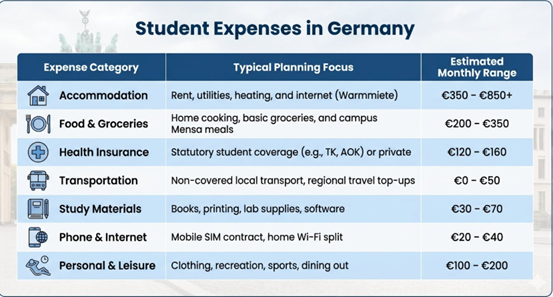
Note: Use these categories as personal guidance to construct your custom budget rather than relying on generalized figures.
Study in Germany Costs by City
Geographic location dramatically dictates your overall student cost of living.
Munich
Munich regularly ranks as Germany’s most expensive student city. While home to world-class academic institutions like TUM and LMU, average monthly rent for shared flats frequently exceeds €800 to €1,000+. Students in Munich require a significantly larger budget than the statutory blocked account minimum.
Berlin
Berlin offers a dynamic, diverse student environment, but housing availability has tightened severely in recent years. While everyday costs like groceries and nightlife remain reasonable, finding affordable accommodation requires persistent searching, with average room rents ranging from €550 to €850 per month.
Smaller German Cities
Enrolling at universities located in smaller cities or college towns—such as Leipzig, Magdeburg, Siegen, or Jena—can drastically lower your monthly expenditure. Shared rooms in these regions often cost between €300 and €450 per month without sacrificing academic quality.
Finding Low Tuition Universities in Germany
To minimize overall education expenses, conduct comprehensive research during your university search phase.
Compare Tuition and Semester Contributions
Look beyond headline tuition numbers. Calculate total mandatory educational costs by factoring in state-level non-EU tuition rules alongside semester contribution rates.
Check Program Language
While many master’s programs are taught in English, English-taught Bachelor of Science degrees at public institutions are more competitive. Preparing your German language skills (aiming for TestDaF or DSH certification) unlocks hundreds of tuition-free public programs, eliminating the need to pay higher fees at private institutions.
Review University Location A tuition-free university located in a high-cost metropolitan area like Munich or Hamburg can result in higher total annual costs than paying a modest fee in a city with low rent. Evaluate university choice through the lens of total cost of attendance.
How to Calculate Your Total Study in Germany Costs
Use this practical formula to forecast your required annual financial investment before applying for your visa:
1. Calculate Education Costs
Annual Education Costs=(Semester Contribution×2)+Annual Tuition (if applicable)+Study Materials
2. Calculate Annual Living Costs
Annual Living Costs=Estimated Monthly Expenses×12 months
3. Add Initial Expenses
Initial Expenses=Visa Fees+Flight/Travel+Accommodation Deposit+Setup Costs (Furniture/Gear)
Total Annual Budget Formula
Total Annual Budget=Education Costs+Annual Living Costs+Initial Expenses+Emergency Reserve
7 Smart Ways to Reduce Your BSc Budget in Germany
1. Compare Universities Carefully
Evaluate degree programs based on the complete cost of living and administrative fees across the entire multi-year duration, rather than relying solely on institutional prestige.
2. Consider Student Housing
Apply for public student dormitories (Studierendenwerk) the day you submit your academic applications to secure priority access to low-cost housing options.
3. Choose Your City Carefully
Selecting a university in a medium or small city rather than a major metropolis can save you thousands of euros per year in rent alone.
4. Use Student Benefits
Maximize your student status to receive discounts on public transit, software subscriptions, museum entries, bank account fees, and local services.
5. Prepare Meals at Home
Dine regularly at your university’s Mensa (which offers subsidized meals for students) and cook at home instead of eating at commercial restaurants.
6. Track Monthly Spending
Maintain a budget spreadsheet or use digital tracking tools to categorize expenses and identify unnecessary subscription or lifestyle costs early.
7. Keep an Emergency Reserve
Maintain a dedicated financial buffer outside your blocked account funds to handle sudden medical expenses, security deposit top-ups, or unexpected travel costs.
Can International Students Work While Studying in Germany?
Yes, non-EU international students enrolled in full-time degree programs are permitted to work alongside their studies, subject to official immigration rules.
- Work Limits: Full-time international students can work up to 140 full days or 280 half days per calendar year (or work up to 20 hours per week during normal term times as a student employee or Werkstudent).
- Mini-Jobs: Students frequently take up Mini-jobs (capped at €538 per month tax-free), providing a flexible way to earn pocket money.
- Planning Strategy: While working part-time helps supplement daily spending, part-time earnings should never be relied upon as your sole required financial proof for initial visa approval or course completion.
Common Financial Mistakes BSc Students Should Avoid
- Looking Only at Tuition: Assuming a program with zero tuition is automatically affordable without factoring in local housing and living costs.
- Ignoring Accommodation: Underestimating how difficult and costly securing housing can be in competitive markets like Munich, Berlin, or Frankfurt.
- Using Outdated Blocked Account Figures: Relying on older financial requirement figures when planning your visa application.
- Forgetting Initial Costs: Failing to budget for flight tickets, rental security deposits (Kaution), and first-month setup expenses before your blocked account payouts begin.
A Practical BSc Germany Budget Checklist
Save this essential action checklist to streamline your preparation:
- Confirm exact university tuition fees (if applicable) for non-EU students.
- Check current semester contribution fees for both terms.
- Verify the latest official blocked account requirement through the Foreign Office.
- Research local rent prices for dorms and WGs in your prospective city.
- Calculate health insurance premiums for statutory student coverage.
- Factor in local public transport access via your Semesterticket.
- Prepare funds for initial visa fees, flights, and apartment security deposits.
- Build a rainy-day emergency fund separate from your monthly blocked account payout.
Is Germany Affordable for International BSc Students?
Germany remains one of the most accessible higher education destinations globally for international undergraduate students. The combination of world-class academic standards, largely public-funded education, and robust student benefits creates exceptional long-term value.
However, affordability is not automatic—it depends heavily on your choice of university, city location, housing type, and personal budgeting discipline.
FAQs About Study in Germany Costs
1. How much do study in Germany costs vary for BSc students?
Total costs vary depending on the university’s federal state, local city rents, and lifestyle choices. While public university tuition is often free, living expenses, semester contributions, and housing determine your actual monthly outlay.
2. Are BSc programs free in Germany for international students?
Many public universities charge no tuition fees for bachelor’s programs, but students must still pay mandatory semester contributions. Exceptions exist, such as public universities in Baden-Württemberg or private institutions across Germany.
3. What are the blocked account requirements for Germany?
A blocked account serves as official proof of financial capability for student visa applicants. The required deposit is currently set at €11,904 per year (€992/month), though applicants should always verify current figures with official German diplomatic sources prior to applying.
4. Which expenses should international BSc students budget for?
Key expenses include accommodation, food, health insurance, transportation, semester contributions, course books, visa processing fees, and personal spending.
5. How can students reduce their study in Germany costs?
Students can reduce overall costs by applying early for public student dorms, choosing universities in smaller, more affordable cities, cooking at home, and leveraging student discounts.
Conclusion
Planning study in Germany costs requires looking beyond headline tuition fees. Semester contributions, accommodation, living expenses, health insurance, and financial proof requirements all shape the realistic total cost of your education.
For prospective BSc applicants, comparing the complete cost of attendance across different universities and cities ensures a smoother academic journey and long-term financial security.